LED Mirror Supply for UAE Hotel Projects: A B2B Guide for Contractors and Importers
A practical B2B guide for UAE hotel contractors and importers covering LED mirror sourcing, IP44 requirements, anti-fog configuration, warm hospitality lighting and OEM procurement from China.
For UAE hotel projects, specifying LED mirrors means addressing five variables from day one: electrical compatibility (220V/50Hz), IP44-rated enclosures for bathroom zone 2, demister pad anti-fog for high-humidity operation, warm CCT in the 3000-4000K range for hospitality-grade ambience, and an OEM partner who can translate FF&E spec sheets into production-ready samples. Chinese factories — particularly those with dedicated hotel-project departments — deliver all five without the cost layer that regional distributors add. This guide covers what contractors and importers need to know before sending out the first RFQ.
Why UAE Hotel Developers Are Sourcing LED Mirrors from China
UAE's hotel construction pipeline hit 717 projects with 177,110 guest rooms in Q1 2026 — a 13% year-on-year increase — while a single Chinese OEM factory can deliver custom-spec LED mirrors at 40-60% less than comparable units sourced through local UAE distributors. That gap isn't about quality; it's about the supply chain removing a middle layer.
The UAE market is saturated with high-cost local suppliers like Grand Mirrors and Sky Fancy Glass, alongside regional importers such as Stanhom. These businesses serve a real function — especially for small-batch, same-week delivery — but for hotel programs requiring 200+ units across multiple room categories, the unit economics shift decisively toward direct OEM procurement.
Three structural factors make direct Chinese sourcing compelling for UAE hotel projects:
Pipeline scale demands volume pricing. With over 26,000 new hotel rooms under construction in the UAE, the unit count per project (especially in Dubai's JBR, Palm Jumeirah, and Business Bay corridors) routinely crosses 150-300 bathroom sets. That volume hits OEM minimums without stretch.
Customization depth at factory level. Local distributors typically carry stock SKUs with limited configuration — one backlit option, one CCT preset, one frame finish. An OEM factory designs from the glass substrate up: mirror dimensions, silver-coating grade, LED strip color temperature, frame profile (framed, frameless, or beveled), and control interface (touch sensor, infrared switch, wall-mount rocker).
OEM branding flexibility. For hotel operators who want in-mirror brand details, custom-installed control panels, or project-specific packaging with GC/contractor labeling, the factory handles it at source. No re-labeling fees, no distributor margin on private-brand work.
What about lead time? A standard hotel-project order (200-500 units, moderate customization) typically ships 25-35 days from sample approval. Sea freight from Shenzhen or Guangzhou to Jebel Ali Port runs 18-22 days. Project managers should budget 50-60 days from PO to site delivery — comparable to the lead time on a millwork package sourced from the same region.
Compliance and Certification Requirements for LED Mirrors in the UAE
UAE hotel projects require LED mirrors with CE conformity documentation at minimum, electrical configuration at 220V/50Hz, and IP44-rated enclosures for bathroom zone-2 installation. For government and Dubai Municipality-inspected projects, ESMA (Emirates Authority for Standardization and Metrology) documentation is frequently requested during the submittal process. Contractors working on projects outside free zones should verify ESMA requirements with the consultant team before locking down a supplier.
Requirement
Details
Chinese OEM Provided?
Electrical Standard
220V/50Hz AC, compatible with BS 1363 (Type G) or Schuko
Yes — standard configuration
CE Marking
EMC (EN 55015) + LVD (EN 60598) for LED luminaires
Yes — in-house or certified lab testing
IP Rating (Min)
IP44 for bathroom zone 2; IP54/IP65 recommended for spa/steam-adjacent
Yes — achieved via sealed frame + gasket assembly
ESMA / Gulf Mark
Requested on some government/hospitality projects; check spec docs
Available on request for qualifying SKUs
RoHS
Restriction of hazardous substances in electronic components
Yes — standard on LED modules and drivers
Fire Rating
Driver and wiring to meet local fire-code requirements
Yes — drivers spec'd per project requirements
A practical note for procurement teams: most UAE hotel FF&E tender documents will reference British Standards (BS) or IEC equivalents for bathroom electrical fixtures. A Chinese OEM that routinely exports to Europe and the Gulf will already hold the necessary test reports. Ask for EN 60598-1 and EN 55015 compliance documents during the RFQ stage, not after PO placement.
Product Adaptation for UAE Hotel Bathroom Conditions
The two environmental factors that kill hotel LED mirrors faster than anything else in the Gulf are sustained high humidity (the demister pad is not optional — it's baseline equipment) and fine airborne dust that works its way into unsealed frame joints and driver compartments. A correctly spec'd mirror for this market addresses both at the design level, not as afterthoughts.
Humidity and the Demister Pad
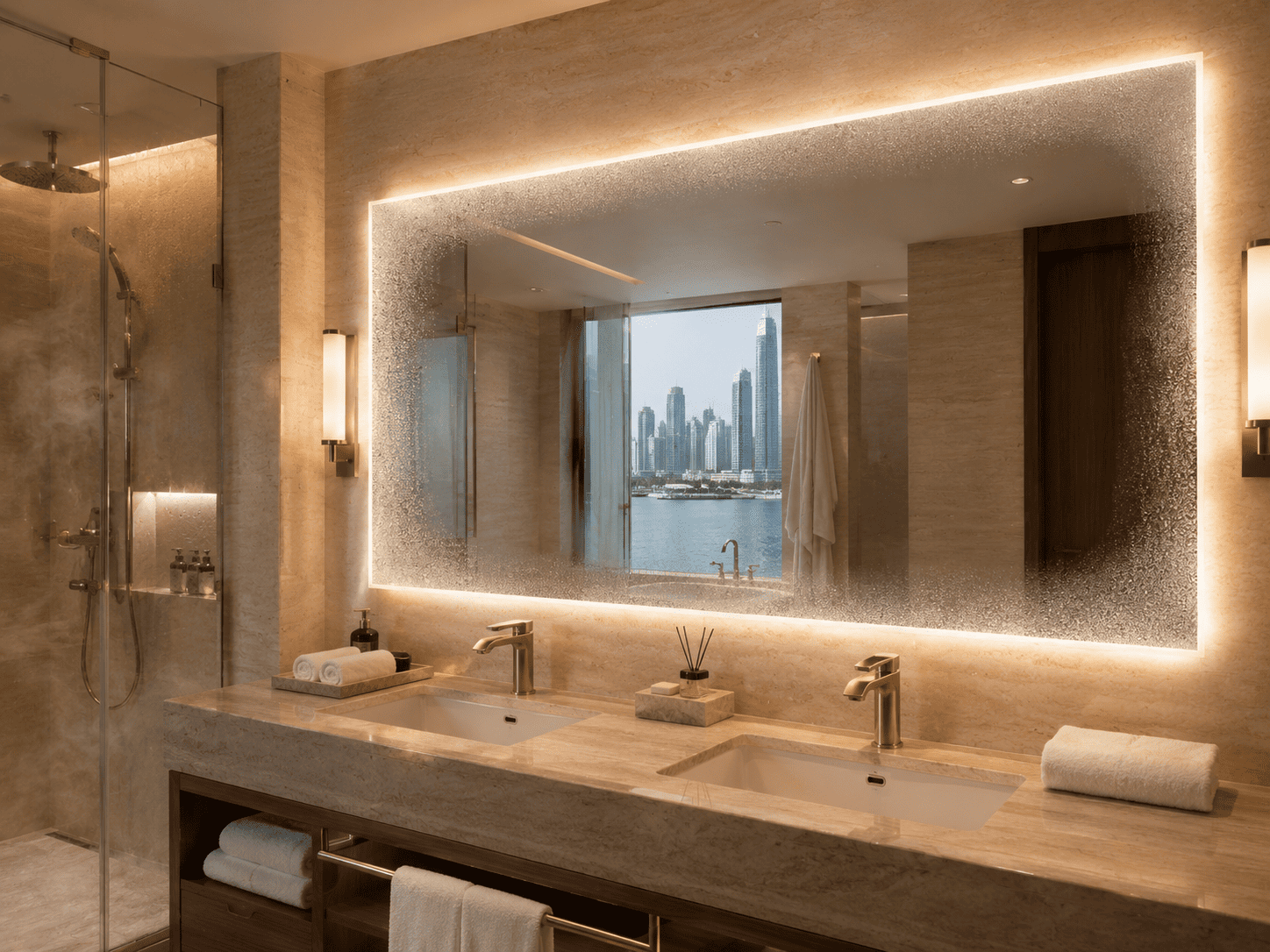
UAE coastal hotel bathrooms — Dubai Marina, Abu Dhabi Corniche, Ras Al Khaimah beachfront — operate at 70-90% relative humidity year-round. Without an active anti-fog system, mirror condensation becomes a housekeeping call within 60 seconds of a guest shower. The demister pad (a thin heating element bonded to the mirror back, typically 40-60W for a standard 600×900mm unit) keeps the glass surface 2-3°C above dew point, eliminating fog entirely. For hotel bathrooms, wire the demister pad to the room's main lighting circuit — it activates when the guest enters the bathroom and stays on during the shower without requiring a separate switch.
Dust Protection and Enclosure Sealing
Desert airborne dust is a long-term killer of LED drivers and connector joints. The mitigation is a fully sealed rear enclosure — aluminum or ABS backplate with CNC-cut gasket sealing — not the open-back frame construction common on budget residential units. For hotel bathrooms in inland Dubai and Abu Dhabi installations, specify an IP44 or IP54 rear housing that encloses both the LED driver and terminal block in a dust-protected compartment.
CCT Selection for Hospitality Ambience
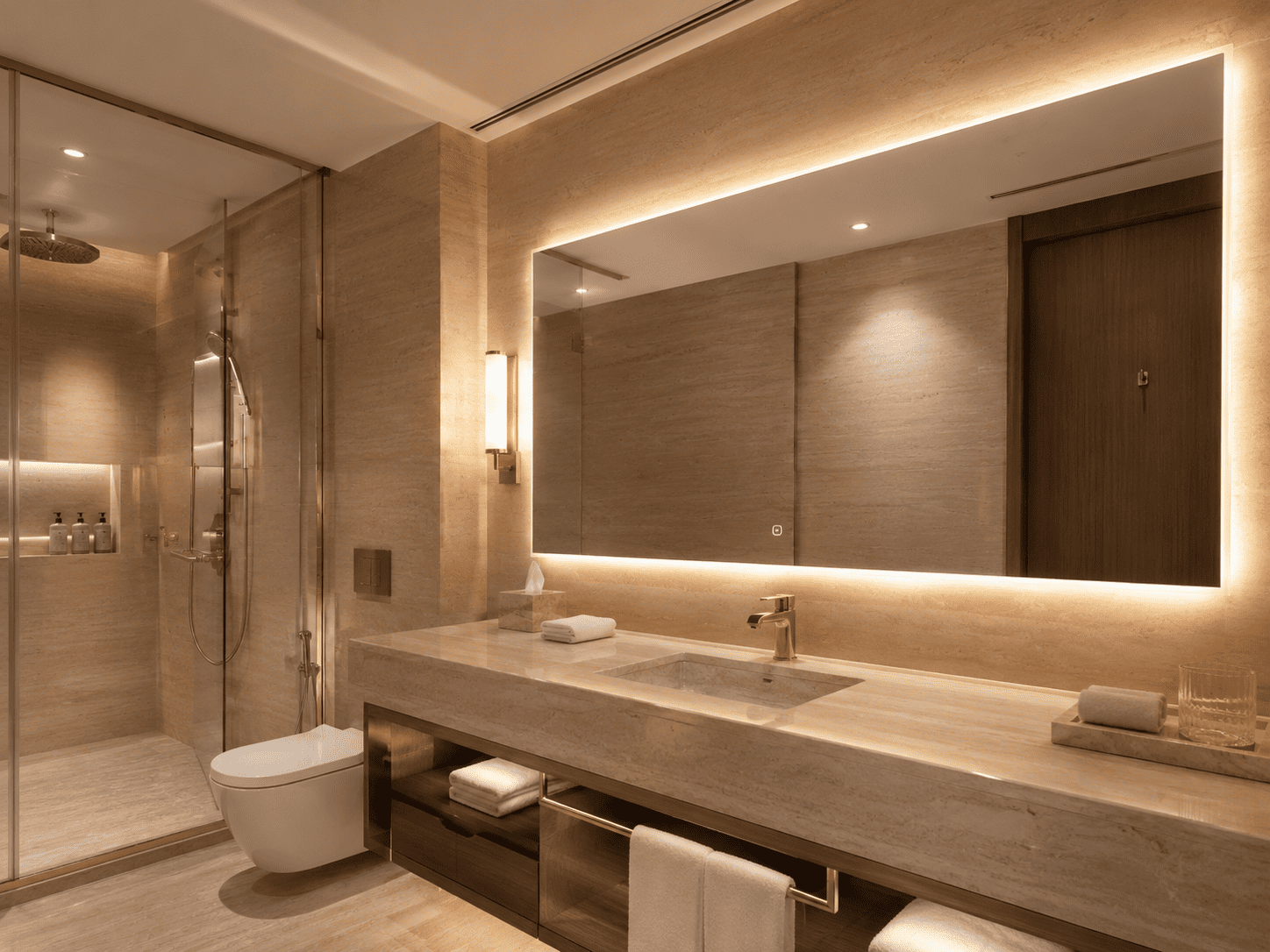
Hotels in the UAE tend toward warm, layered bathroom lighting — 3000K to 4000K is the working range. A 3000K setting produces a golden, residential-luxury feel suited for five-star properties and boutique hotels. 4000K reads as clean, neutral daylight — standard for business hotels, international chains, and properties targeting a contemporary aesthetic. Triple-CCT mirrors (switchable between 3000K/4000K/6000K via a touch sensor) give a single SKU that covers multiple room categories, which is operationally cleaner for FF&E procurement.
Glass and Frame Durability
Specify 5mm silver-coated float glass as the minimum substrate — thinner glass warps under the demister pad's heat cycle and develops visible distortion over 12-18 months. For framed designs preferred in classic luxury hotels, aluminum alloy frames with anodized or powder-coated finishes resist the pitting and surface oxidation that chrome-plated frames show after 2-3 years in a high-humidity bathroom. For frameless polished-edge designs (contemporary, minimalist properties), verify the edge-polishing grade — a #2 polish is minimum; #3 or diamond-grade polishing prevents micro-chipping at the edges that catches light and degrades the mirror's visual quality under hotel bathroom downlighting.
UAE Hotel LED Mirror Specification Checklist
This table captures the specification fields a UAE hotel FF&E schedule typically demands. Use it as a one-page reference when sending an RFQ to OEM suppliers — it covers what the factory needs to quote accurately and what the consultant team will ask for during submittal review.
Specification Field
Hotel Standard Range
Notes for Procurement
Mirror Dimensions
600×900mm to 1200×1800mm
Custom per room type; provide dimension schedule
Glass Thickness
5mm silver-coated float glass
4mm acceptable for budget-tier; 5mm preferred for durability
Illumination Type
Backlit / Edge-lit / Front-lit strips
Backlit (diffused panel behind glass) is current hotel trend
CCT (Color Temperature)
3000K / 4000K / 6000K
Triple-CCT switchable preferred for flexibility across room types
Anti-Fog
Demister pad, 40-60W
Non-negotiable for UAE hotel bathrooms
IP Rating
IP44 minimum; IP54/IP65 for spa
Must be verifiable in test report; not just stated on spec sheet
Control Method
Touch sensor / IR switch / Wall switch
Touch sensor with memory function simplifies guest UX
Voltage & Driver
220V/50Hz AC input; 12V/24V DC LED output
Driver to be EN 61347 compliant; confirm LED brand during sampling
Frame Finish
Brushed aluminum / Matte black / Polished chrome / Frameless
Finish sample to be submitted with material submittal
Warranty
2-3 years manufacturer warranty
Confirm warranty terms in writing; include spare-driver provision in PO
Packaging
Individual carton with foam insert
Plywood crate for sea freight; specify if branded cartons required
One procurement detail that saves project managers real headaches: always request 3-5% spare units in the PO (mirrors, drivers, touch sensors, transformers). LED mirrors are glass products on a construction site — breakage and installer error are inevitable, and a five-week re-order cycle during snagging is not a conversation anyone wants to have with the hotel operator.
How the Procurement Process Works with a Chinese OEM Factory
The procurement cycle for a hotel LED mirror program follows five stages: specification lock → sample approval → production → inspection → export. Total lead time from signed PO to site-ready delivery at Jebel Ali Port is typically 50-60 days. The longest variable is almost always the specification lock stage — not the factory's production time.
Stage 1: Specification Lock (1-2 weeks)
The contractor or FF&E procurement team sends a dimension schedule and spec requirements (CCT, IP rating, illumination type, control method, frame finish). The factory engineering team reviews and confirms feasibility, proposes alternative specs if something doesn't translate to production, and issues a formal quotation with unit pricing, tooling charges (if any — typically zero for standard customization), and lead-time estimate. This is also when certification documentation (CE, RoHS, EN test reports) is submitted for consultant review.
Stage 2: Sample Approval (2-3 weeks)
The factory produces 1-2 pre-production samples matching the locked spec. These ship by air courier (3-5 days to UAE) for physical inspection. The procurement team checks: illumination uniformity across the mirror surface, demister pad activation speed (should clear fog within 2-3 minutes of shower simulation), frame/edge finish quality, touch-sensor responsiveness, and overall build quality. This is the approval gate — no production proceeds without signed-off samples.
Stage 3: Production (3-4 weeks)
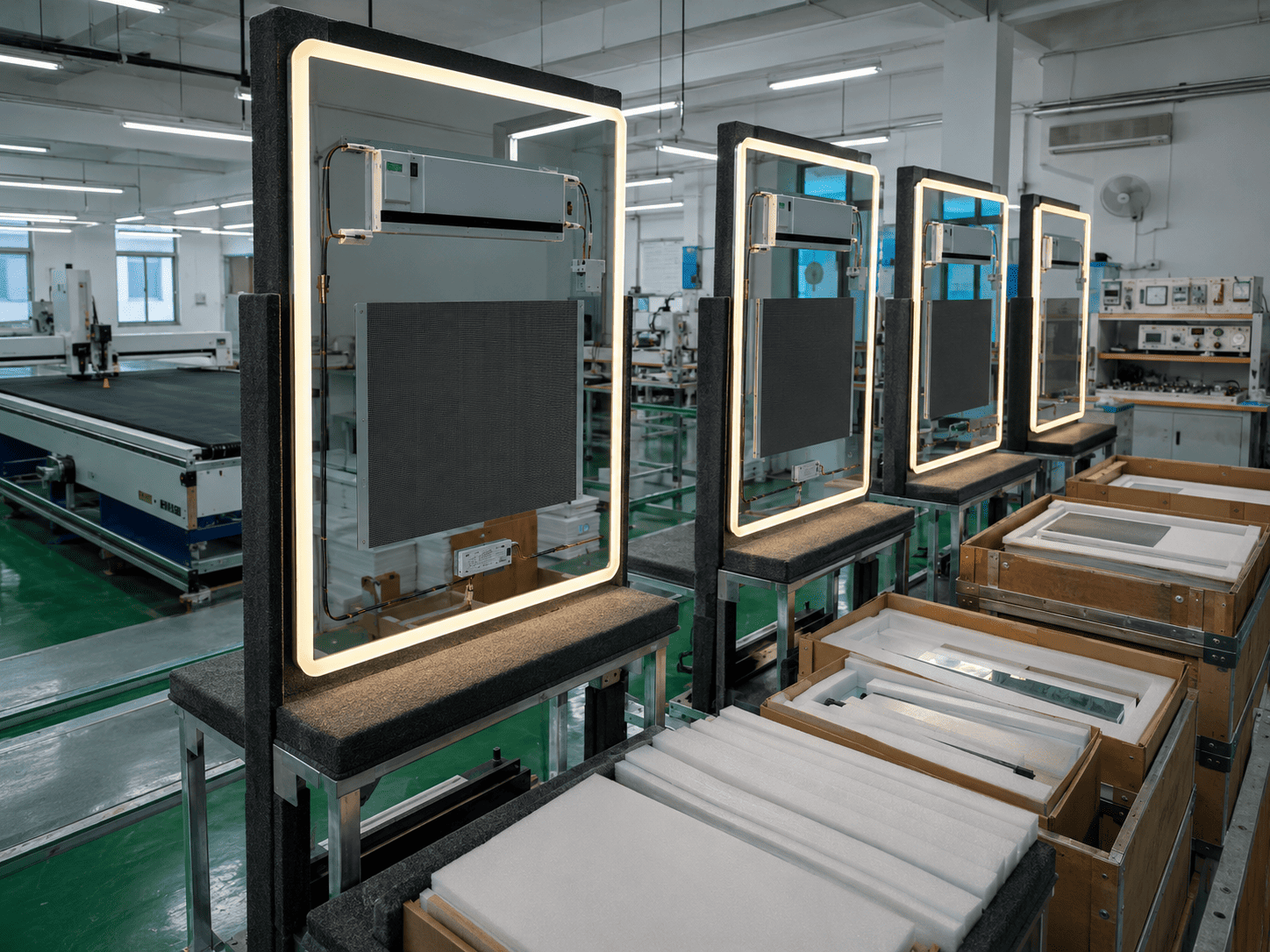
Mass production begins after sample sign-off and deposit payment (standard terms: 30% deposit, 70% before shipment or against BL copy — negotiated per project). Production QC checkpoints: glass cutting and silver-coating inspection, LED strip bonding and light-uniformity test, demister pad adhesion and thermal-cycle test, frame assembly and IP-seal verification, packaging inspection. A mid-production QC report (with photos) is a reasonable request in the PO terms.
Stage 4: Pre-Shipment Inspection (2-3 days)
Before container loading, a pre-shipment inspection (AQL 2.5, Level II sampling) verifies: quantity count, visual defects (scratches, edge chips, coating blemishes), illumination function, anti-fog function, packaging integrity. Buyers can commission third-party inspection (SGS, Bureau Veritas, Intertek) or rely on the factory's in-house QC team — the cost difference is roughly $300-500 USD for third-party, and for a $50,000+ hotel order, it's cheap insurance.
Stage 5: Export and Delivery (3-4 weeks sea freight)
Container loading at Shenzhen or Guangzhou port. Transit to Jebel Ali Port: 18-22 days. Customs clearance: 3-5 days with complete documentation (commercial invoice, packing list, BL, certificate of origin, CE test reports). Delivery to site: 1-2 days local trucking. Total door-to-door: roughly 25-30 days from container departure.
For project managers working with tight construction schedules: the fastest way to compress this timeline is to have specs locked and samples requested before the main contract is awarded. The factory can produce samples while the FF&E review runs its course, shaving 2-3 weeks off the critical path.
Frequently Asked Questions
What certifications are required for LED mirrors imported to the UAE?
LED mirrors imported to the UAE should at minimum carry CE marking (widely accepted). For hotel projects, ESMA-compliant documentation is often requested by contractors. Confirm exact certification requirements with your supplier based on the specific model and destination emirate.
What IP rating should hotel bathroom LED mirrors have in the UAE?
For UAE hotel bathrooms, IP44 is the minimum recommended rating for LED mirrors in zone 2 areas. For higher humidity environments like spa areas, IP54 or IP65 may be specified depending on the installation zone and project requirements.
Can Chinese OEM factories handle custom sizes and hotel branding for UAE projects?
Yes. Most Chinese OEM LED mirror manufacturers, including RATO, support custom sizing, CCT selection, anti-fog options, frame finish, control logic, and private-label carton marks — all based on approved samples and project specifications.
What is the typical voltage for hotel LED mirrors in the UAE?
The UAE uses 220V/50Hz electrical supply, compatible with European-standard LED drivers. Hotel projects should confirm voltage configuration with the supplier during the specification phase to ensure correct driver selection.
How long does it take to get custom LED mirrors from China to a UAE hotel site?
Budget 50-60 days from signed purchase order to site delivery — comprising 2-3 weeks for sample approval, 3-4 weeks for production, 18-22 days sea freight to Jebel Ali Port, and 3-5 days customs clearance and local delivery.
What should a UAE hotel FF&E spec sheet include for LED mirrors?
A complete LED mirror spec sheet should include: mirror dimensions, glass thickness, illumination type (backlit/edge-lit), CCT range, anti-fog specification, IP rating, control method, frame finish, voltage/driver details, and packaging requirements. Submit a dimension schedule by room type — not individual SKU-by-SKU — to streamline the RFQ process.
Next Step: Confirm Your Project Specs with RATO
RATO LED Mirror — Heshan Rato Special Glass and Building Materials Co., Ltd. — is a Guangdong-based OEM manufacturer specializing in hotel-grade LED mirrors for international hospitality projects. With production lines handling glass cutting, silver coating, LED integration, and QC inspection under one roof, RATO supports the full specification range covered in this guide: custom dimensions, triple-CCT configurations, IP44/IP54-rated enclosures, demister pad integration, and project-ready packaging.
To start the RFQ process: send your room-type mirror schedule and specification requirements to the RATO engineering team. The factory provides a quotation, compliance documentation package, and pre-production sample timeline within one week of receiving confirmed specs.
Talk to our project team about your mirror specification.
Send drawings, BOQ, mirror sizes, target quantity, voltage, lighting preference, packaging needs and destination market. Specifications are confirmed according to the selected model and project requirements.