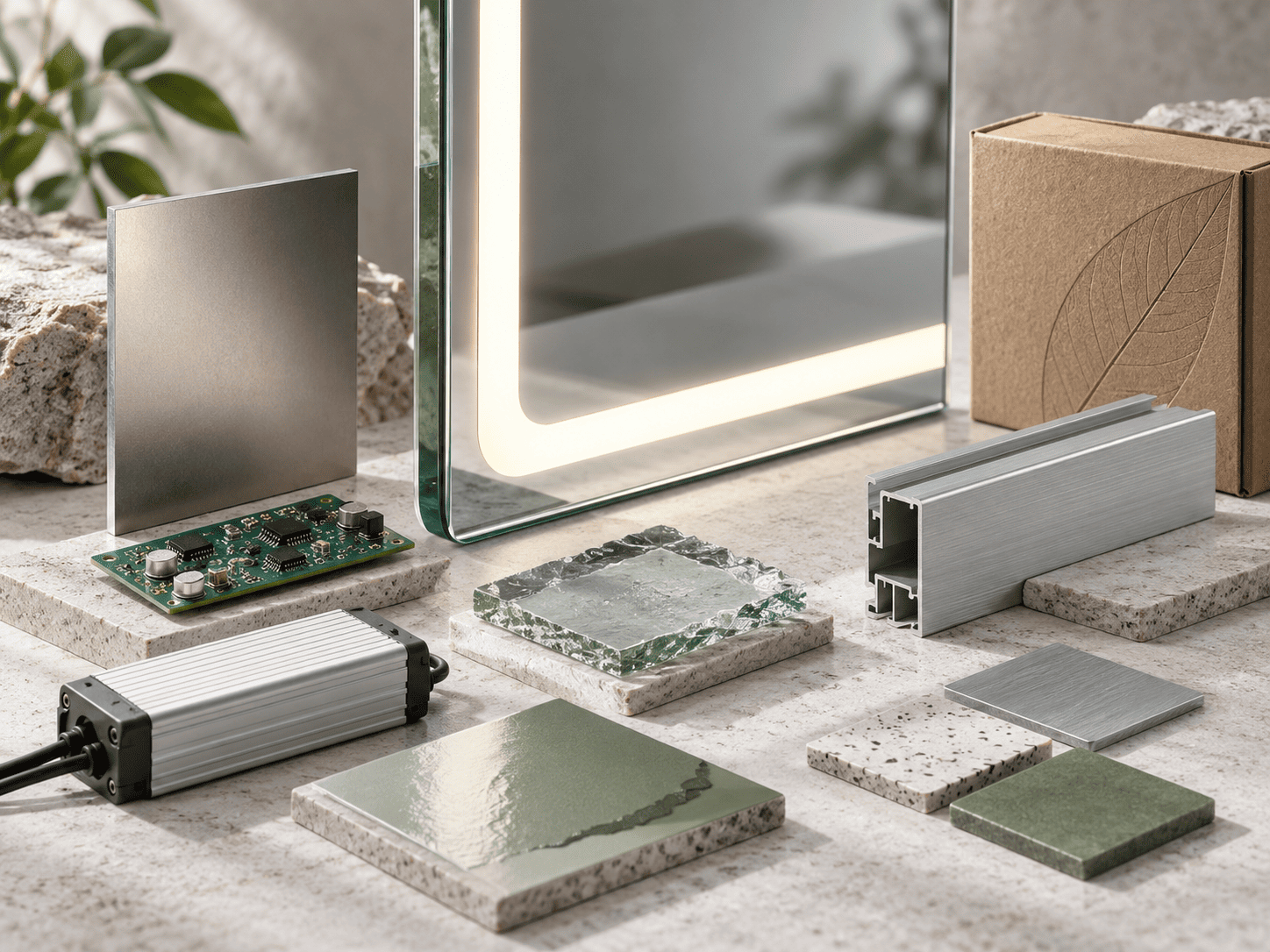
Sustainable & Green Manufacturing for LED Mirrors — Copper-free & Lead-free Eco Production.
A procurement-level guide to sustainable and green manufacturing for LED mirrors: copper-free and lead-free silver-mirror coating lines, REACH/RoHS-compliant plating, low-carbon LED supply chains, and energy-label compliance for OEM, hospitality and project-supply buyers.
Why green manufacturing is now a specification, not a slogan
Green manufacturing in the LED mirror industry is no longer a nice-to-have that marketing departments append to brochures. It has become a verifiable specification layer that European, Australian and Middle-East tender boards increasingly ask for: restricted-substance declarations on the coating line, energy data on the LED driver, and a written environmental-management system at the factory. In factory reality, the sharpest differentiator between mirror suppliers is not the backlit versus edge-lit design — that is a mature choice — it is whether the finishing line can prove copper-free and lead-free production with documentation a compliance engineer will actually accept.
For a Hotel bathroom mirror as for a single OEM order, the question a procurement team should ask is not "is your green claim certified?" but "which standard is the claim certified against, and can I see the current certificate issued by the body that issues it?"
What copper-free and lead-free actually mean inside the coating plant
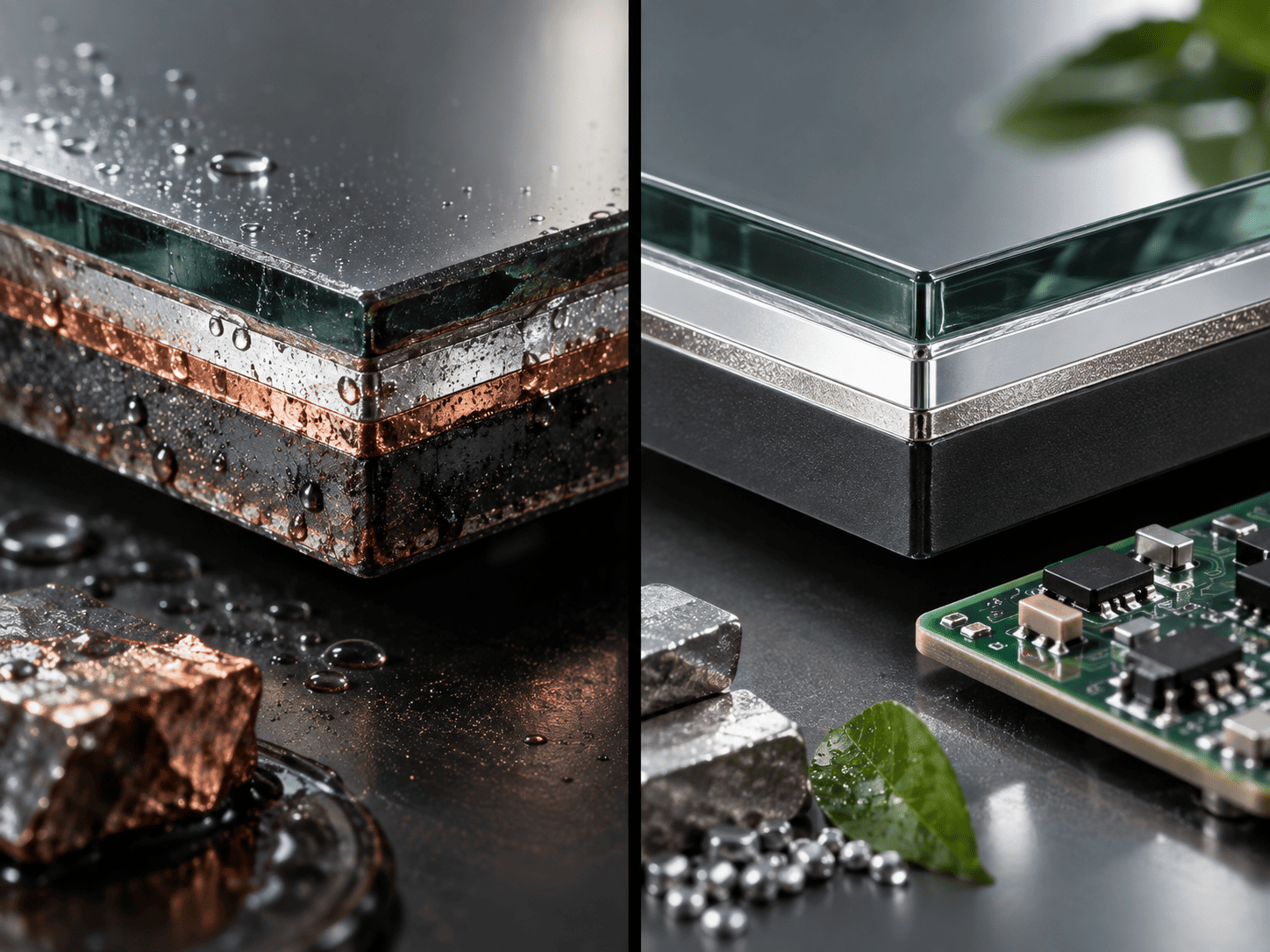
Copper-free and lead-free refer to two different stages of the mirror finishing line, and conflating them confuses buyers. Copper-free describes the protective backing over the silver reflective layer. A traditional mirror sputters silver, then deposits copper as a protective film, then seals with paint. A copper-free line replaces that copper step with a passivation treatment followed by an epoxy resin or palladium-based backing. The environmental benefit is concrete: no copper salt solution enters the wash water, so the plant does not need to treat and dispose of copper-bearing effluent the way a conventional line does.
Lead-free describes the chemistry policy across the line and the dressings. Lead appears historically in two places a buyer can control: mirror backing paints formulated with lead driers, and the solder paste used on the LED driver board. A genuinely lead-free product carries a RoHS-aligned declaration covering both the mirror finish and the electrical assembly.
What does copper-free mean for LED mirror durability? Removing copper eliminates the galvanic corrosion pathway between copper and silver that drives black-edge degradation in humid bathrooms — so the eco choice is also the durability choice, which is why green backing and long-humidity service life tend to appear in the same specification.
The copper-free coating process and the chemistry that replaces copper
The copper-free mirror coating sequence follows a controlled chemical bath process: the glass is cleaned and tin-sensitised, silver is deposited by wet chemical reduction to the target film thickness, then instead of a copper strike the surface receives a passivation step followed by an epoxy or palladium-based backing applied before the paint seal. Because there is no copper galvanic couple, the edge does not develop the classic blackening seen on conventional mirrors in coastal or poorly ventilated bathrooms.
A practical procurement takeaway: do not accept the label "copper-free" at face value. Ask for the process sheet that names the passivation and backing chemistry, and pair it with a CASS corrosion test performed to ISO 9227 or ASTM B368. For hotel and commercial project supply, a defensible minimum is 300 hours without edge corrosion; stronger plants publish 480+ hours. On the environmental side, the same process sheet should confirm the wash-water loop is closed so no silver or backing-metal discharge leaves the site untreated.
Lead-free electrics and the parts list that carries the compliance burden
The mirror's compliance risk concentrates in the electrical bill of materials, not the glass. An LED Bathroom mirror is a finished electrical product: driver, LED strip, switch or sensor, and internal wiring all carry restricted-substance and safety obligations. A genuinely green LED mirror therefore delivers three interdependent declarations:
a RoHS-compliant driver using lead-free solder and a current EMC/LVD test report inside the CE file;
for EU-bound hospitality stock, a REACH SVHC declaration confirming the assembly is clear of candidate-list substances above the 0.1% threshold;
for Australia and New Zealand, an RCM/SAA registration with the current minimum energy performance standard applied to the driver.
What voltage should be specified for export LED mirrors? Confirm 100–240V or project-specific line voltage (220–240V for Europe, Middle East and Australia; 110–120V for North America) before sample approval, because driver selection — and the energy label that goes with it — depends on it.
Sustainable supply chain: where the carbon actually sits
An honest carbon picture of an LED mirror is dominated by upstream stages: float-glass production and cutting, aluminium extrusion and anodising for the frame, the printed circuit boards and driver components, and freight. Factory-side LED assembly and mirror finishing are a comparatively small share. That matters because it tells a buyer which green requests are meaningful and which are cosmetic.
What makes an LED mirror supply chain sustainable? Prioritise in this order:
Glass yield and offcut recovery — a plant that plans cutting layouts digitally cuts waste before it exists; offcuts re-enter float-glass recycling.
Frame and packaging sourcing — aluminium with high recycled content, and FSC-certified paper and timber for crates where wood is used.
LED driver efficiency — a higher-efficiency driver cuts the mirror's in-use energy draw; for fluorescent-era-style claims this is now simply metered by the driver's energy label.
Inbound freight — consolidation into fewer, fuller containers reduces per-unit shipping emissions for project supply.
The mirror's own glass recycling is the least flexible point: once silver-backed glass is laminated or painted, it cannot be recycled back into float-glass feedstock the way virgin cullet can. Manufacturers that take back production offcuts and keep them out of landfill separate the finishing-line scrap earlier, which is the practical lever available today.
Green compliance: energy labels, restricted substances and what a buyer files in a tender
The green credentials that survive a tender review are the ones that reduce to documents. For a Hospitality project or an OEM brand selling into regulated markets, the mirror supplier's green file should include an ISO 14001 certificate covering the finishing site, ISO 9001 for quality management, RoHS and REACH declarations, a CE technical file where EU law applies, and — increasingly for backlit mirrors and larger units — standby and on-mode power data that lets the project quote the driver's energy performance rather than guess it.
Do not rely on a supplier's own written certification list as proof. Cross-check the certificate number with the issuing body's public register where one exists, and treat an unverifiable "CE-compliant" or "REACH compliant" claim as a red flag unless the underlying test report is shared. Honest factories publish the report; they do not merely assert the label.
How do green material choices affect Custom Mirror pricing? Copper-free backing and lead-free solder add a small, bounded cost mainly at the glass and driver stage — typically a few percent — while recycled-frame and FSC-packaging options are usually close to neutral on a per-unit basis. For OEM and project quantities the green premium is one line on the quote; the compliance risk it removes is the item that can otherwise stall a border clearance or a tender shortlist.
How a buyer verifies green manufacturing before sample approval
Verification is a checklist, not a conversation. Before authorising a sample or a pilot run, request and review:
1. ISO 14001 + ISO 9001 — current certificates naming the finishing and assembly site, not the trading office. 2. RoHS DoC and REACH SVHC declaration — covering the finished LED mirror assembly, dated and on letterhead. 3. Driver energy and safety data — the energy-label or standby-power test report plus the CE/RCM registration for the intended market. 4. Copper-free process sheet + CASS report — confirming the passivation chemistry and ≥300h edge-corrosion performance. 5. Packaging and frame sourcing note — confirming FSC paper/timber and recycled-content aluminium where promised.
One green procurement note that saves real money: state the verification documents in the request-for-quotation as mandatory deliverables at sample stage, not post-order. A factory that cannot assemble this file for one sample will not assemble it across a hotel rollout. Procurement teams should confirm the environmental file is part of the production release before mass production, so the first green audit does not happen on a packed shipment at a foreign border.
The bottom line for buyers
Green manufacturing in LED mirrors is a document-driven engineering competency: copper-free and lead-free coating chemistry, a closed-loop finishing line with verifiable restricted-substance declarations, an efficient driver with real energy data, and a frame-and-packaging supply chain that reports its recycled content. When a supplier can produce the ISO, RoHS/REACH and CASS file behind each claim, the sustainable story becomes a purchasing advantage rather than a decoration. Confirm the coating and driver specifications with your factory before sample approval, and treat every environmental assertion as something to be evidenced in the same shipment as the mirror itself.
FAQs
What does copper-free and lead-free mean in LED mirror manufacturing?
Copper-free mirror backing replaces the traditional copper protective layer with a passivation film plus epoxy or palladium-based seal, so no copper salt is discharged during manufacture and no copper-spray residue enters wash water. Lead-free refers to the coating line and solder: mirror paints and LED driver solder paste are specified without lead compounds, aligning the finished mirror with RoHS and REACH restricted-substance limits for EU and Australia/Oceania project supply.
How do I verify a factory's green manufacturing claims before ordering LED mirrors?
Ask for three documents rather than trusting brochures: an ISO 14001 environmental-management certificate covering the mirror-coating site, a RoHS Declaration of Conformity plus REACH SVHC list for the LED mirror assembly, and the driver's EU energy-label or standby-power test report. For copper-free claims, request the coating-line process sheet showing the passivation step and the CASS corrosion test report confirming ≥300 hours.
Does choosing copper-free mirrors raise the price for hospitality projects?
Copper-free backing typically adds 5–10% over standard silver-coated mirrors at the glass stage, but it eliminates lead-and-copper chemical compliance risk and extends in-service life roughly 3× in humid bathrooms. For a hotel or apartment development that buys by lifecycle cost and must hold environmental credentials for tenders, the net cost is usually neutral to favourable once replacement and compliance are priced in.
Which green certifications should an OEM mirror buyer ask a Chinese factory to hold?
Realistically a factory serving export must hold ISO 9001 and ISO 14001; for EU-bound stock it should supply RoHS and REACH declarations and a CE file (LVD + EMC + Energy-related Products where relevant). For Australia specify SAA/RCM and the current MEPS for the driver. Do not accept claims of certifications a supplier cannot show a current certificate for — confirm each document against the issuing body before sample approval.
B2B Project Inquiry
Talk to our project team about your mirror specification.
Send drawings, BOQ, mirror sizes, target quantity, voltage, lighting preference, packaging needs and destination market. Specifications are confirmed according to the selected model and project requirements.