Silver Coating vs Copper-free Mirror: Technical Comparison for B2B LED Mirror Buyers
Silver coating and copper-free technology both use a silver reflective layer, but the protective backing separates them. This technical deep dive compares manufacturing processes, corrosion resistance, CASS testing, and cost implications for B2B buyers sourcing LED bathroom mirrors.
What Is Silver-Coated Mirror Glass?
A silver-coated mirror starts with a sheet of float glass — typically 4mm, 5mm, or 6mm — that receives a chemical deposition of metallic silver to create its reflective surface. The glass is washed, sensitized with a tin chloride solution, then sprayed with a silver nitrate and reducing agent mixture. The silver precipitates onto the glass surface in a uniform layer approximately 0.7 microns thick, producing the 90–95% reflectivity that defines a quality mirror.
The critical detail for procurement teams: the silver layer alone is vulnerable. Bare silver corrodes on contact with moisture and airborne sulphur compounds. That's why manufacturers immediately apply a protective copper layer over the silver — and it's this second step that creates the fundamental distinction between traditional silver-coated mirrors and copper-free alternatives.
How is the silver layer applied to mirror glass? The wet-chemical deposition process — sometimes called the Brashear or Tollens process — uses a precisely controlled silver nitrate solution reduced by an organic aldehyde, typically glucose or Rochelle salt. The reaction deposits elemental silver onto the glass under controlled temperature and pH conditions. After deposition, the mirror passes through drying ovens before the backing layers are applied. At RATO's factory in Guangdong, this entire line runs with automated spray systems that ensure consistent silver coverage across sheet sizes up to 2400mm × 1800mm — important when you're ordering 500+ mirror units for a hotel project.
For hotel and commercial procurement, the key takeaway: traditional silver-coated mirrors with copper backing work adequately in controlled environments but introduce a predictable failure point — the copper layer itself degrades in humidity, and when it does, it takes the silver with it.
What Is Copper-Free Mirror Technology?
Copper-free mirrors eliminate the copper backing layer entirely. Instead of coating silver with copper, manufacturers apply a chemical passivation treatment directly onto the silver surface, followed by multiple layers of protective epoxy paint. The passivation film — typically a metal-ion-based compound — chemically bonds with the silver to create an oxidation-resistant barrier without introducing a reactive metal intermediary.
This isn't a new concept, but it's become the de facto standard for bathroom and LED mirror applications over the past decade. The manufacturing sequence goes: float glass → silver deposition → passivation treatment → first epoxy coat → second epoxy coat → curing at elevated temperature. No copper anywhere in the stack.
Does copper-free mean no silver? No — this is a common misunderstanding among first-time OEM buyers. Copper-free mirrors still use silver as the reflective layer. "Copper-free" refers exclusively to the absence of a copper backing layer. The silver content and reflectivity are functionally identical to traditional mirrors. What changes is how the silver is protected, not what provides the reflection.
I've reviewed factory specifications from multiple Guangdong manufacturers, and the best copper-free lines apply a minimum of two epoxy coats with total dry film thickness of 50–70 microns on the back. Some premium specifications add a third coat for edge-sealing, particularly relevant for mirrors destined for coastal or high-humidity installations. In the GCC market — where we regularly ship to Dubai and Riyadh — this third coat is worth specifying as a line item in your purchase order.
Head-to-Head: Silver Coating vs Copper-Free — The Technical Breakdown
The core difference between these two technologies plays out across four dimensions that matter for commercial procurement. Here's the side-by-side comparison with data points you can use when evaluating supplier specifications:
300–500 hours before edge degradation begins (per CASS testing)
120+ hours CASS test without visible edge corrosion; estimated 3x longer service life in >85% RH environments
Typical service life (bathroom)
3–5 years before edge blackening appears
10+ years under equivalent conditions
Edge corrosion mechanism
Galvanic: copper acts as cathode, silver as anode in the presence of moisture → accelerated silver dissolution
No dissimilar metal junction → no galvanic corrosion pathway
Price premium
Baseline
+10–20% per m² (varies by glass thickness and sheet size)
Recyclability
Copper complicates glass recycling
More compatible with glass recycling streams (no copper contamination)
When you're evaluating supplier cut sheets, look specifically for the backing layer composition. Suppliers who describe "gray backing paint" or "green epoxy backing" without specifying layer count may be shipping copper-backed stock. A legitimate copper-free specification sheet will explicitly state "copper-free" and reference the passivation chemistry.
The price difference is real but modest. On a 1200mm × 800mm LED mirror unit — a common hotel bathroom size — the copper-free premium translates to roughly $2–4 USD per unit at factory-gate pricing. Across 200 hotel rooms, that's $400–800 in additional material cost against the avoidance of even a single maintenance call-out for edge corrosion.
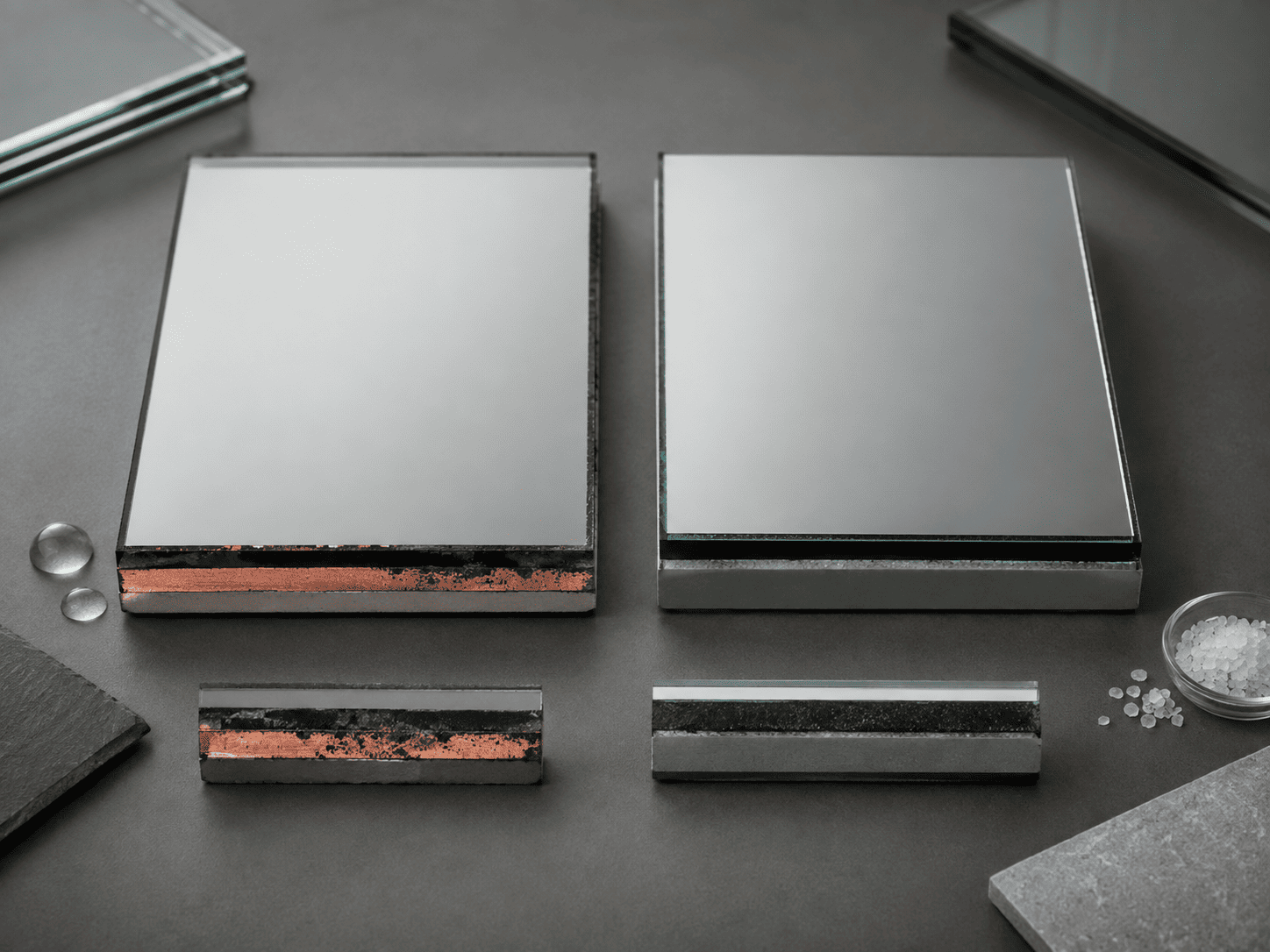
Traditional silver mirror and copper-free mirror layer structures compared for humid bathroom applications.
Why Copper-Free Outlasts Traditional Silver Mirrors in Humid Environments
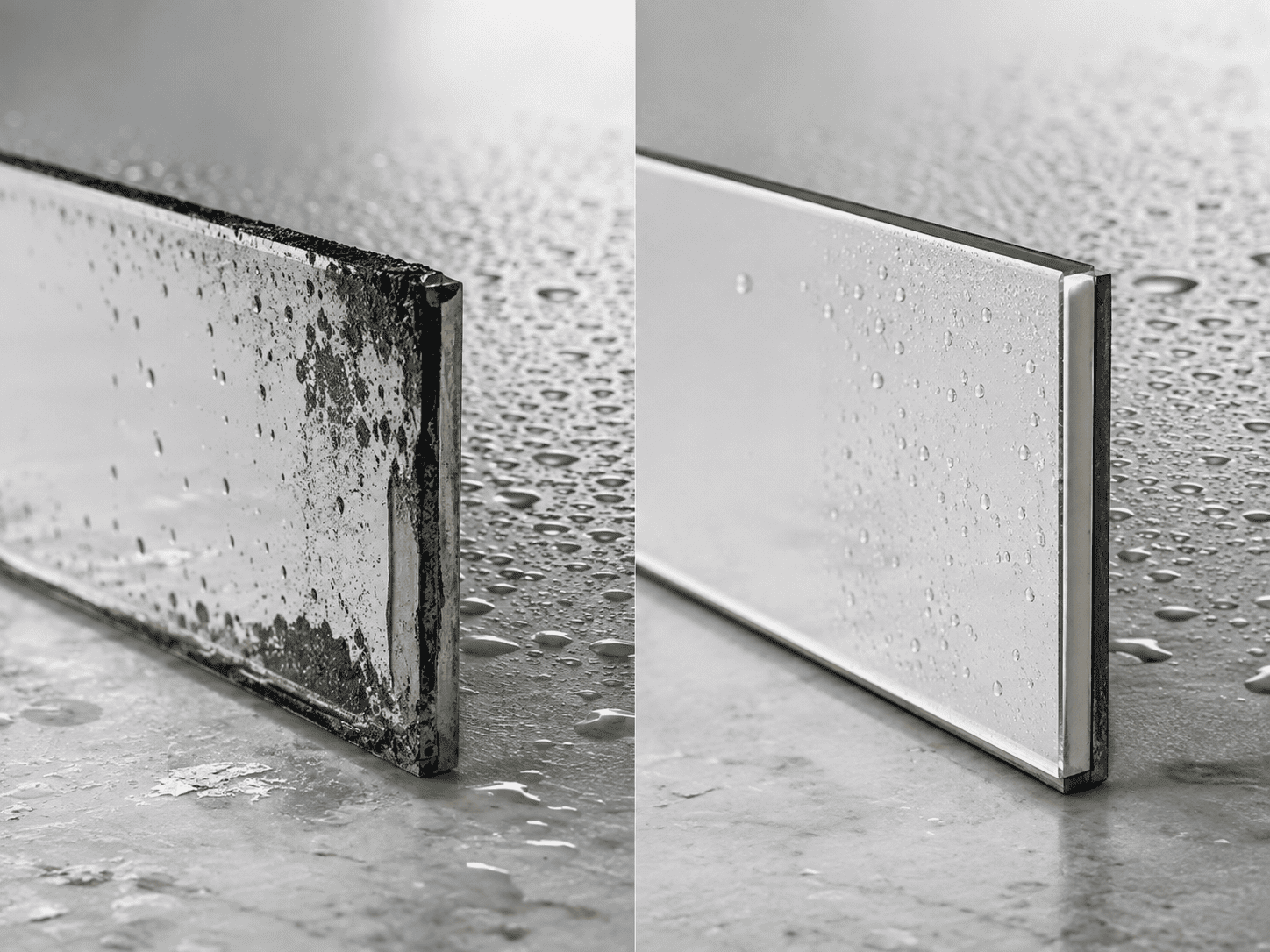
The failure mode in traditional silver-coated mirrors is predictable and electrochemically inevitable. When moisture penetrates the paint edge — and in a bathroom with daily steam cycling, it will — it creates an electrolyte bridge between the copper and silver layers. Copper has a higher electrochemical potential than silver, so it acts as the cathode. Silver becomes the sacrificial anode. The result is galvanic corrosion: silver dissolves at the edge, leaving dark voids that propagate inward — what the industry calls black edge syndrome.
Copper-free mirrors eliminate this galvanic cell by removing the second metal from the stack. With only one metal (silver) in contact with the electrolyte, there's no potential difference to drive corrosion. The passivation film further suppresses oxidation by forming a stable chemical complex at the silver surface. I've seen cut samples from hotel bathrooms in Jeddah where copper-backed mirrors showed edge blackening within 18 months, while copper-free units from the same installation batch remained clean at year five.
The LED driver adds another variable that standard corrosion testing doesn't always capture. An LED mirror's driver generates heat during operation — typically raising the air temperature in the cavity behind the mirror by 5–10°C during extended use. This thermal cycling accelerates moisture vapor transmission through any micro-pores in the backing paint. In a copper-backed mirror, each heat cycle is another opportunity for the galvanic couple to activate. Copper-free structures don't have this vulnerability because there's no second metal to create the electrical potential difference.
For project procurement managers specifying LED mirrors for hotel bathrooms: if the mirror includes a built-in LED driver that will cycle on/off daily, copper-free isn't a nice-to-have. It's the difference between a mirror that looks new after five years and one that generates guest complaints within two.
CASS Testing and Certification: How to Verify Coating Quality
The CASS test (Copper-Accelerated Acetic Acid Salt Spray) is the industry-standard accelerated corrosion test for mirror coatings, defined under ISO 9227. It exposes mirror samples to a saline mist containing copper chloride and acetic acid at 50°C — conditions far more aggressive than normal bathroom humidity, designed to simulate years of corrosion exposure in 48–120 hours.
A quality copper-free mirror should withstand 120 hours of CASS testing with no visible edge corrosion exceeding 0.3mm from the edge inward. This is the threshold I'd recommend including in your quality acceptance criteria when negotiating with suppliers. Traditional copper-backed mirrors typically begin showing edge degradation at 48–72 hours under the same test conditions.
What to request from your supplier:
A dated CASS test report from an accredited third-party lab (not an in-house test certificate). Look for A2LA, CNAS, or ILAC-MRA accreditation on the report header.
The report should specify the test duration (minimum 120 hours), the number of samples tested, and close-up photographs of sample edges post-test.
For LED mirror assemblies specifically, request testing on finished units — not raw mirror sheet stock. The edge-sealing integrity around cable cutouts and driver mounting points matters as much as the mirror edge itself.
One practical check you can do during a factory visit: inspect the mirror backing under natural light. A copper-free mirror's back surface should show a uniform grey or dark green coating with no reddish undertone. If you see a coppery-brown hue through the paint, you're looking at a copper layer. This 30-second visual check has caught more than one supplier claiming copper-free while shipping standard stock.
ISO 9227 is the relevant standard to cite in your technical specification documents. Mirror-specific testing is often conducted per EN 1036 for European markets, though the core methodology aligns with ISO 9227. For Australian projects, request AS/NZS 2208-compliant reports. UAE and Saudi projects typically accept ISO 9227 test data without additional local certifications, though it's worth confirming with your project's MEP consultant.
Cost Implications: Is Copper-Free Worth the Premium?
The procurement math on copper-free vs. traditional silver mirrors needs to account for more than the per-unit material delta. The 10–20% price premium represents the direct cost difference at the factory gate, but the total cost of ownership (TCO) calculation for a commercial installation pulls in several additional factors.
First, replacement cost. A traditional silver mirror in a hotel bathroom that develops edge corrosion at year three requires a replacement unit, labour for installation (usually requiring an electrician if the mirror is LED-integrated), and the brand cost of a room being out of service during replacement. One replacement cycle alone typically exceeds the cumulative copper-free premium across the entire project.
Second, procurement and logistics. If you're importing containers from Guangdong to Jeddah or Sydney, the freight cost per mirror is the same regardless of coating type. The copper-free premium becomes a smaller percentage of the landed cost than it is of the FOB price. For a hotel project in Dubai where the landed mirror cost might be 2.5× the factory price after freight, duty, and clearance, the effective copper-free premium drops to 4–8%.
Third, risk allocation. For OEM buyers who private-label bathroom mirrors under their own brand, a corrosion warranty claim from a hotel chain is a relationship-threatening event. The cost of recalling, replacing, and rebuilding trust dwarfs the specification premium.
The decision framework I'd suggest for procurement teams:
Project with fewer than 20 units and dry climate installation: Traditional silver-coated may be acceptable. The replacement risk is manageable and the savings are tangible.
Hotel project with 50+ rooms, any climate: Copper-free should be the baseline specification. The risk-adjusted economics don't favour saving $3 per unit.
Coastal installation (within 5km of salt water): Copper-free plus an additional edge-seal coat. Salt spray accelerates galvanic corrosion by an order of magnitude compared to inland humidity.
OEM/private-label bathroom brand: Copper-free only. Your brand warranty costs will eat any upfront savings from using copper-backed stock.
Matching Coating Type to Project Requirements
Different project types impose different stress profiles on mirror coatings. Here's how to match the specification to the application:
Hotel bathroom LED mirrors — High humidity, daily temperature cycling from shower steam, chemical cleaning agent exposure, LED driver heat. Copper-free is the correct specification. In luxury hotel segments where the spec calls for 4mm silver mirror with anti-fog functionality and integrated LED, the mirror substrate is already the highest-cost component. Saving $3 on coating makes no procurement sense.
Coastal resort installations — Salt-laden air adds an aggressive corrosion vector that standard humidity testing doesn't simulate. Specify copper-free with confirmed CASS test data at 120+ hours, and add an edge-seal requirement to your PO. For projects in Dubai's Palm Jumeirah or Sydney's coastal suburbs, I've seen the difference between a three-year replacement cycle and a mirror still clean at year eight.
Salon and commercial vanity mirrors — These see less steam than bathroom mirrors but more frequent cleaning with chemical agents. Ammonia-based glass cleaners can wick into micro-cracks at the mirror edge and accelerate copper corrosion. Copper-free handles this chemical exposure better because there's no reactive copper to attack. For salon chains upgrading across multiple locations, the coating specification should be standardized at copper-free to simplify warranty management.
Dry-climate residential developments — If the bathrooms have good mechanical ventilation and the climate is arid (parts of inland Australia, certain Middle Eastern inland cities), traditional silver with copper backing can deliver acceptable performance. The copper-free premium may not justify itself when humidity exposure is limited to brief, occasional steam events.
OEM branded product lines — If you're a bathroom brand importing LED mirrors for distribution under your own brand in the EU, Australia, or North America, use copper-free across the entire product line. The liability exposure from even a 5% corrosion failure rate on a 10,000-unit import batch outweighs the specification cost. Many European bathroom brands now list "copper-free silver mirror" as a standard product line requirement — check your distributor agreements for this language.
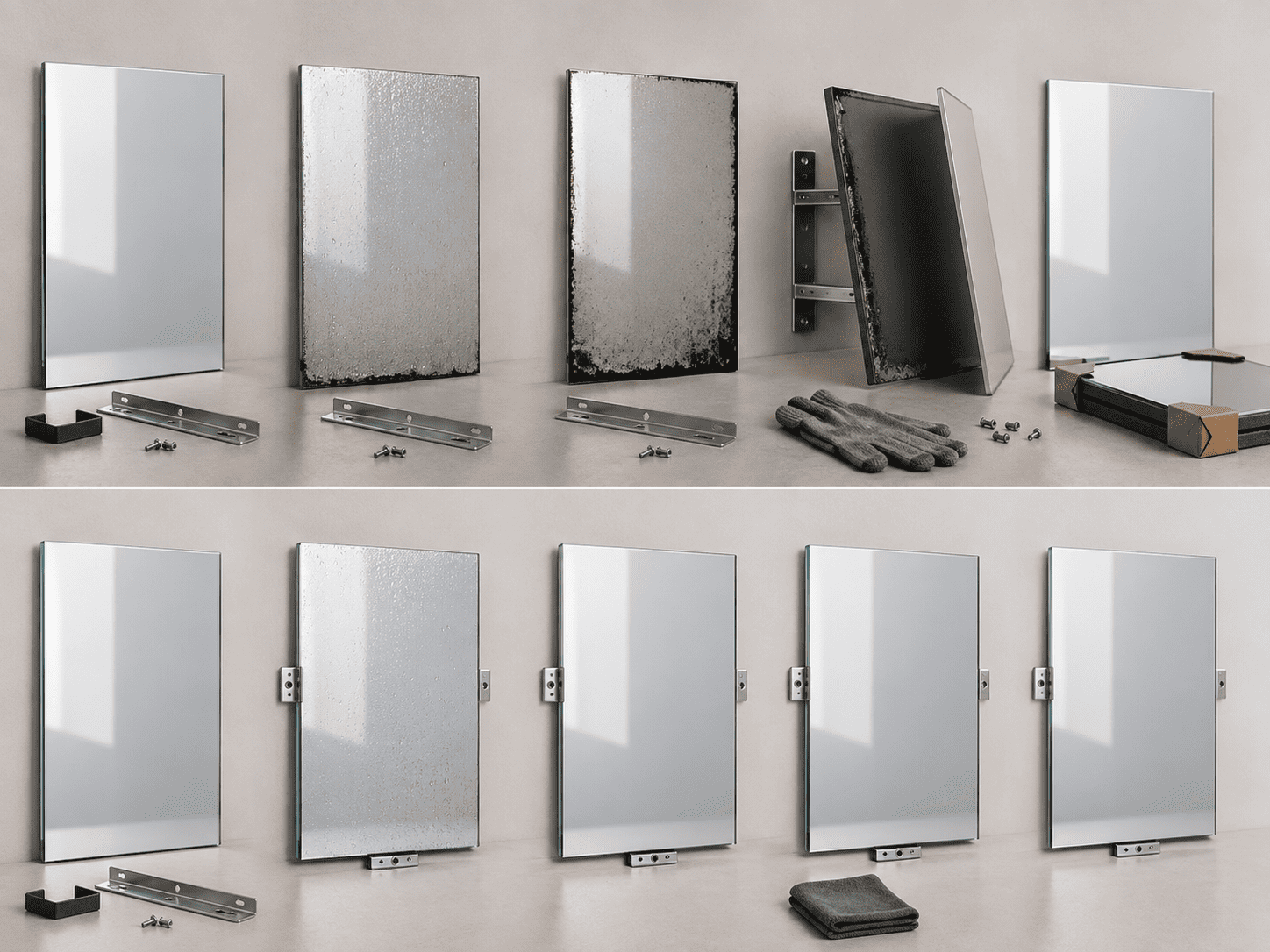
Total cost of ownership considerations for traditional silver and copper-free mirror specifications.
Edge Protection: The Overlooked Variable in Mirror Longevity
Even a copper-free mirror can fail early if edge protection is inadequate. The mirror edge is the primary entry point for moisture — every cut edge exposes the silver layer directly to the environment. Quality manufacturers address this three ways:
Edge sealing with a dedicated epoxy or silicone bead applied after cutting and before framing. In LED mirror production, this should be applied around the perimeter and around any cable routing cutouts. At a minimum, the edge should receive the same multi-layer coating as the back surface.
The glass cutting quality itself matters. A clean score-and-break edge has fewer micro-fractures than a roughly cut edge. Micro-fractures provide capillary pathways for moisture ingress. When auditing a factory, look at the cutting line — automated CNC cutting lines with diamond wheel scoring produce consistently cleaner edges than manual scoring stations.
For framed LED mirrors, the frame profile should incorporate a gasket or silicone seal that prevents water from pooling at the mirror edge during cleaning. This is a detail that separates commodity mirrors from commercial-grade products, and it's worth confirming on the product drawing during the sampling stage.
Selecting a Copper-Free LED Mirror Supplier: What to Ask Before Sampling
Beyond the specification sheet, there are supplier-level questions that reveal whether the factory actually understands and controls their coating process:
Request the mirror substrate supplier certificate. Many LED mirror factories purchase pre-coated mirror sheets from specialized glass processors rather than running their own silvering line. Ask who supplies the raw mirror glass, and request that supplier's batch test data. If the factory can't name their glass substrate source, they're likely buying from spot-market traders with no quality traceability.
Ask about passivation chemistry. A factory that can describe their passivation process — even at a general level (tin-based, copper-sulphate-based, proprietary compound) — demonstrates process knowledge. A factory that responds with "we just use copper-free paint" may not understand the difference between passivation and paint. The passivation step is what creates the chemical bond with the silver; paint alone is just a physical barrier.
Request CASS test data for the specific glass thickness you're ordering. A CASS test on 5mm mirror stock doesn't necessarily validate performance on 4mm or 6mm, because different glass thicknesses can have slightly different edge characteristics during the silvering process. If you're ordering 6mm mirror for a heavy commercial installation, get the 6mm CASS data.
Check LED integration quality. The mirror coating is only one variable. An LED mirror's longevity also depends on the quality of the LED strip, driver, and — critically — how the electrical components are mounted. Screw-mounted drivers with grommet-sealed cable entries preserve edge sealing. Adhesive-mounted components that compromise the backing paint create moisture entry points. During sample evaluation, inspect the back of the mirror around every mounting point and cable exit.
The coating decision on LED mirrors sits at the intersection of materials science, project economics, and brand risk. Copper-free technology has matured to the point where the premium is modest and the performance differential is well-documented. For commercial projects where mirror longevity directly impacts guest experience or brand reputation, specifying copper-free is a low-cost insurance policy against a predictable failure mode.
For OEM buyers and hotel project procurement teams, the actionable next step is simple: request copper-free mirror samples with accompanying CASS test data from your shortlisted suppliers, and make coating type a pass/fail criterion in your technical evaluation. The mirror glass specification on your purchase order should state "copper-free silver mirror, passivation-treated, 120+ hours CASS test per ISO 9227" — not just "silver mirror."
Contact the RATO LED Mirror engineering team to discuss copper-free mirror specifications for your next project. We provide batch-specific CASS test reports and can arrange factory visits to our Guangdong production line so you can inspect the silvering and coating process directly.