Saudi Arabia LED Mirror Project Supply: B2B Guide for Hotel & Construction Buyers
A B2B guide to LED mirror supply for Saudi Arabia covering SASO compliance, 220V/60Hz specification, corrosion resistance and hotel project procurement for Riyadh, Jeddah and NEOM.
Saudi Arabia's construction pipeline has no parallel in the global hospitality sector. Vision 2030 has committed over $1 trillion to tourism and infrastructure, directly generating demand for engineered building materials — including LED mirrors — across hotel, residential, and mixed-use developments. For procurement managers and contractors, the question is not whether to specify LED mirrors, but how to source units that survive local operating conditions, meet SASO conformity requirements, and arrive on schedule at project scale.
This guide covers the technical, regulatory, and supply-chain specifics that separate a successful Saudi LED mirror tender from a compliance failure.
Why Saudi Arabia Is Driving Hotel LED Mirror Procurement in 2026–2030
The Saudi government's Vision 2030 framework targets 150 million annual tourist visits by 2030, up from approximately 100 million in 2023. Accommodating that volume requires an estimated 310,000 additional hotel keys, distributed across giga-projects that each carry their own architectural brief and procurement timeline. Every key represents at minimum one bathroom mirror — often two or three when vanity, full-length, and makeup mirrors are counted — creating a project addressable market in the millions of units over the next four years.
Key project clusters active in LED mirror procurement:
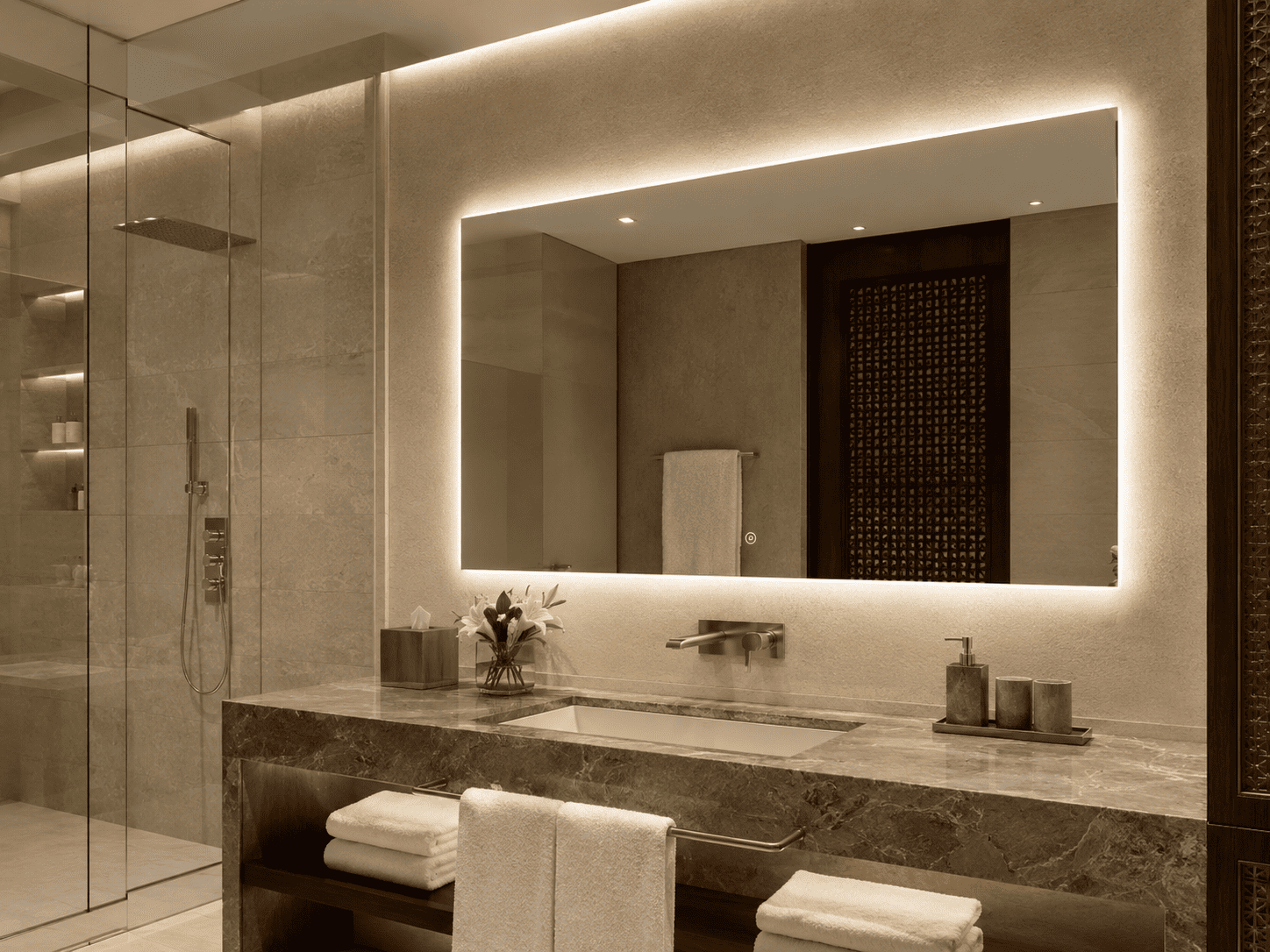
NEOM (Tabuk Province): The Line, Sindalah Island, Trojena, and Oxagon collectively plan over 600,000 rooms across luxury, ultra-luxury, and staff accommodation tiers. Interior fit-out packages typically split mirror supply into guest-room lots (backlit rectangular, 600×900mm to 900×1200mm) and public-area lots (custom shapes, oversized).
Red Sea Global (Western Coast): 50+ resorts across 22 islands and inland sites, with 8,000 rooms operational by end-2025 and 16,000 targeted by 2030. Coastal installations mandate IP44 minimum and salt-spray-rated construction.
Diriyah Gate (Riyadh): 38 luxury hotels within a UNESCO World Heritage-adjacent master-planned district, specifying premium finishes (brushed stainless steel, matte anodized aluminum) and integrated demister pads as standard.
Qiddiya (Riyadh perimeter): Entertainment and hospitality district targeting 60,000 rooms, with high-volume standardized mirror specs across multiple hotel brands.
Rua Al Madinah (Medina): 47,000 hotel rooms in the religious tourism corridor, requiring robust, easy-to-maintain mirrors with high-lumen output for guest satisfaction in a high-turnover environment.
Procurement managers working these projects commonly ask: *How do we verify that a Chinese factory's LED mirror can handle Jeddah's 85% humidity during August without delamination or LED failure?* The answer sits in the spec sheet — specifically in the salt-spray rating of the mirror back coating and the IP rating of the LED housing.
SASO Certification and Electrical Compliance for LED Mirrors
Any LED mirror entering Saudi Arabia must carry SASO (Saudi Standards, Metrology and Quality Organization) compliance documentation. The relevant standard for LED mirrors is SASO 2892 (energy efficiency and safety for low-voltage electrical appliances), with additional reference to SASO IEC 60598 for luminaire safety.
What a factory-side compliance package should include:
SASO Certificate of Conformity (CoC): Issued by an accredited body (SGS, Bureau Veritas, TUV, Intertek). For LED mirrors, this covers the complete assembly — mirror substrate, LED array, driver, and any integrated electronics (demister pad, touch sensor, Bluetooth module).
CB Scheme Test Report: IEC 60598-1 and IEC 60598-2-1 test data accepted by SASO as a basis for national certification. A factory that already holds CB reports for its LED mirror range can fast-track SASO registration.
Saber Platform Registration: Every shipment requires a Saber certificate linked to the product's HS code (7009.92 for framed glass mirrors with electrical components). The importer of record must register the shipment on the Saber platform; the factory provides the CoC and test reports to support the filing.
Energy Efficiency Label: If the mirror's LED driver output exceeds the SASO threshold, an EER label issued through SASO's energy efficiency program is required. Most hotel-grade LED mirrors with 24W–48W driver output cross this threshold.
A procurement manager in Dammam recently flagged a shipment held at King Abdulaziz Port because the factory's CoC listed the mirror under HS 7009.91 (unframed glass mirror) while the Saber filing referenced HS 7009.92. The discrepancy — a single digit — caused a 12-day clearance delay. This is the operational reality of Saudi imports: the documents are as critical as the product.
Voltage, Frequency, and Plug Specification
Saudi Arabia's grid delivers 220V at 60Hz, with BS 1363 (Type G) 3-pin sockets as the dominant standard in new hotel construction. This creates two specification traps that frequently catch first-time suppliers:
50Hz LED drivers failing at 60Hz: Many factory-standard LED drivers sourced from component markets in Guangdong are rated 220–240V/50Hz only. Run at 60Hz, the driver's output current can drop 15–20%, causing visible flicker in the LED array, or the transformer core can saturate, leading to thermal runaway within 6–12 months. Specification requirement: driver rated 220–240V/50–60Hz with CE/CB certification.
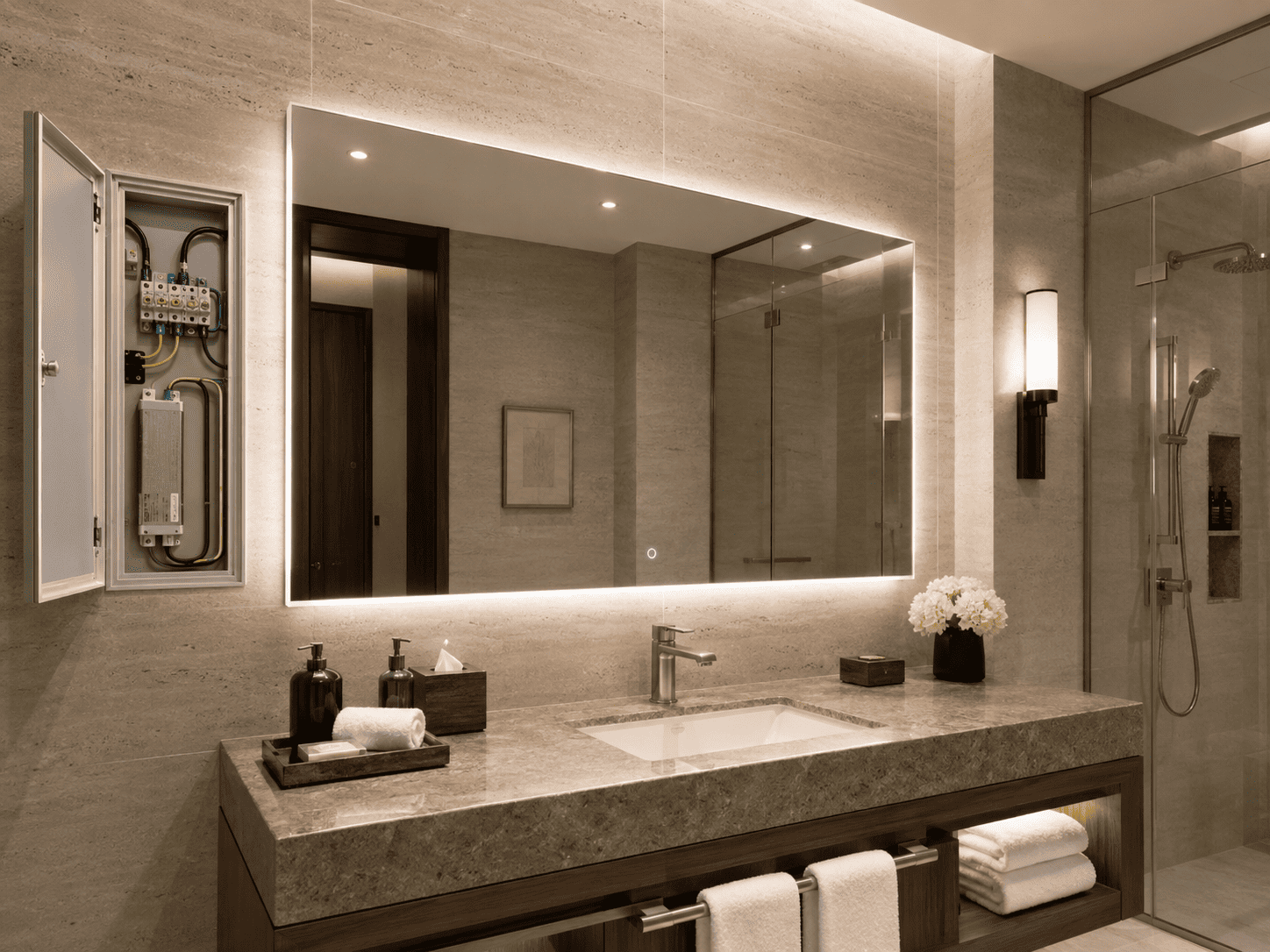
Europlug vs. BS 1363 wiring: European-spec LED mirrors usually ship with a Type C (Europlug) or hardwired terminal block. Saudi contractors expect either a factory-fitted BS 1363 plug or a junction box with clear L/N/E terminals and a wiring diagram in English and Arabic. Hardwired installations are standard in hotel projects — cord-and-plug units are typically limited to retail channels.
Materials and Corrosion Resistance for Gulf Climate
Saudi Arabia's climate is not uniform. The Red Sea coast (Jeddah, KAEC, Red Sea Global sites) combines 80–90% relative humidity with airborne salt, while the Arabian Gulf coast (Dammam, Al Khobar) adds sulfur compounds from petroleum infrastructure. Riyadh's inland climate stresses dust ingress and thermal cycling (5°C winter nights to 48°C summer afternoons). A mirror specification that works in a London hotel will degrade visibly within 18 months in Jeddah.
The following table maps environmental stress factors to the minimum specification required for project-grade LED mirrors across Saudi Arabia's three principal climate zones:
Standard silver mirror with moisture-barrier edge seal
Frame Material
304 stainless steel or 6063 anodized aluminum, no exposed iron fasteners
304 stainless steel or marine-grade aluminum (5052)
Anodized aluminum or powder-coated aluminum, 304 stainless steel
Ingress Protection
IP44 minimum, IP65 for semi-outdoor installations
IP44 minimum
IP44 minimum
LED Driver Enclosure
Sealed aluminum housing, conformal-coated PCB
Sealed aluminum housing
Standard aluminum housing with ventilation
Edge Seal
Silicone-sealed, full-perimeter, ≥2mm bead width
Silicone-sealed, full-perimeter
Moisture-barrier edge seal (paint-based acceptable)
Demister Pad
Required; 40–60W, IP44-rated connector, auto-shutoff at 60°C
Recommended; 40–60W
Optional
Hardware / Mounting
304 stainless steel Z-clips or French cleat, wall anchors rated for concrete block
304 stainless steel Z-clips
304 stainless steel or zinc-plated steel Z-clips
A hotel procurement director sourcing for a Red Sea Global resort asked us: *Can a factory apply a salt-spray-resistant back coating to an off-the-shelf mirror, or does it need to be built into the manufacturing process?* The coating must be applied during silvering — applying it post-production leaves the silver layer unprotected at the edges, where corrosion initiates. This is not a retrofit option; it is a production-line decision.
LED Mirror Specifications That Saudi Contractors Actually Require
Beyond regulatory compliance and climate hardening, Saudi hospitality projects impose functional requirements driven by brand standards (Marriott, Hilton, Accor, IHG) and local end-user expectations.
Illumination and CRI
Color temperature: 4000K (natural white) is the dominant spec for hotel bathrooms across Saudi Arabia. 3000K appears in ultra-luxury and boutique properties. 6000K, common in Chinese domestic market mirrors, is almost never specified — it reads as clinical and washes out skin tones under bathroom lighting.
CRI: CRI ≥90 for vanity and makeup mirrors, CRI ≥85 for general bathroom mirrors. LED strips using Epistar or Samsung 2835 chips at appropriate binning achieve CRI 90+ without a significant cost premium.
Luminous efficacy: Minimum 80 lm/W at the driver output. A standard 24W hotel mirror delivers approximately 1,920–2,100 lumens — sufficient for a 600×900mm mirror over a single vanity.
Touch Sensor and Demister Integration
Touch switch: Capacitive-touch sensors are standard on midscale and above. The sensor must be responsive through 5mm silver mirror glass and must not register false triggers in high-humidity environments. Factories using the HTTM-series touch IC with sensitivity trim adjustment avoid the humidity-induced false-trigger problem common with lower-cost capacitive circuits.
Demister pad: A silicone-encapsulated heating pad bonded to the mirror back, typically 40–60W, that clears a central zone of condensation within 3–5 minutes. Saudi hotel FF&E specifications treat the demister as standard — it is listed on the room data sheet alongside the mirror itself, not as an optional extra.
Memory function: The driver should retain the last brightness and color temperature setting after power-off. This is a brand-standard requirement for Marriott and Hilton properties and is verified during snagging inspections.
Packaging for Project Shipments
Project shipments differ fundamentally from retail container loads. A factory that ships 1,000 LED mirrors in individual retail boxes with polystyrene inserts will generate 30–40% packaging waste that the contractor must dispose of onsite. Project packaging specifications:
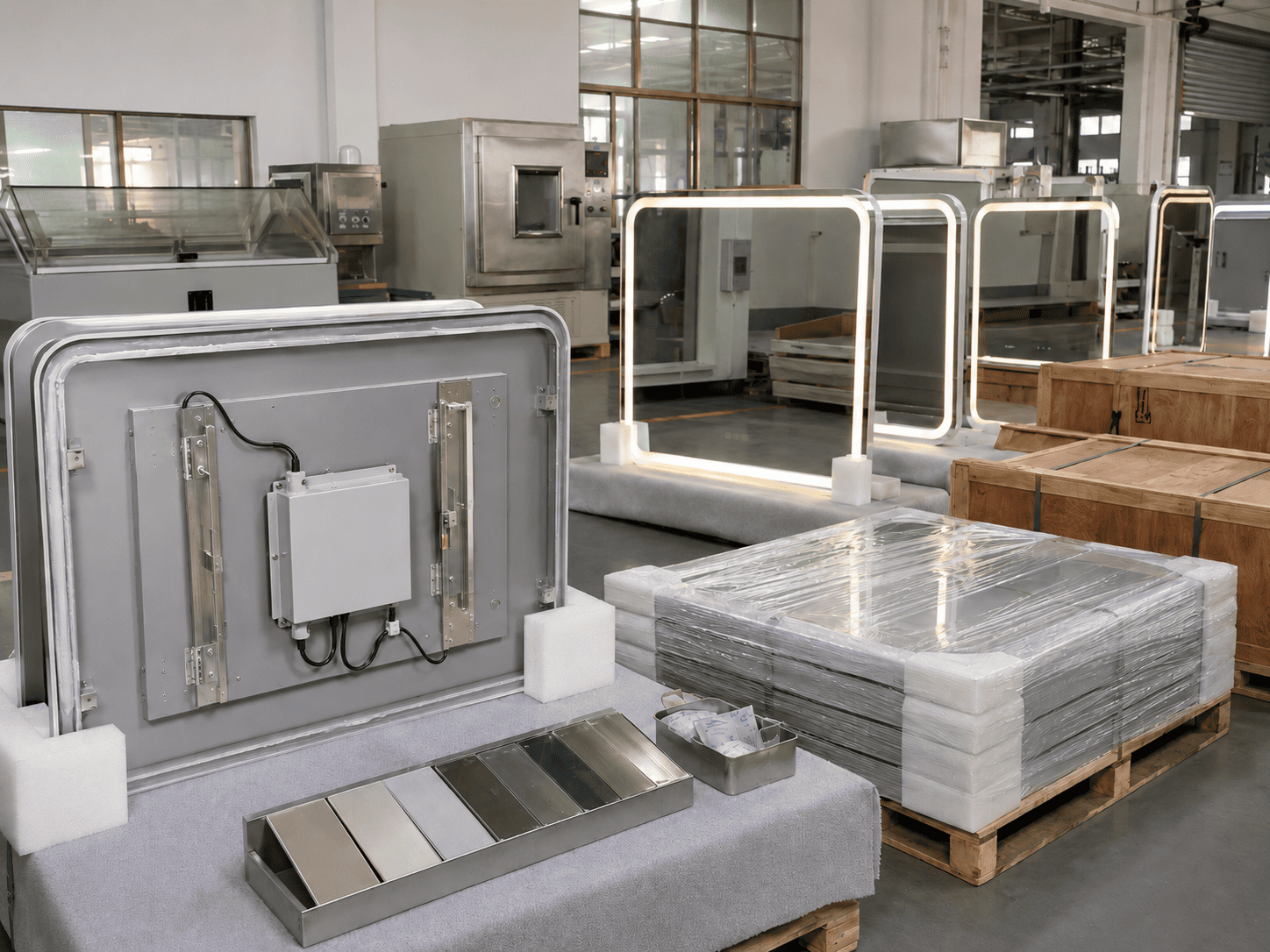
Palletized, 8–12 mirrors per pallet, foam interleaving between units
Corrugated corner protectors, stretch-wrapped, pallet strapped with PET banding
Each pallet labeled with project name, PO number, mirror SKU, and quantity
Individual mirror polybag with silica gel desiccant for sea freight humidity protection
No single-use retail packaging unless contractually specified
This approach reduces onsite waste handling, speeds up FF&E receiving, and cuts per-unit freight volume by approximately 25% compared to retail-packaged alternatives.
Supply Chain: Factory Selection, MOQ, and Logistics
Factory Qualification Criteria
Selecting a Chinese LED mirror factory for a Saudi project requires verifying capabilities beyond the Alibaba or Canton Fair booth pitch. The following checklist separates project-capable factories from trading companies:
Qualification Area
Minimum Evidence
Saudi export history
Bill of lading showing at least one FCL shipment to Jeddah Islamic Port or King Abdulaziz Port Dammam within the past 24 months
SASO documentation
Active CoC for at least one LED mirror SKU, renewed within the current calendar year
In-house silvering
Photographs of the silvering line and mirror cutting/edging station at the factory address matching the business license
Quality management
ISO 9001:2015 certificate with scope explicitly mentioning LED mirror or bathroom mirror manufacturing
Electrical safety
CB Scheme test report (IEC 60598) for the LED mirror range being quoted, issued by a SASO-accredited lab
Environmental testing
In-house salt-spray chamber or third-party test reports per ASTM B117 for back-coating corrosion resistance
Capacity
Factory floor plan or production-line photographs demonstrating capacity of ≥3,000 units/month for hotel-standard mirrors
MOQ and Pricing Structure
Project-grade LED mirror pricing operates in tiers that align with the giga-project procurement cycle:
Sample stage (1–5 units): Full sample fee plus air freight. A typical hotel-grade 600×900mm backlit LED mirror with stainless steel frame and demister pad costs $85–$120 per sample unit including DHL/FedEx to Riyadh or Jeddah.
Pilot order (50–200 units): Factory MOQ for customized mirror models, typically 50–100 units per SKU. Unit price $45–$75 FOB for the spec above, depending on frame material (anodized aluminum at the low end, 304 stainless steel at the high end) and LED configuration (single CCT vs. tunable CCT).
Project order (500–5,000+ units): Unit price $32–$55 FOB. At this volume, the factory amortizes frame die tooling, customized packaging, and SASO compliance testing across the order. NEOM and Red Sea Global contracts routinely exceed 2,000 units per mirror SKU, qualifying for the bottom of this range.
Framework agreement (10,000+ units across multiple SKUs): Blanket PO with quarterly call-offs, pricing locked for 12–18 months with raw material adjustment clauses tied to the LME aluminum index and Shanghai Silver Exchange spot price.
Standard FOB terms: FOB Shenzhen or FOB Nansha, with FOB Jebel Ali (Dubai) available through factories that consolidate through a UAE forwarder. Dammam as a destination port adds approximately $350–$500 per 20-foot container compared to Jebel Ali, plus a longer clearance window.
Lead Time Benchmarks
First-article samples: 15–21 days from PO and artwork approval
Pilot/production order (500 units): 30–35 days
Project order (2,000+ units): 40–50 days
Sea freight Shenzhen → Jeddah: 18–22 days transit + 7–14 days customs clearance if Saber documentation is complete
Contractors and procurement managers planning for a Q4 2026 hotel opening should place mirror orders no later than May–June 2026 to allow for production, shipping, clearance, and a 30-day buffer for snagging and replacement units.
What Differentiates a Project-Capable LED Mirror Factory
The gap between a factory that can make a single acceptable LED mirror and one that can supply 3,000 identical units to a Diriyah Gate hotel tower is not incremental — it is structural. Project-capable factories demonstrate consistency across three dimensions:
Production consistency: LED color temperature variance of ≤±150K across a production batch of 500+ units, verified with a spectrometer at QC stations. Factories that batch-measure and bin LED strips before assembly maintain this tolerance; factories that rely on supplier-provided strip without incoming QC see ±400–600K variance that becomes visible when adjacent mirrors are installed on the same wall.
Documentation discipline: A project shipment to Saudi Arabia generates 40–60 pages of compliance documentation — CoC, CB report, test data sheets, packing list with HS codes, certificate of origin (typically Form E for China-GCC trade), and the Saber shipment certificate. Factories that assign a dedicated documentation coordinator and use a digital QC reporting system (rather than handwritten inspection sheets) deliver this package without delay.
After-sales for projects: A standard retail warranty of 12 months is insufficient for hotel projects where the mirror is considered a fixture. Project-capable factories offer 3–5 year warranties with defined response times, maintain a 2–3% spare-unit stock held at a Dubai or Dammam warehouse, and provide on-site technical support for large-scale snagging during hotel pre-opening.
Summary: Saudi LED Mirror Procurement Checklist
Verify SASO CoC covers the reported HS code (7009.92 for framed LED mirrors)
Confirm LED driver is rated 220V/60Hz, not 50Hz only, with CB test report
Specify salt-spray-rated mirror back coating (≥96h ASTM B117) for coastal projects
Require 304 stainless steel or 6063 anodized aluminum frames; zero ferrous hardware
Enforce IP44 minimum ingress protection, IP65 for semi-outdoor bathrooms
Include demister pad with auto-thermal shutoff as standard, not optional
Request palletized project packaging — no retail boxes — with silica gel desiccant
Demand batch-level color temperature tolerance (≤±150K) and CRI test reports
Prepare Saber platform registration before shipment; do not file after vessel departure
Budget 50 days for production plus 30 days for sea freight and clearance to Jeddah or Dammam
With $1 trillion in construction spend and 310,000 hotel keys entering procurement between 2026 and 2030, Saudi Arabia represents a generational demand cycle for engineered LED mirrors. Factories and procurement teams that align on SASO compliance, climate-hardened specifications, and project-scale logistics will capture contracts measured in thousands of units rather than dozens.
FAQs
What certifications are required for LED mirrors in Saudi Arabia?
SASO certification is mandatory for electrical products imported into Saudi Arabia. LED mirrors must comply with SASO 2892 for low voltage electrical appliances. Your factory should provide SASO-compliant power supplies (220V/60Hz) and proper labeling. Work with a factory experienced in Saudi exports to avoid customs delays.
Can standard Chinese factory LED mirrors work in Saudi Arabia's climate?
Standard mirrors may fail within 1-2 years in Saudi Arabia's coastal humidity (Jeddah, Dammam) and inland dust (Riyadh). Specify salt-spray resistant back coating, stainless steel or anodized aluminum frames, IP44 minimum for bathrooms, and silicone-sealed edges to prevent corrosion and dust ingress.
What voltage and plug types do Saudi hotel projects require?
Saudi Arabia uses 220V/60Hz with BS 1363 (British standard) 3-pin plugs, the same as the UAE and UK. Confirm with your factory that the LED driver is rated for 60Hz — many standard drivers are 50Hz only, leading to flicker or premature failure at 60Hz.
How do Saudi Arabia's mega-projects source LED mirrors?
Projects like NEOM, Red Sea Global, and Diriyah Gate typically work through tier-1 contractors who require bulk pricing, consistent quality across thousands of units, and on-time shipping. Factories serious about these contracts should prepare batch-test certificates (salt spray, humidity, insulation resistance) and offer FOB Jebel Ali or Dammam port terms.
B2B Project Inquiry
Talk to our project team about your mirror specification.
Send drawings, BOQ, mirror sizes, target quantity, voltage, lighting preference, packaging needs and destination market. Specifications are confirmed according to the selected model and project requirements.