New Zealand LED Mirror Standards: Compliance Guide for Hotel & Commercial Projects
A practical compliance guide for New Zealand hotel and commercial LED mirror projects, covering NZS 4223.3 safety glazing, AS/NZS 3000 bathroom zones, RCM documentation, 230V/50Hz configuration and procurement checks.
New Zealand Hotel Industry Overview
The New Zealand hospitality sector is in the middle of its most significant construction cycle in a generation. Over 5,700 hotel rooms are in the active development pipeline, with the majority scheduled for completion across 2026–2027. This translates directly into bathroom fit-out demand — every room requires at least one mirror installation, and in upscale properties often a second vanity or full-length mirror.
Auckland leads the charge. The Radisson RED Auckland opened February 2026 with 322 rooms; Moxy Auckland (190 rooms) follows mid-2026; and DoubleTree by Hilton Auckland (231 rooms) is on track for late 2026. Together these three properties alone represent more than 740 mirrored bathroom installations in a single city. Meanwhile, Queenstown remains the country's most active regional hotel market, with the QT Hotel expansion adding 222 rooms (2026–2027) and the Roki Collection delivering 15 ultra-luxury suites mid-2025. Hamilton's 191-room Pullman is also in the pipeline for 2026.
For project supply teams, the critical takeaway is timing: product specifications need to be locked in at least 4–6 months before hotel opening dates. With international visitor arrivals projected to return to pre-pandemic levels by 2026–2027, developers are under pressure to deliver on schedule. Delays caused by non-compliant bathroom LED mirrors are an avoidable risk when compliance is designed in from the start.
Compliance Requirements for New Zealand
Every LED mirror installed in a New Zealand commercial bathroom must satisfy two separate compliance frameworks: glazing safety and building code durability. These are not optional — they are enforceable under the Building Act 2004 and referenced in consent documentation.
The primary glass standard is NZS 4223.3:2016 (Human Impact Safety Requirements). For bathrooms and ensuites, any mirror surface within 2,000 mm of finished floor level must be safety glass. This covers virtually every wall-mounted hotel bathroom mirror. If the mirror doubles as a wall cladding panel and falls within the same 2,000 mm zone, the safety glass requirement still applies. There is one recognised alternative: fully backing the mirror with adhesive to a solid substrate, provided the adhesive tape spacing does not exceed 100 mm and sealant coverage reaches at least 20% per square metre. In practice, however, specifying Grade A safety glass or laminated mirror glass is the cleaner, more repeatable approach for a multi-room hotel project.
Two Building Code clauses add durability requirements. Clause B2 (Durability) mandates a minimum 5-year service life — for mirrors this means silver edge sealing against moisture ingress and corrosion, without which black-edge deterioration can appear within 12–18 months in unventilated hotel bathrooms. Clause F2 (Hazardous Building Materials) requires that if the mirror does break, it should not cause injury — satisfied by a safety vinyl backing film applied during OEM production.
A practical installation note worth having in your spec book: leave a 5 mm ventilation gap behind large-format mirrors, and mount the bottom edge at least 200 mm above the basin rim to keep the mirror clear of direct splash-over. This is not a code requirement per se, but it aligns with manufacturer warranty conditions and reduces long-term maintenance issues.
Electrical Safety & AS/NZS 3000 Bathroom Zones
New Zealand bathroom electrical installations are governed by AS/NZS 3000 (the Wiring Rules), which divides wet areas into defined zones. Where an LED mirror sits within those zones determines the minimum IP rating and installation method required.
Zone
Definition
Minimum IP Rating
Installation Notes
Zone 0
Inside the shower tray or bathtub
IPX7, SELV ≤12V only
LEDs effectively prohibited for standard mirrors
Zone 1
Above the shower head, up to 2.5 m height, 1.2 m radius
IPX4 minimum, fixed wired
Mirrors rarely placed here in hotel layouts
Zone 2
600 mm beyond Zone 1, up to 2.25 m height; 150 mm around basin rim
IPX4 minimum, RCD ≤30 mA
Typical hotel vanity mirror location
Outside Zones
Beyond Zone 2
IP44 recommended for humidity
Still best practice for commercial bathrooms
Why does IP44 matter when IPX4 is the legal minimum in Zone 2? Because the first digit in an IP rating covers solid-object protection, and hotel bathrooms accumulate hair, lint, and cleaning debris that IP44-rated enclosures are designed to keep out. Supplying IP44-rated bathroom LED mirrors as standard eliminates installation-zone guesswork and satisfies both hotel brand standards and council inspections.
All hardwired luminaires — including LED mirrors with direct electrical connections — must be installed by a licensed electrician under AS/NZS 3000. Hardwired mirrors are preferred in hotel projects because they eliminate visible cords and power points, but this also means the installation cost is higher. Factor roughly 45–90 minutes per unit for a licensed electrician's install when building your project budget.
Additional guidance comes from AS/NZS 60598.1 and 60598.2.1, which set construction and test requirements for fixed general-purpose luminaires. Any LED mirror sold into New Zealand that carries an integrated light source should have test reports referencing these standards, even if the product falls outside the declared-article category.
SAA Certification & RCM Marking for Importers
One of the most misunderstood aspects of the New Zealand market is that CE marking alone holds zero regulatory weight. New Zealand operates under the AS/NZS 3820 essential safety framework, and electrical equipment must demonstrate compliance through SAA certification with RCM (Regulatory Compliance Mark) labelling. The SAA and RCM system is a trans-Tasman arrangement — a product certified in Australia is automatically accepted in New Zealand under mutual recognition.
The distinction that matters for OEM buyers is between *declared* and *non-declared* articles. Declared (regulated) electrical products require pre-market SAA certification before they can be sold. Non-declared products — which many standard LED mirrors with integrated drivers may fall under — do not require pre-market certification, but the importer (you) remains legally liable for ensuring the product meets AS/NZS 3820 essential safety requirements. In a hotel project context, this legal obligation is not worth testing: building consent authorities and project certifiers will ask for evidence, and an SAA certificate is the cleanest path through that gate.
Key facts to keep on hand when vetting a Chinese LED mirror factory:
SAA certificates are valid for a maximum of 5 years — check the issue date
The RCM mark must appear on the product label, not just on packaging
Ask your supplier for copies of the SAA certificate and the corresponding test report (AS/NZS 60598 series)
If the mirror includes a demister pad, heated pad, or Bluetooth speaker, each additional electrical function may need separate assessment
A factory with existing SAA-certified models saves 8–12 weeks of lead time versus starting a fresh certification cycle.
Product Adaptation for New Zealand Climate
New Zealand's climate creates specific demands on LED mirror construction that differ from drier markets. The country's high-humidity coastal environment — particularly in Auckland, Wellington, and Christchurch — makes demister pad sizing and edge-sealing quality genuine performance factors, not marketing checkboxes.
For a hotel project supply, three adaptation points matter most:
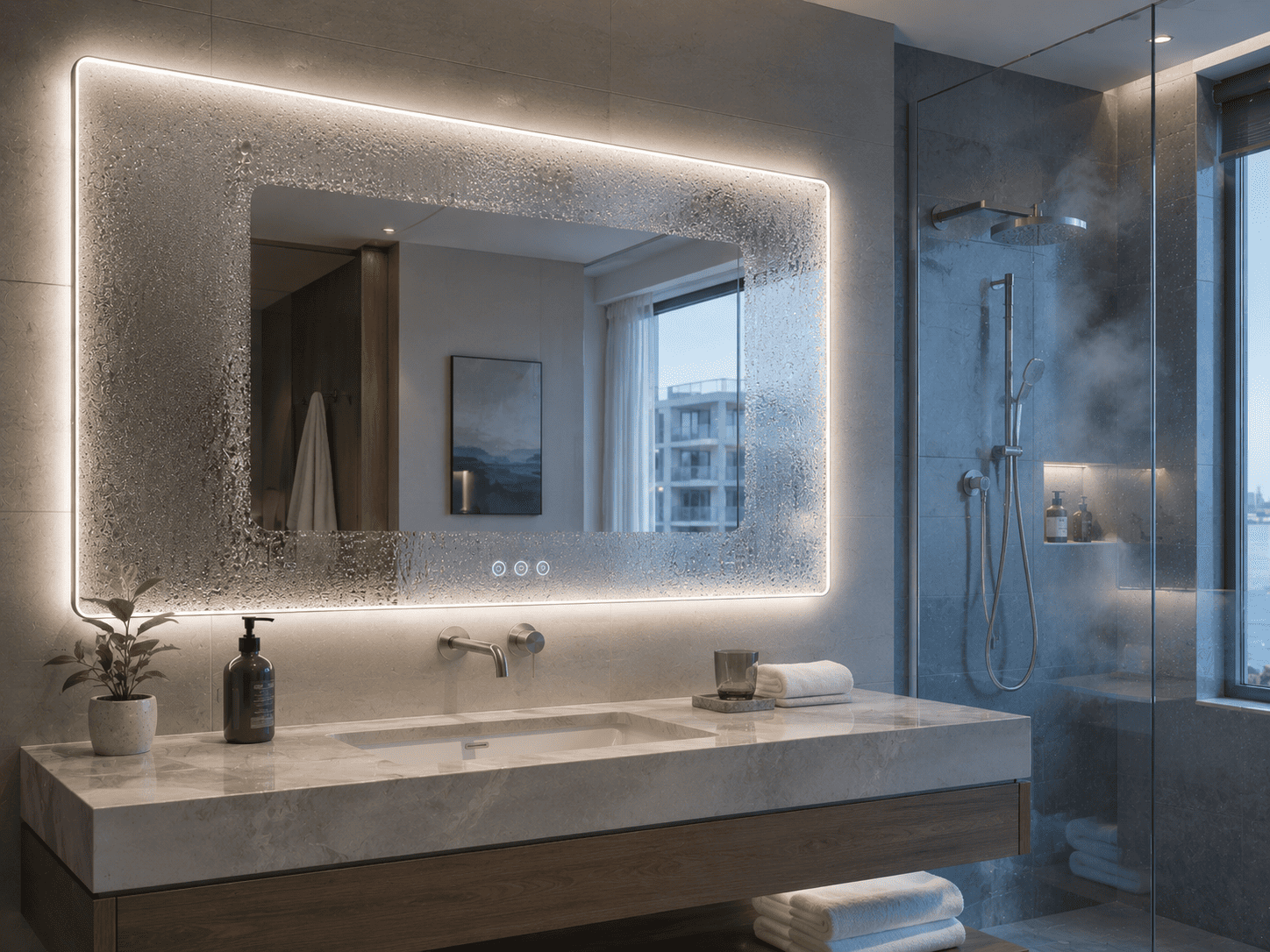
Demister pad coverage. A demister pad should cover at least 70% of the mirror's rear surface to keep the reflection clear in a post-shower bathroom. Smaller pads create uneven clearing patterns that are visible to guests and generate maintenance complaints. Specify full-coverage or near-full-coverage demister pads in your purchase order — the cost increment is marginal compared to the call-back risk.
Silver edge sealing with copper-free mirror. Moisture ingress begins at the edge. Copper-free silver mirrors with epoxy edge sealing prevent the black-edge corrosion that is the number-one mirror failure mode in coastal hotels. The Building Code B2 5-year durability requirement effectively mandates this specification.
Anti-fog film vs. demister pad. An anti-fog film is a passive coating applied to the mirror surface; a demister pad is an active heating element. For hotel bathrooms, the active demister pad is the correct specification. Passive films degrade with repeated cleaning and are better suited to residential use. The heated demister pad — wired to the bathroom lighting circuit so it activates when the guest turns on the light — is the industry-standard approach for hospitality projects.
Voltage & Electrical Configurations
New Zealand runs on 230V/50Hz, identical to Australia. From a factory perspective, this is a single SKU: the Australian and New Zealand markets share the same electrical specification. If your supplier already manufactures for Australian hotel projects, the same LED driver, demister pad voltage, and switch configuration translate directly to New Zealand.
Three technical points to confirm at the factory level:
LED driver compatibility. Mirror-integrated LED drivers must be rated for 220–240V input with 50 Hz frequency. Drivers certified only for 110–120V or 60 Hz markets (North America, Japan) cannot be adapted and require a separate production run with 230V drivers.
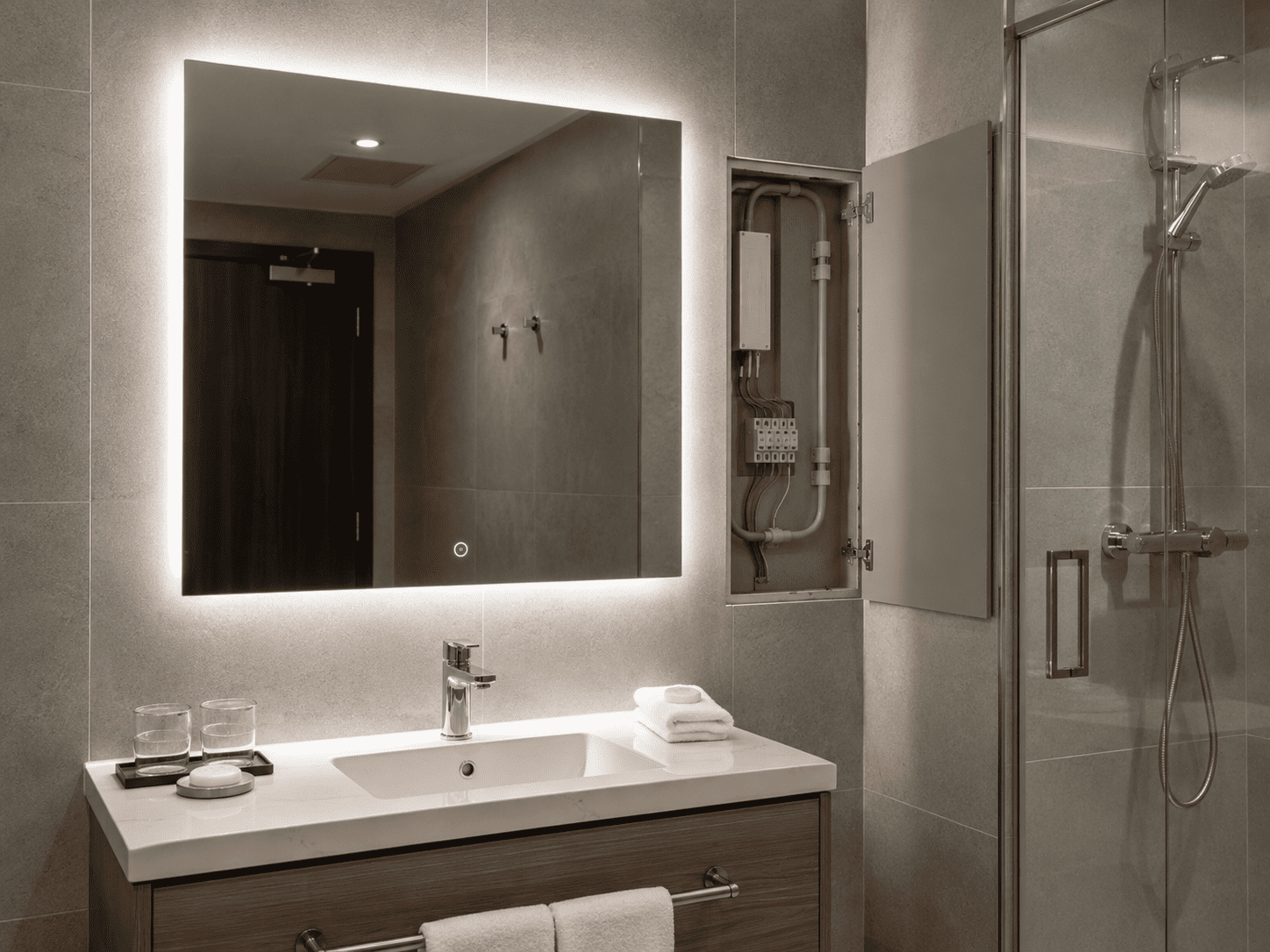
Hardwired vs. plug-in. Hotel projects almost exclusively specify hardwired mirrors. Confirm with your factory that the mirror's junction box or terminal block is accessible from the front (after removing the mirror from its mounting bracket) — this avoids the installer having to unmount the entire unit to make electrical connections.
Switch integration. Most hotel LED mirrors use touch-sensor switches integrated into the mirror surface. The sensor should be rated for 230V operation and tested under AS/NZS 60598. If your project specifies a wall-switch-controlled mirror (common in budget hotel chains), ensure the LED driver supports power-on memory — the mirror returns to its last-used colour temperature and brightness setting when the wall switch is toggled, rather than resetting to a default. For hotel housekeeping, this reduces the number of settings guests reset daily.
Procurement Process with Chinese Factory
Sourcing LED mirrors from a Chinese factory for a New Zealand project follows a defined sequence. Getting the steps right early eliminates the compliance surprises that delay hotel openings.
Step 1: Spec lock (8–12 weeks before production). Lock down mirror dimensions, glass type (copper-free safety glass), IP rating (IP44), LED colour temperature (most hotels use CCT 3000K warm white or tunable 3000K–6000K), demister pad size, edge finish (polished flat edge or bevelled), and mounting system (Z-clip or French cleat). Include SAA certification requirements as a line item in the specification document.
Step 2: Certification verification. Request the factory's existing SAA certificates and corresponding AS/NZS 60598 test reports. If the factory has no SAA-certified models in your required configuration, build 8–12 weeks into the timeline for a new certification cycle through a JAS-ANZ accredited testing body.
Step 3: Sample approval. Order 2–3 production-grade samples shipped to New Zealand. Test them on 230V power, verify the IP44 rating through a local electrical inspector if needed, and check the demister pad performance in a humid bathroom environment. A sample that works in a Guangdong factory showroom may behave differently in a Wellington winter.
Step 4: Production and QC. Agree on an inspection protocol before production begins. At minimum, specify inline electrical safety testing (earth continuity, insulation resistance, hi-pot test) on every unit, plus an AQL 2.5 random inspection on cosmetics and dimensional tolerances before the container ships.
Step 5: Shipping and documentation. The factory should supply a commercial invoice, packing list, bill of lading, SAA certificates, and product test reports. New Zealand Customs does not typically require a Certificate of Conformity for non-declared electrical articles, but having test documentation on file is essential for your building consent compliance record.
A timeline reality check: from confirmed purchase order to container arriving at Auckland or Lyttelton port, plan on 45–60 days for production plus 18–24 days ocean freight from southern Chinese ports. With certification and sampling included, a first-time project can easily run 14–18 weeks door-to-door. Build this into your construction schedule rather than treating it as an afterthought.
FAQ
What certification does an LED mirror need for New Zealand?
LED mirrors imported into New Zealand must comply with AS/NZS 3820 essential safety requirements. Regulated electrical products require SAA certification and RCM (Regulatory Compliance Mark) marking. CE certification alone is not accepted. Non-declared products do not require pre-market certification, but the importer is legally responsible for ensuring electrical safety. Most hotel-grade LED mirrors should carry SAA or equivalent JAS-ANZ accredited certification to satisfy project specifications.
What IP rating is required for bathroom LED mirrors in New Zealand?
Under AS/NZS 3000, bathroom Zone 2 (600 mm from shower/bath and around basins) requires a minimum IPX4 rating. However, for hotel and commercial projects, specifying IP44 is standard practice — it provides protection against both splashing water and solid objects. Mirrors installed outside defined zones should still carry IP44 due to bathroom humidity. Zone 1 installations directly above showers require IPX4 minimum with fixed wiring by a licensed electrician.
Does New Zealand use the same voltage as Australia for LED mirrors?
Yes. New Zealand operates on 230V/50Hz, identical to the Australian standard. LED mirrors manufactured for the Australian market are electrically compatible with New Zealand installations. The same AS/NZS 3000 wiring rules apply across both countries, and SAA certification is recognised through a trans-Tasman mutual recognition framework. Hardwired mirrors must be installed by a licensed NZ electrician.
Where can I find a factory that produces SAA-certified LED mirrors for hotel projects?
Heshan Rato Special Glass and Building Materials Co., Ltd., based in Guangdong, China, manufactures SAA-certified LED mirrors with RCM marking for hotel, commercial, and OEM supply. With existing certification across our product range and experience supplying hospitality projects across Australasia, we work directly with hotel developers, bathroom brands, and importers to align mirror specifications with New Zealand compliance requirements before production begins. Contact our project supply team with your room count and target delivery window for a technical proposal and lead-time assessment.
B2B Project Inquiry
Talk to our project team about your mirror specification.
Send drawings, BOQ, mirror sizes, target quantity, voltage, lighting preference, packaging needs and destination market. Specifications are confirmed according to the selected model and project requirements.