LED Mirror Control Technologies: Touch Switch vs Motion Sensor vs Remote Control
A B2B guide to LED mirror control technologies, comparing capacitive touch, IR motion sensors, RF remotes and hardwired wall switches for hotel, villa, commercial and OEM projects.
The Four Control Technologies — How Each Works at the Component Level
Every LED mirror control method is a choice about three things: how the user interacts with the mirror, what components the factory integrates into the mirror assembly, and how the mirror interfaces with the building's electrical system. For B2B buyers, understanding each technology at the PCB and component level is essential — it determines reliability, serviceability, and total landed cost across a 200-unit hotel project.
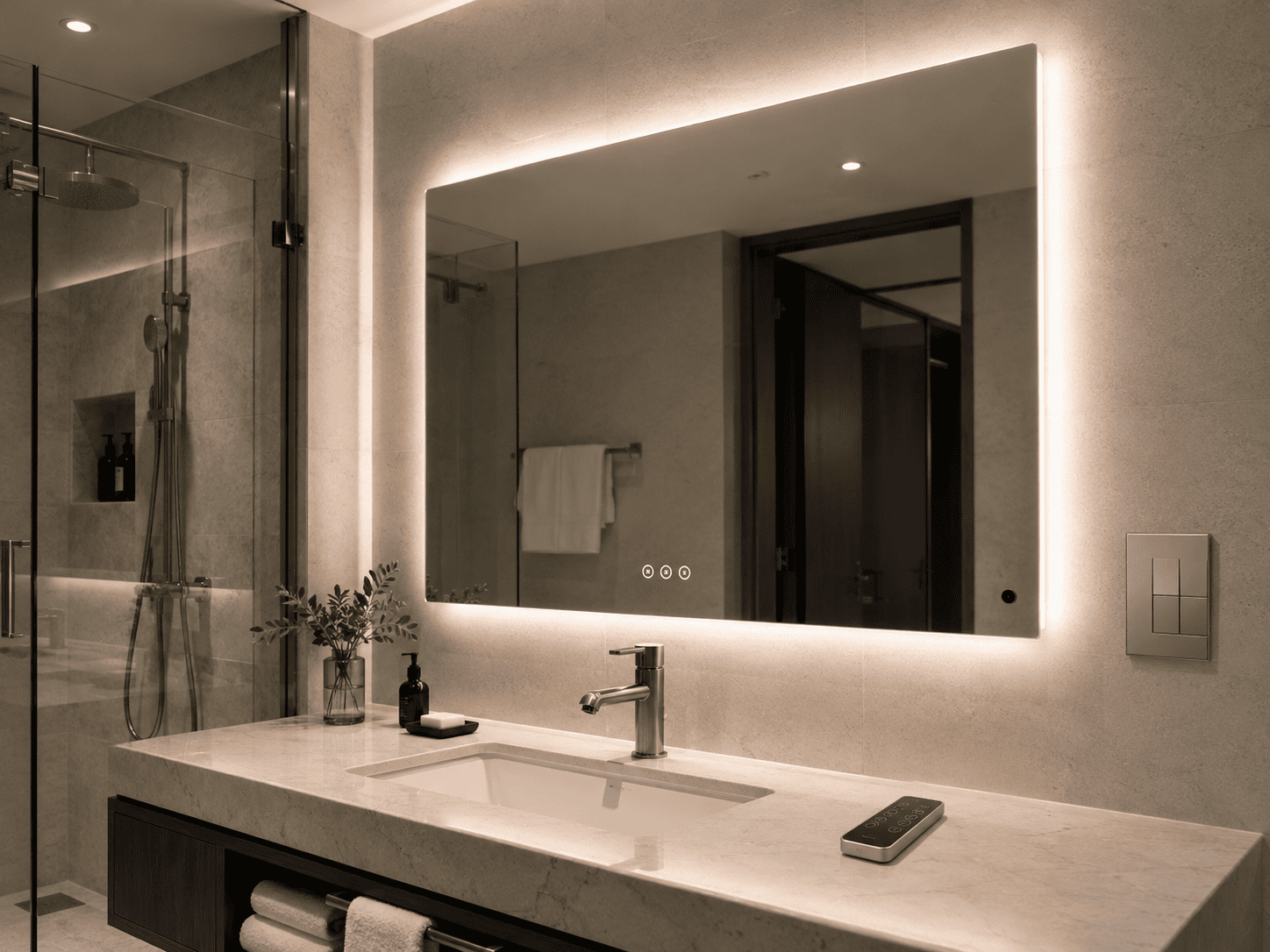
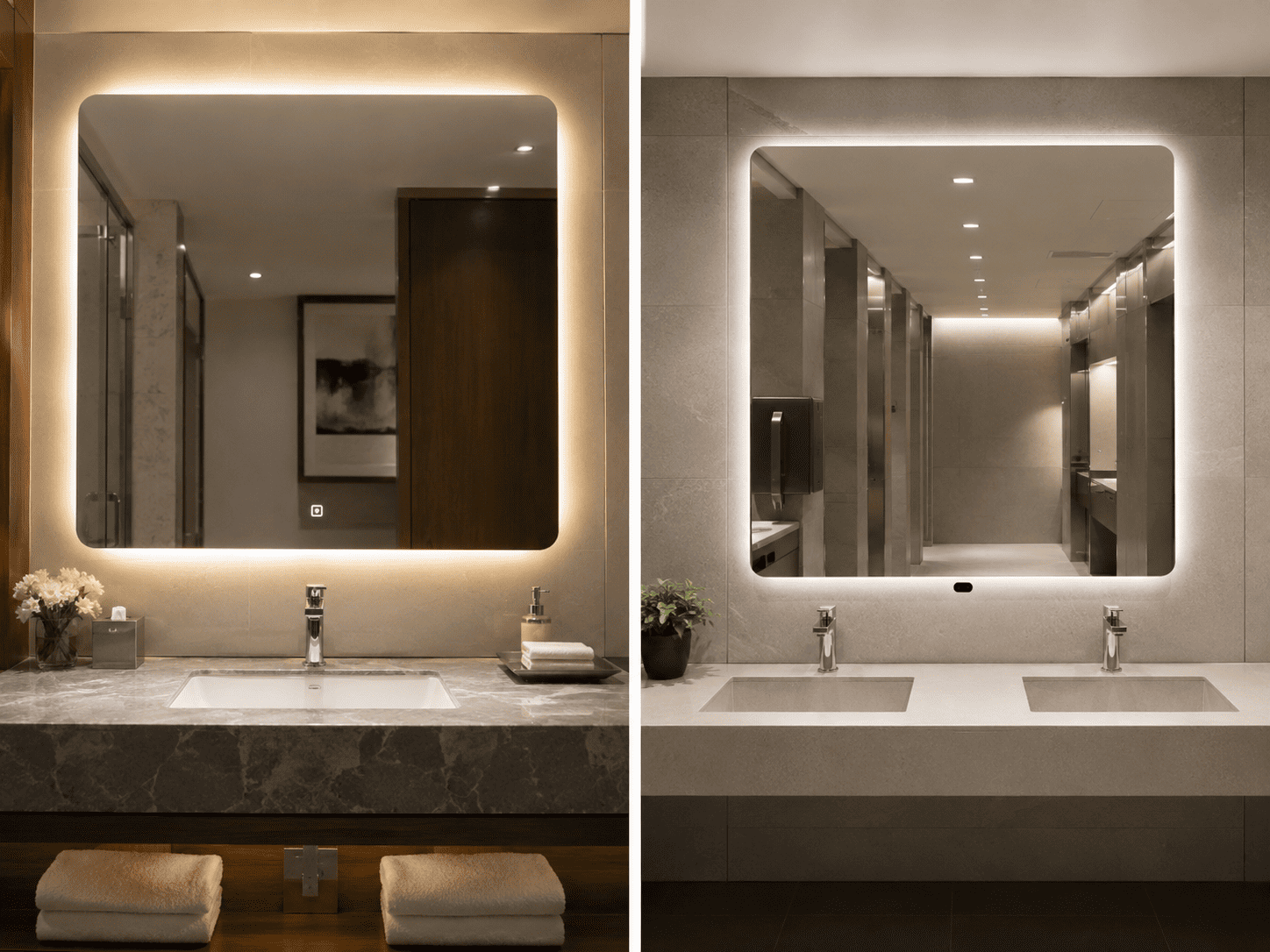
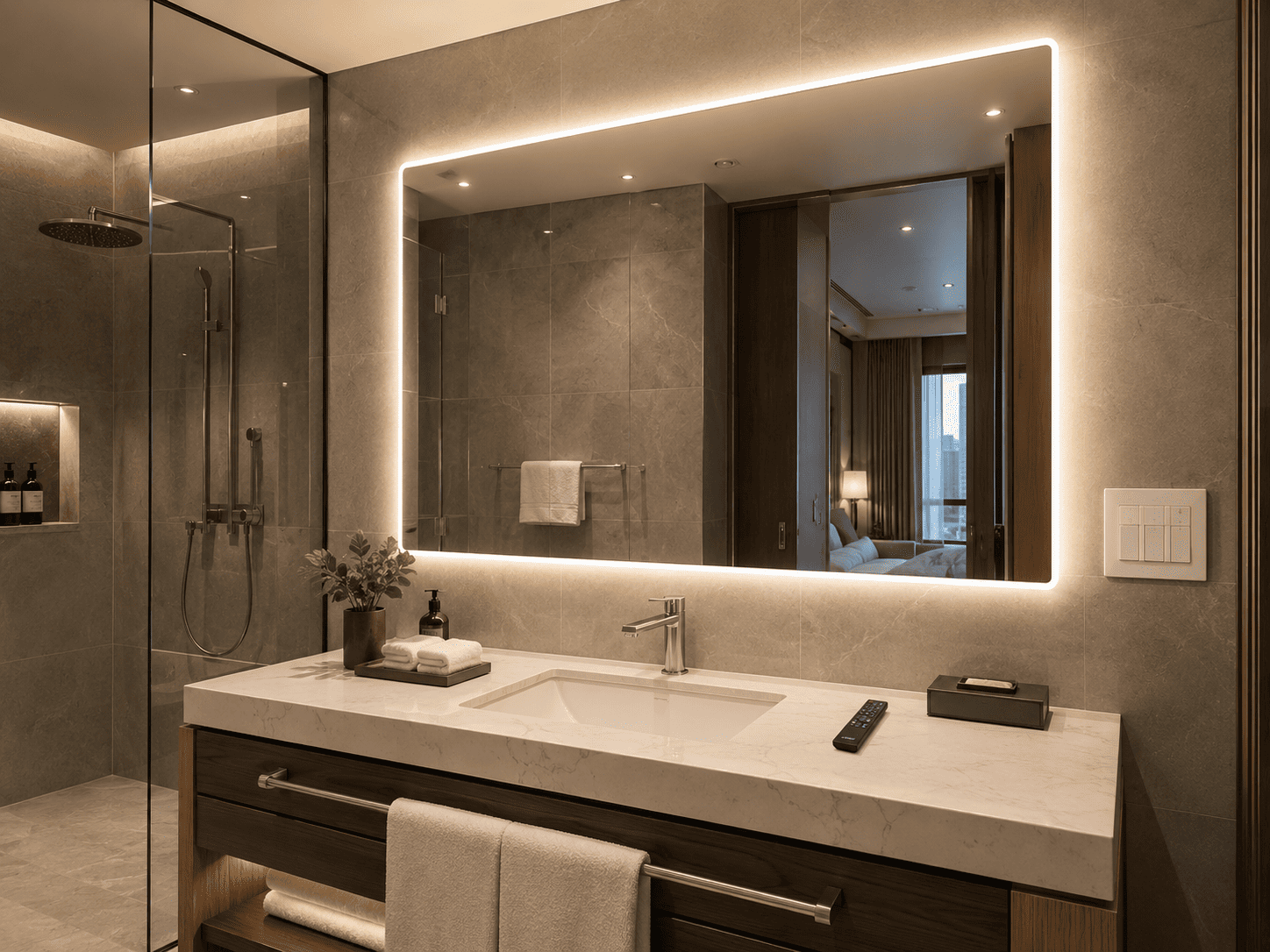
Bathroom mirror control configurations should be matched to the project type, user experience and maintenance plan.
Capacitive touch switch is the dominant OEM control method for hotel-grade illuminated mirrors. The mechanism is a flat capacitive sensor pad adhered to the back of the glass, connected to a dedicated touch controller PCB (common IC model: TTP223 or TSS02-3A). When a finger contacts the icon area on the mirror front, it alters the electrostatic field — the controller detects this delta, debounces the signal, and toggles the mirror's LED output. A typical touch controller drives three functions: on/off, CCT toggle (3000K warm to 6000K cool), and stepless dimming. The sensor itself is invisible from the front — only a printed icon (silk-screened or sandblasted onto the glass) marks the touch zone.
IR motion sensor (PIR) uses a passive infrared detector module — typically a D203S or RE200B PIR element paired with a Fresnel lens — mounted in a cutout on the mirror frame or glass edge. The sensor detects thermal radiation changes when a person moves within its field of view. Detection range is typically 30 to 80 cm with a 100–120° beam angle for mirror applications. When triggered, the controller activates the LED lighting and demister pad for a preset duration (factory-configurable, commonly 90 or 180 seconds). Unlike touch switches, there is no physical interaction — this eliminates fingerprint marks on decorative mirrors but requires careful sensor placement to avoid blind spots or false triggers from HVAC drafts.
RF remote control adds a 2.4GHz RF receiver module to the mirror controller PCB and a paired handheld transmitter. Common implementation uses Nordic nRF24L01 or similar chipset with a simple pairing protocol. The remote typically provides 4–7 function keys: on/off, brightness up/down, CCT select, stepless color temperature adjustment, and a demister toggle. The RF receiver is integrated into the mirror's internal junction box alongside the LED driver. Because the remote operates on 2.4GHz, it does not require line-of-sight — an advantage in bathrooms where the mirror might be positioned behind furniture or partial walls.
Wall switch (hardwired) is the simplest configuration: the mirror carries no onboard switch, and the LED lighting is controlled entirely by the wall switch circuit. The factory wires the mirror's LED driver directly to the terminal block — no touch controller, no sensor module, no receiver. This is the lowest-failure-rate option because it eliminates all active switching electronics inside the mirror. The trade-off is that dimming and CCT adjustment are unavailable unless the wall switch itself is a smart dimmer compatible with 12V/24V DC constant-voltage LED drivers.
Control technology comparison — component-level specifications:
Specification
Capacitive Touch
IR Motion Sensor
RF Remote
Wall Switch
Sensor type
Capacitive pad (TTP223/TSS02)
PIR element + Fresnel lens (D203S/RE200B)
2.4GHz RF receiver (nRF24L01)
None
User interaction
Finger touch on icon
Movement within 30–80 cm
Handheld remote button
Wall switch toggle
Mounting position
Glass back surface
Frame or glass edge cutout
Internal junction box
External — wall circuit
Functions supported
3 (on/off, CCT, dimming)
2 (on/off + demister auto-off)
5+ (full CCT/dimming/defog)
1 (on/off only)
IP rating factor
Sealed — no openings needed
Lens opening needs IP44 min. seal
Internal — no additional exposure
N/A — external fixture
Failure mode
Controller PCB fault
Lens fogging / PIR drift
RF pairing loss / battery wear
Switch or driver failure
Procurement Cost Comparison — What Each Control Adds to the BOM
From a factory Bill of Materials perspective, each control method adds a different incremental cost to the mirror assembly. The baseline unit is a standard illuminated mirror with a DC 12V/24V LED driver — before any control electronics are added.
Capacitive touch switch adds the lowest incremental BOM cost among active control methods. The component set is minimal: one touch controller PCB, one flat capacitive sensor pad, and one membrane cable for connection. No mechanical parts, no openings in the glass or frame. This is why touch switch is the default OEM configuration for mid-range and upper-mid hotel mirrors — the cost-to-function ratio is the most favorable in the industry.
IR motion sensor adds a moderate BOM increase. The additional components include the PIR detector module, a Fresnel lens housing, and a cutout in the aluminum frame or glass for sensor placement. The frame modification alone adds a machining step and potential yield loss. The sensor module itself is a commodity component, but the integration labor and IP-sealing process push the total incremental cost above a touch switch.
RF remote control adds the highest BOM cost among the four options. It requires two separate assemblies — the receiver PCB inside the mirror and a battery-powered handheld transmitter. The remote involves injection-molded housing, keypad membrane, coin cell battery, and FCC/CE certification for the transmitter as a standalone radio device. Per-unit cost is 2–3× that of a touch switch, making it suitable only for premium projects where the feature justifies the premium.
Wall switch (hardwired) adds zero incremental factory BOM cost — the mirror ships without any control electronics beyond the LED driver and terminal block. However, this shifts cost to the site installation phase: the electrical contractor must run a dedicated switch loop to the mirror location, which adds labor and material on site. For new construction this is marginal; for retrofit projects it can be substantial.
Relative BOM cost ranking (lowest to highest):
Control method
Relative BOM increase
Additional site cost
Wall switch
None (baseline)
Switch wiring labor on site
Capacitive touch
Low (+)
None
IR motion sensor
Medium (++)
None (plug-and-play)
RF remote
High (+++)
None (pairing on site)
A 50-room hotel ordering touch-switch mirrors versus sensor mirrors can see a meaningful difference in the total project mirror budget. For a 200-unit hotel tower, this gap scales further. Procurement teams should request factory quotes that separate the control option cost from the base mirror cost — this makes the BOM delta transparent and enables apples-to-apples comparison across suppliers.
Decision by Project Type — Which Control for Which Application
Control selection is not a universal preference — it is a project-type decision driven by guest experience requirements, maintenance tolerance, and budget.
Remote and wall-control options add flexibility when the mirror must be operated from a distance.
Five-star hotel guest bathroom: The optimal choice is capacitive touch switch. Guests encounter no learning curve — the printed icons (power, brightness, color temperature) are self-explanatory. Touch switches generate no audible clicks, operate silently, and require zero maintenance over a 5–7 year installation cycle. The absence of remote controls eliminates the guest-facing problem of lost or non-functional handsets. For luxury properties where the mirror aesthetic is a design statement, touch switches are invisible — no sensor cutout, no frame protrusion.
Hotel public area and corridor mirrors: IR motion sensor is the preferred solution. Hands-free activation is critical in high-traffic zones for hygiene and convenience. The sensor's auto-off timer (factory-set to 90–180 seconds) aligns with energy-conservation protocols in public restrooms and lobby areas. Maintenance staff never need to check whether a mirror was left on. The one consideration is that detection range must exceed the distance from the washbasin to the mirror — typically 40–60 cm — so sensor placement (center-bottom of frame or glass-edge) should be confirmed with the factory at the sample stage.
Premium villa and serviced apartment mirrors: RF remote control provides the flexibility that high-end residential end-users expect. A single remote controls all bathroom mirror functions — lighting, defogger, and brightness scene presets — from the bathtub or vanity. For master bathrooms where the mirror is positioned 1.5 m or more from the bathtub, remote control eliminates the inconvenience of walking to the mirror to adjust lighting. The trade-off is that remotes are a consumable item: batteries drain, water damage happens, and property management must stock spares. Procurement contracts for villa projects should stipulate remote replacement quantities and pricing.
Budget hotel and rental apartment mirrors: Wall switch (hardwired) is the most reliable and cost-efficient solution. There is nothing inside the mirror that can fail — no controller PCB, no sensor, no receiver. The mirror's service life is governed entirely by the LED driver MTBF (typically 30,000–50,000 hours with a quality constant-voltage driver). For operators managing hundreds of keys with a lean maintenance team, the lowest-failure-rate option is the correct one.
Project type → control recommendation matrix:
Project type
Recommended control
Primary reason
5-star hotel guest room
Capacitive touch
Guest-intuitive, silent, invisible
Hotel public area / corridor
IR motion sensor
Hands-free hygiene, auto-off energy saving
Premium villa / serviced apartment
RF remote
Full-function control from distance
Budget hotel / rental apartment
Wall switch
Minimum failure points, lowest cost
OEM / white-label order
Touch (standard), sensor (option)
Market-proven, certification-ready
Humidity, Temperature, and Sensor Reliability in Middle East Climates
Climate conditions in the UAE, Saudi Arabia, Qatar, and the broader GCC region exert specific stress on LED mirror control electronics. Two environmental factors affect different control technologies in different ways: sustained high humidity inside bathrooms and ambient temperature exceeding 35°C.
Capacitive touch switches and humidity: Capacitive sensing relies on detecting a change in the electrostatic field when a finger contacts the mirror surface. Condensation — common in bathrooms where hot showers meet air-conditioned interiors — deposits a thin water film on the glass surface, which has a dielectric constant significantly different from air. This film can mimic a touch event, leading to false triggers where the mirror turns on or changes settings without user input.
The root cause is not the touch controller IC itself but the sensor pad's inability to discriminate between a localized finger touch and a distributed water film. Factory-level mitigation includes applying a hydrophobic nano-coating to the touch sensor area and tuning the controller firmware's debounce threshold to reject slow-ramp capacitance changes characteristic of condensation. For procurement specifications targeting GCC hotel projects, buyers should ask the factory whether their touch controllers include moisture-rejection firmware and whether the sensor area has been validated in 85% RH environments.
IR motion sensors and high temperature: Passive infrared sensors detect the thermal contrast between a moving human body (approximately 36°C) and the background environment. In bathrooms where ambient temperature exceeds 35°C — common in Middle East summer months — this thermal contrast narrows significantly. PIR sensor sensitivity drops as the background temperature approaches body temperature, because the sensor element (pyroelectric crystal) generates a weaker voltage differential. A sensor rated for 80 cm detection at 25°C may only trigger reliably at 40–50 cm in a 37°C bathroom.
This is not a sensor defect — it is a physical characteristic of pyroelectric detection. The practical implication for hotel procurement is that bathroom sensor mirrors in Middle East installations should specify extended-range PIR modules (rated for up to 100 cm at 25°C to maintain usable range at higher temperatures) and positioned to maximize thermal differential — ideally aimed at the entrance door where body-to-background contrast is strongest.
IP rating requirements for mirror control electronics: The mirror's control components — whether touch PCB, PIR module, or RF receiver — are housed inside the mirror frame or rear enclosure, not exposed to direct water spray. However, bathroom humidity still penetrates through seals and cable entries over time. A minimum of IP44 (splash-proof) for the controller enclosure is recommended; for mirrors installed within 60 cm of a shower enclosure or bathtub, IP65 (dust-tight, protected against water jets) is strongly recommended.
RATO factory's standard mirror controllers are configured with sealed touch sensor pads and sensor windows using O-ring gaskets appropriate for IP44 environments. For IP65-grade requirements, additional grommet-sealed cable entries and conformally coated PCBs are available on project order — confirm during the sample approval stage.
Certification and Compliance for Controller Electronics
LED mirror controllers fall under safety extra-low voltage (SELV) regulations in most target markets, which simplifies compliance compared to mains-voltage appliances. However, project buyers must understand which certifications apply and which must be confirmed with the supplier.
All RATO LED mirror controllers operate at DC 12V or 24V — supplied by an external constant-voltage LED driver that performs the AC-to-DC conversion. Because the mirror-side controller never handles mains voltage directly, its regulatory classification is SELV, which exempts it from certain high-voltage safety tests but does not exempt it from electromagnetic compatibility (EMC) requirements.
CE marking (EU and Middle East): For hotel projects in the UAE and GCC — which generally accept CE marking as a reference standard — the controller assembly must comply with the EMC Directive (2014/30/EU) for radiated and conducted emissions, and the Low Voltage Directive (2014/35/EU) for safety. The LED driver (the AC-connected component) bears the heavier compliance burden; the mirror-side controller typically requires only EMC verification. When sourcing mirrors for a Dubai or Abu Dhabi hotel project, request the Declaration of Conformity (DoC) for the complete mirror assembly, not just the LED driver.
SAA (Australia): Australian project specifications require the LED driver to carry SAA approval. The mirror controller, as a SELV device, does not require independent SAA certification, but the complete mirror must comply with AS/NZS 60598.2.1 for luminaires. Buyers should confirm with the factory that the driver used is SAA-listed.
CCC (China domestic): For hotel projects within mainland China, the LED driver must carry CCC certification. The mirror controller itself, operating at SELV levels, is outside CCC's compulsory scope. However, the mirror as a complete product must meet GB 7000.201 for fixed general purpose luminaires.
Certification summary by market:
Market
Driver certification required
Controller requirement
Standard reference
EU / GCC (CE)
CE (EMC + LVD)
CE (EMC only)
EN 60598-2-1
Australia (SAA)
SAA listed driver
AS/NZS 60598.2.1 compliant
AS/NZS 60598.2.1
China (CCC)
CCC certified driver
GB 7000.201 compliant
GB 7000.201
North America (UL/ETL)
UL/ETL listed driver
UL 2108 / CSA C22.2
UL 2108
Factory certifications should be verified for the specific mirror model and control configuration being quoted. A supplier holding CE for a touch-switch mirror does not automatically mean the RF remote variant is CE-compliant — the transmitter introduces a radio device that requires separate ETSI EN 300 328 assessment. Always confirm certification scope with the supplier by model number.
OEM Buyer Considerations — Specifying Controls for Custom Orders
When placing an OEM order, the mirror control configuration is one of the few design elements that changes the product's electrical architecture. Buyers should define four parameters in the purchase specification to avoid post-production disputes.
Parameter 1 — Controller function set: Specify exactly which functions the end-user can control. A three-function touch switch (on/off, CCT select, stepless dimming) requires a different controller PCB than a single-function on/off switch. Adding anti-fog (demister pad) control to a touch switch requires an additional relay output on the controller — this must be specified at the design stage, not retrofitted.
Parameter 2 — Sensor placement and detection range: For IR sensor mirrors, define where on the mirror the sensor sits and the required detection range. Bottom-center frame placement is standard; side-edge placement is possible but changes the detection zone geometry. Detection range must be verified against the intended installation scenario — a sink 50 cm away is different from a double vanity at 80 cm.
Parameter 3 — IP rating of controller enclosure: Define the minimum IP rating required for the controller housing. IP44 suffices for most hotel bathrooms; IP65 is needed for mirrors near wet zones. This affects the mirror's frame sealing design — it is not a trivial factory adjustment.
Parameter 4 — Certification requirements: List the target market certifications explicitly in the PO or technical specification sheet. Do not assume the factory will provide the correct certification by default. A mirror ordered for a Dubai hotel and one ordered for a Sydney hotel may share the same physical assembly but require different documentation packages.
Conclusion — Matching Control Technology to Project Requirements
Selecting an LED mirror control technology is fundamentally a procurement decision, not a design preference. Each technology maps to a specific use case, cost envelope, and maintenance profile:
Capacitive touch — the standard for guest bathrooms where intuitive operation and clean aesthetics matter
IR motion sensor — the solution for public and commercial spaces where hands-free hygiene and energy conservation drive the specification
RF remote — the premium option for residential and villa projects where full-function remote access adds genuine value
Wall switch — the no-failure-points baseline for budget-conscious, high-volume deployments
Factory review should confirm control components, wiring, service access and the target installation environment.
The key to a successful specification is to define the operating environment first — humidity levels, ambient temperature range, user profile — and then select the control technology that performs reliably under those conditions. A control method that works perfectly in a London hotel lobby may underperform in a Dubai beach resort bathroom. RATO's engineering team can provide application-specific guidance, including sensor placement recommendations and IP-rated enclosure options, from the sample stage onward.
For hotel project buyers and OEM procurement managers, the recommended next step is to request mirror samples with the intended control configuration and test them under representative conditions — this confirms sensor range, touch responsiveness, and remote pairing behavior before a single unit ships from the factory.
B2B Project Inquiry
Talk to our project team about your mirror specification.
Send drawings, BOQ, mirror sizes, target quantity, voltage, lighting preference, packaging needs and destination market. Specifications are confirmed according to the selected model and project requirements.