CCT Guide for LED Bathroom Mirrors: 3000K vs 4000K vs 6000K
A B2B guide to LED mirror CCT: compare 3000K warm white, 4000K neutral white, and 6000K cool daylight. Learn which color temperature hotel buyers and contractors should specify for guest bathrooms, commercial projects, and salon installations.
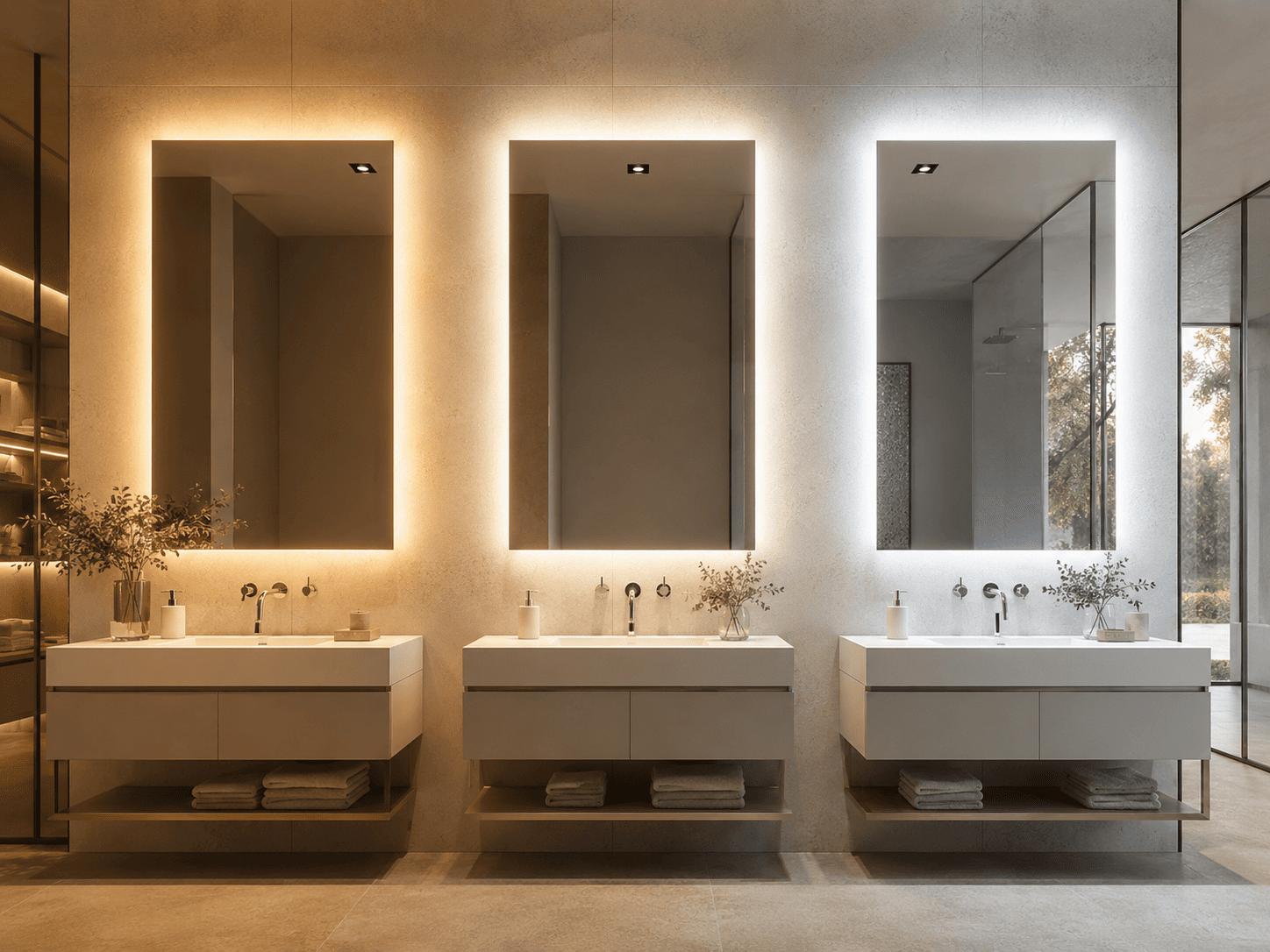
LED bathroom mirror CCT determines the visual warmth or coolness of the light. 3000K delivers warm white — the hospitality standard for guest bathrooms. 4000K provides neutral white suited to task-oriented grooming. 6000K supplies cool daylight for salons and commercial applications where color-matching precision matters. The specification you choose directly impacts guest satisfaction, project compliance, and long-term maintenance costs — so procurement teams should lock CCT in the BOM before production, not after.
What Is CCT (Correlated Color Temperature) in LED Mirror Lighting?
CCT, or Correlated Color Temperature, measures the hue of light an LED emits — expressed in Kelvin (K). Lower values (2700K–3000K) appear warm/yellow; mid-range (4000K) reads neutral white; higher values (5000K–6500K) cast a blue-tinted daylight. It is the single most-often-specified parameter in LED mirror RFQs after physical dimensions.
CCT is not a measure of brightness — that's lumens. Nor is it a measure of heat — that's the thermal management of the LED driver. It describes the colour appearance of the light source itself.
In the factory, CCT is verified using an integrating sphere spectrometer. Reputable manufacturers test each production batch against a target CCT ± tolerance band. A mirror advertised as "3000K" typically has an actual CCT tolerance of ±150K, meaning the delivered product falls between 2850K and 3150K. For critical hotel projects, this tolerance should be written into the QA inspection criteria.
The LED strips used in bathroom mirrors are built from SMD chips — most commonly SMD 2835 or SMD 5050 — with phosphor coating ratios that determine the final CCT output. These strips run on a constant-current LED driver, typically hidden behind the mirror glass or integrated into the junction box. When specifying a mirror, confirm that the driver is matched to the full load of the LED array at the target CCT; a mismatched driver causes flicker and premature CCT drift.
Procurement takeaway: Always request a photometric test report with your pre-production sample to verify actual CCT output against the specification sheet.
3000K — Warm White for Hospitality Comfort
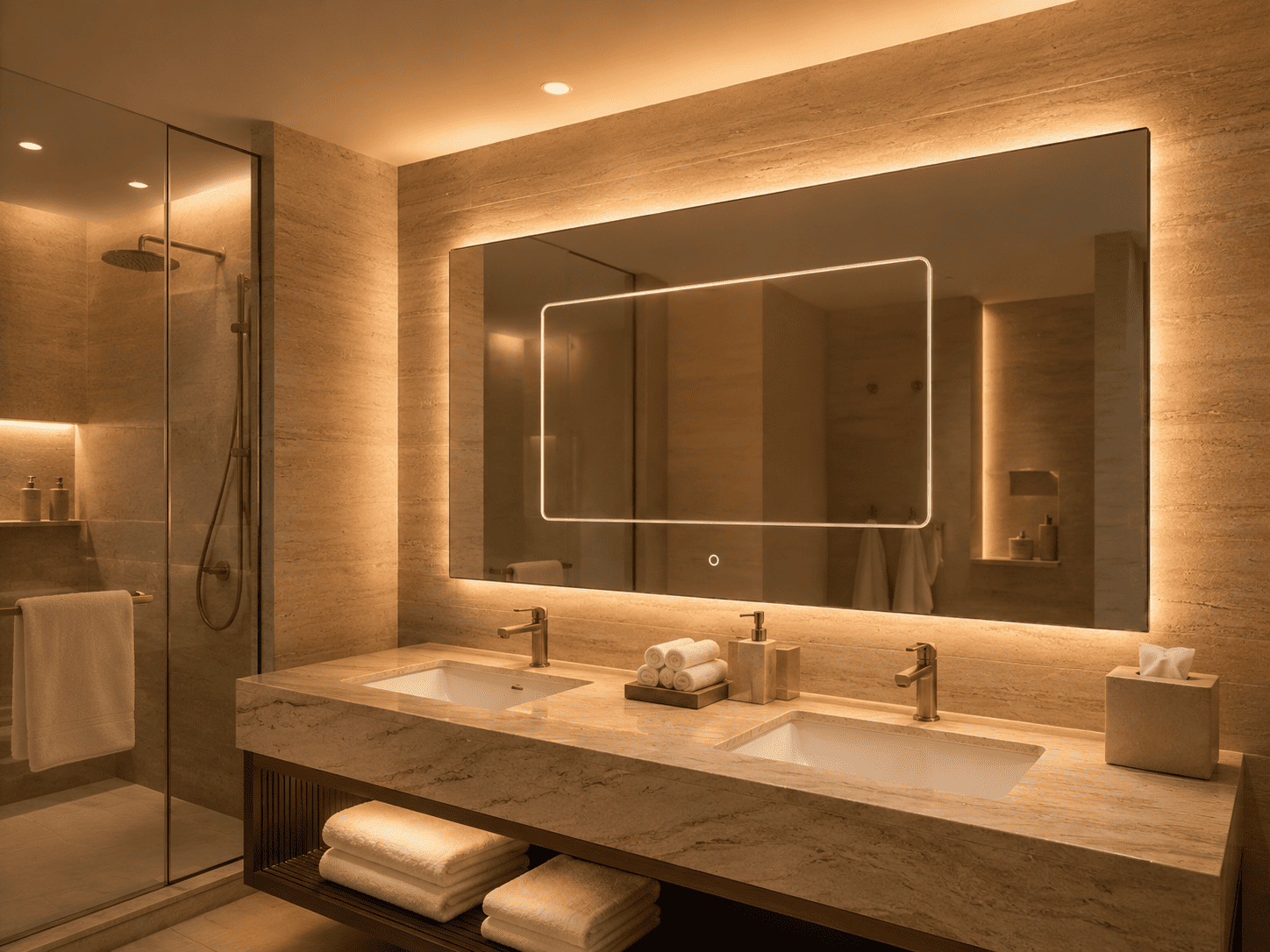
3000K warm white is the default specification for hotel guest bathrooms because it produces a soft, amber-toned glow that feels residential rather than institutional. It masks uneven skin tones, reduces glare on polished stone surfaces, and photographs well — all factors that influence guest review scores.
Most full-service hotel chains and branded properties specify 3000K for guest bathroom vanity lighting. The reasoning is straightforward: after a long flight or a business meeting, guests want a bathroom that feels like a spa, not a surgical suite.
Engineering considerations for 3000K mirrors:
CRI pairing is critical. At 3000K, even a modest CRI 80+ strip can appear flat or muddy on skin tones. Specifying CRI 90+ eliminates this — RATO strongly recommends CRI 90+ for any hotel-grade 3000K mirror order.
Lumen output compensation. 3000K LEDs inherently produce slightly fewer lumens per watt than 4000K or 6000K strips. If your project requires a specific illuminance level at the vanity surface, factor in a ~5–7% lumen penalty at 3000K compared to the same LED density at 4000K.
IP rating. Hotel bathrooms in UAE and Australian markets commonly require IP44-rated mirrors due to proximity to shower enclosures. 3000K LED strips inside an IP44-rated mirror housing are standard at RATO.
Why do premium hotels always choose 3000K over 4000K? Because 3000K aligns with hospitality lighting psychology: warm light triggers relaxation responses, softens harsh architectural lines, and creates the "escape" feeling that justifies a premium room rate. A 4000K guest bathroom reads as corporate, functional, and budget-conscious — exactly the opposite of what a luxury property wants to communicate.
Procurement takeaway: If your project spec doesn't explicitly designate a CCT, default to 3000K for any guest-facing bathroom. It reduces the risk of post-installation complaints from hotel operators who expected warm lighting.
4000K — Neutral White for Task-Oriented Spaces
4000K neutral white sits between the warmth of 3000K and the clinical coolness of 6000K. It is best suited for public area bathrooms in commercial buildings, employee washrooms, gym changing rooms, and co-living facilities — spaces where accurate visibility takes priority over ambient comfort.
A 4000K mirror produces a clean, neutral light that neither adds nor subtracts colour warmth. This makes it the preferred option when the mirror serves a functional purpose first: shaving, makeup application, contact lens handling, or inspection of clothing in a dressing room.
Bright enough for grooming post-workout without feeling harsh.
Serviced apartment bathrooms
Conditional
Only if the property is positioned as functional rather than luxury.
Hospital staff bathrooms
Strong fit
Clinical neutrality without the harshness of 6000K.
Residential ensuite
Avoid
Usually too cold for a personal bathroom setting.
Procurement tip: When you specify 4000K, the factory will likely offer a standard CRI 80+ LED strip as the baseline. For any application involving makeup or colour judgment, upgrade to CRI 90+ to avoid colour rendering complaints. The per-unit cost increase is marginal at volume.
6000K — Cool Daylight for Commercial & Salon Use
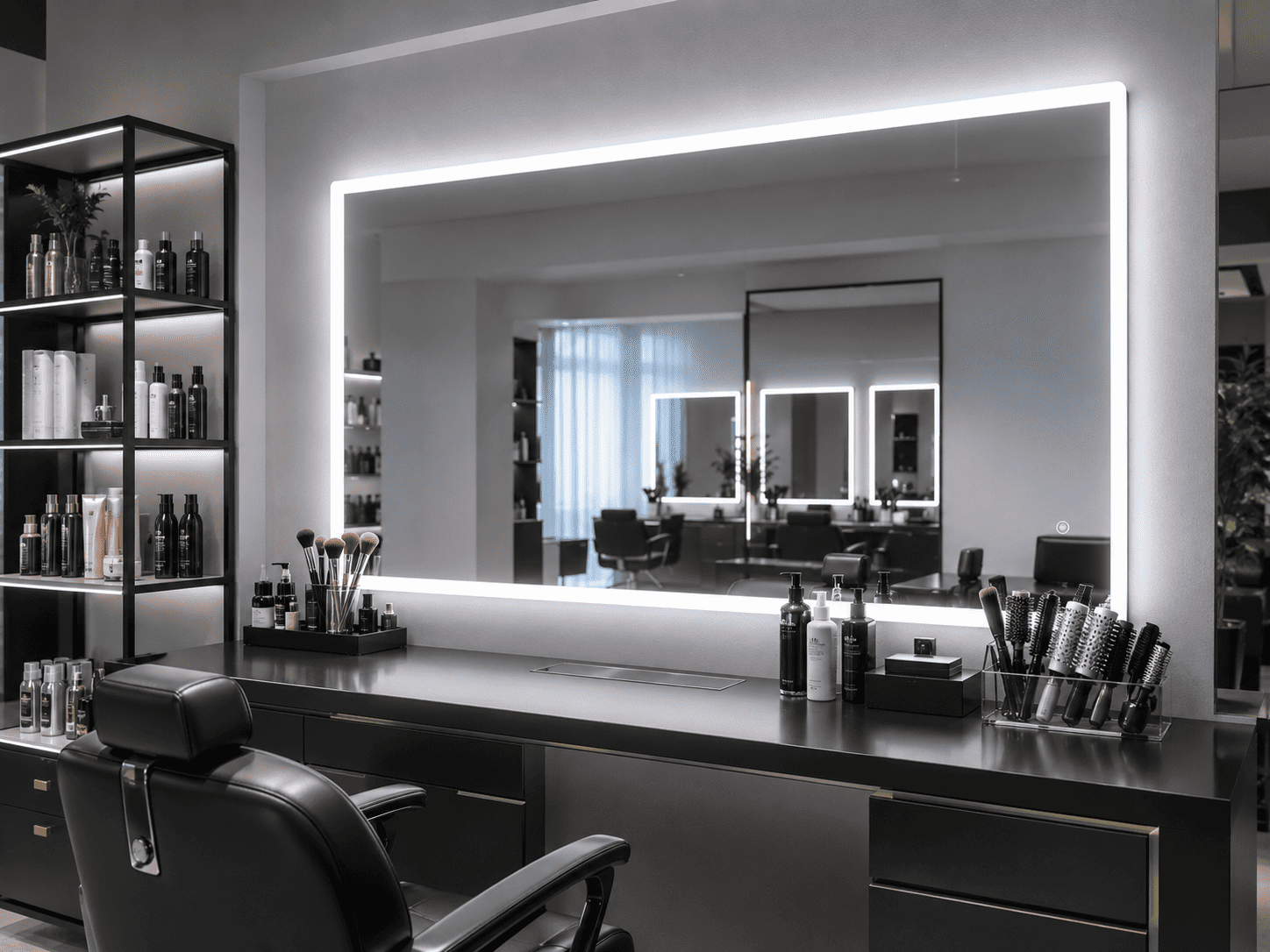
6000K cool daylight replicates midday natural light, producing a bluish-white cast with maximum visual acuity. This CCT is the industry standard for professional salon mirrors, cosmetic clinic lighting, dental practice mirrors, and commercial retail fitting rooms where colour fidelity under daylight conditions is non-negotiable.
Salon owners and cosmetic professionals specifically request 6000K because it exposes every detail — hair colour gradation, skin imperfections, makeup blending edge — under light that matches outdoor conditions.
Key 6000K specification notes:
High glare risk. 6000K LED strips at full brightness can produce significant glare, especially on polished mirror surfaces. Pair 6000K mirrors with a dimmable LED driver (trailing-edge dimming, 220V/50Hz compatible).
CRI matters more at 6000K. A low-CRI 6000K strip will produce a ghostly, unnatural light. Specify CRI 90+ minimum.
Colour binning consistency. At 6000K, even small deviations between LED chips become visible. Request single-bin LED sourcing from the factory.
Which CCT Should Hotels Specify for Guest Bathrooms?
For hotel guest bathrooms, 3000K is the industry standard. This is not a design preference — it is embedded in hospitality brand guidelines across the mid-scale and luxury segments.
If your project serves dual purposes — a guest bathroom that also functions as a makeup vanity — consider specifying tunable white mirrors that allow adjustable CCT switching. This is increasingly common in upper-upscale properties where the same bathroom must serve both evening relaxation and morning grooming.
For public restrooms in hotel lobbies, gyms, and pool areas, 4000K is a practical compromise: enough warmth to feel pleasant, enough clarity for functional use.
CCT and CRI are independent specifications — one does not compensate for the other. A 3000K strip with CRI 80 will produce warm light that still makes skin look washed out. A 6000K strip with CRI 70 will produce cold, ghostly illumination.
In factory reality, CRI 90+ at 3000K is harder to achieve than CRI 90+ at 4000K — the warmer phosphor mix has inherently narrower spectral coverage. Confirm with your supplier that they can deliver CRI 90+ at your chosen CCT before moving to production.
When reviewing sample approval reports:
Confirm the CCT reading falls within ±150K of target.
Confirm the CRI reading is ≥ 90, or ≥ 80 if that is the project specification.
Check the R9 value (deep red rendering). A value below 0 indicates poor red rendering.
Request a sample review across at least 5 units to verify production consistency.
Can CCT Be Adjusted? Understanding Tunable White LED Mirrors
Tunable white LED mirrors allow the user to adjust CCT within a range — typically 3000K to 6000K (or 2700K to 6500K on premium models). These use dual-strip LED arrays (warm + cool) with independent dimming channels controlled by a touch sensor or remote.
When to specify tunable white:
High-end hotel suites where the bathroom serves both evening and morning functions
Multi-use commercial spaces (salon studios that also host photography)
Showroom environments where the same mirror needs to demonstrate different lighting effects
Caution: Tunable white adds 15–25% to the LED driver cost and increases the failure point count. For standard hotel projects where CCT is fixed by brand guidelines, a single-CCT mirror is more reliable and cost-effective.
How to Communicate CCT Requirements to Your Factory
When sending an RFQ to a Chinese LED mirror factory like RATO, include the following CCT-related specifications:
Target CCT value (for example, 3000K ± 150K).
CRI requirement (for example, CRI ≥ 90, R9 ≥ 0).
LED brand / grade preference (for example, Epistar, Sanan, or Lumileds — higher-grade chips deliver tighter colour consistency).
Dimmable or non-dimmable (if dimmable, specify trailing-edge 220V compatibility).
IP rating (for example, IP44 if installed near shower enclosures).
Single-bin requirement so all LEDs come from the same bin and avoid colour mismatch.
Photometric test report request for the pre-production sample and first article inspection.
A detailed specification sheet prevents the most common factory communication failure: "we assumed 4000K was fine for your application because that's what our standard stock runs at." Flag your CCT requirement in writing in the initial RFQ.
FAQ
What CCT do most hotels use for bathroom mirrors?
Most full-service hotels specify 3000K warm white for guest bathrooms. This CCT creates a comfortable, residential feel that aligns with hospitality design standards. Budget properties may use 4000K as a compromise between ambiance and task visibility.
Is 6000K too harsh for a bathroom mirror?
6000K cool daylight can feel clinical in a residential or hotel bathroom. It is more appropriate for salon mirrors, commercial changing rooms, or medical facility applications where color accuracy under daylight-matching light is critical.
Can I get a mirror with adjustable CCT?
Yes — tunable white LED mirrors support adjustable CCT, typically ranging from 3000K to 6000K (or 2700K to 6500K). These are increasingly specified in high-end hotel projects and multi-use commercial spaces where the same mirror serves different lighting needs throughout the day.
Need help specifying the right CCT for your next project? Contact the RATO team for sample-matching and photometric test reports before production.
FAQs
What CCT do most hotels use for bathroom mirrors?
Most full-service hotels specify 3000K warm white for guest bathrooms. This CCT creates a comfortable, residential feel that aligns with hospitality design standards.
Is 6000K too harsh for a bathroom mirror?
6000K cool daylight can feel clinical in a residential or hotel bathroom. It is more appropriate for salon mirrors or medical facilities where color accuracy under daylight-matching light is critical.
Can I get a mirror with adjustable CCT?
Yes — tunable white LED mirrors support adjustable CCT, typically ranging from 3000K to 6000K. These are increasingly specified in high-end hotel projects and multi-use commercial spaces.
B2B Project Inquiry
Talk to our project team about your mirror specification.
Send drawings, BOQ, mirror sizes, target quantity, voltage, lighting preference, packaging needs and destination market. Specifications are confirmed according to the selected model and project requirements.