LED Driver Types for Bathroom Mirrors: A Complete Technical Guide
A technical guide to constant current and constant voltage LED drivers for bathroom mirrors, covering dimming protocols, IP ratings, driver sizing and failure prevention for hotel and project supply.
Understanding LED Driver Basics for Bathroom Mirrors
An LED driver converts mains AC power (110-240V) into the low-voltage DC current that LEDs require to operate. Without a properly matched driver, LED modules either fail to light, flicker, or degrade rapidly. In bathroom mirrors, the driver does double duty: it must deliver clean, stable power and survive a high-humidity environment where condensation is a daily reality.
LEDs are current-driven semiconductors. Unlike incandescent bulbs that tolerate wide voltage swings, an LED's brightness and lifespan depend on precise electrical input. A 24VDC LED strip without a driver would be destroyed within milliseconds if connected directly to 230V mains. The driver steps voltage down, rectifies AC to DC, and — depending on type — either regulates current or maintains steady voltage.
In factory reality, the driver is the most common point of failure in LED mirrors. When a mirror stops lighting on one side or develops a flicker after 12 months in a hotel bathroom, the root cause is almost always a failed or mismatched driver, not the LED strip itself.
PAA: Do all LED bathroom mirrors use the same type of driver? No. The driver type depends on the LED configuration inside the mirror. Mirrors using LED strip lighting (the majority of backlit and edge-lit designs) require constant voltage drivers, typically 12VDC or 24VDC. Mirrors with integrated high-power LED modules may need constant current drivers. Always confirm with the mirror manufacturer before ordering replacement drivers or specifying for a new project.
Constant Current vs. Constant Voltage LED Drivers
The fundamental decision in driver selection comes down to how your LED mirror's light source is wired: in series (constant current) or in parallel with current-limiting components (constant voltage). Getting this wrong doesn't just mean dim output — it can destroy LEDs and create safety hazards on site.
Constant Current (CC) Drivers
Constant current drivers deliver a fixed output current — typically 350mA, 700mA, or 1050mA — while allowing output voltage to vary within a defined range (e.g., 9-42VDC). The driver actively adjusts voltage to maintain the target current regardless of LED temperature or forward voltage drift.
In LED mirrors, constant current drivers appear most often in designs using discrete high-power LEDs wired in series, such as certain smart mirrors with individual COB (Chip-on-Board) LED modules. These configurations benefit from CC drivers because each LED receives identical current, producing uniform brightness across the entire mirror surface.
Advantages for bathroom mirror applications:
Thermal runaway prevention — as LEDs heat up, their forward voltage drops, which would cause a constant voltage driver to deliver more current, accelerating failure. A CC driver compensates by reducing voltage.
Consistent brightness across series-wired LEDs
Cleaner dimming at very low levels (below 5%) when using compatible dimming protocols
Trade-offs:
If one LED in a series string fails open-circuit, the entire string goes dark
Not suitable for LED strip lights, which are the most common illumination method in bathroom mirrors
Generally higher cost per watt than equivalent CV drivers
Constant Voltage (CV) Drivers
Constant voltage LED drivers maintain a fixed output — most commonly 12VDC or 24VDC — and the LEDs (or LED strips) regulate their own current draw through built-in current-limiting resistors or on-board regulation ICs.
This is the driver type behind the vast majority of bathroom LED mirrors. LED strips used in backlit and edge-lit mirror designs are manufactured for 12V or 24V operation, with current limiting built into the strip's flexible PCB. The driver's job is simply to deliver clean, stable voltage at sufficient wattage.
Advantages for bathroom mirror applications:
Simpler wiring and component matching — if the strip says 24VDC, you feed it 24VDC
Lower cost, widely available in compact form factors suitable for behind-mirror mounting
Easy to replace — maintenance teams can swap without specialized electrical knowledge
Compatible with parallel wiring, so one failed LED segment doesn't take down the entire mirror
Trade-offs:
LED strips must have proper current-limiting design; cheap strips without adequate regulation can draw excess current and fail early
Slightly less efficient than well-matched CC systems at high wattages
Direct Comparison Table
Feature
Constant Current (CC)
Constant Voltage (CV)
Regulates
Current (fixed mA/A)
Voltage (fixed 12/24VDC)
Typical bathroom mirror use
Integrated COB/high-power LED modules
LED strip lighting (backlit/edge-lit)
Brightness uniformity
Excellent across series-wired LEDs
Good when strips have quality regulation ICs
Failure mode
One LED failure = entire string dark
Single segment failure = local dark spot only
Relative cost
Higher
Lower
Maintenance complexity
Requires exact current-matched replacement
Standard 12V/24V driver, widely available
Most common in
Smart mirrors, commercial display mirrors
Hotel bathroom mirrors, residential vanity mirrors
Procurement takeaway: For standard hotel bathroom mirror projects, specify 24VDC constant voltage drivers unless the mirror design explicitly calls for constant current. 24V is preferred over 12V for longer LED runs because it halves current draw, reducing voltage drop and allowing thinner cabling between driver and LED strip.
Dimming Protocols: TRIAC, 0-10V, and DALI Explained
Adding dimming to an LED bathroom mirror isn't just a matter of adding a dimmer switch. The driver, the dimmer, and the control wiring must all speak the same protocol. Mismatched dimming is the #1 post-installation complaint that project managers report from hotel fit-outs.
TRIAC / Phase-Cut Dimming
TRIAC (leading-edge) and ELV (trailing-edge) dimmers work by chopping portions of the AC waveform before it reaches the driver. The driver interprets this chopped signal and adjusts LED output accordingly.
For bathroom mirrors, TRIAC is the simplest option — it uses existing wiring with no additional control cables. It's appropriate for standalone mirrors in guest bathrooms where the mirror dims independently from a local wall switch.
However, TRIAC compatibility between dimmer brands and LED drivers is notoriously inconsistent. A Lutron dimmer that works perfectly with one driver model may cause visible flicker with another. Procurement teams should request a tested dimmer-driver compatibility list from the mirror manufacturer, not rely on generic "TRIAC dimmable" claims.
Typical dimming range: 10-100%. Below 10%, most TRIAC setups show flicker or drop out entirely.
0-10V Analog Dimming
0-10V is the workhorse of commercial lighting control. It uses a dedicated pair of low-voltage control wires (typically purple and grey, per ANSI C137.1) carrying a 0-10VDC analog signal. 10V commands full brightness, 1V commands minimum, 0V typically switches off.
For hotel projects with centralized lighting control panels, 0-10V is often the default choice. It offers smooth, flicker-free dimming from 0.1-100% and is broadly compatible across fixture brands — the protocol is standardized, not proprietary.
The wiring requirement is the main consideration: each mirror location needs two additional conductors run back to the control panel. This must be planned during electrical rough-in. Retrofitting 0-10V into an existing bathroom without control wiring is effectively impossible without surface-mount conduit.
DALI (Digital Addressable Lighting Interface)
DALI is a bi-directional digital protocol (IEC 62386) designed specifically for lighting. Each DALI driver has a unique address, allowing individual control, grouping into scenes, and real-time fault reporting — a driver can tell the building management system that it's overheating or that an LED string has failed.
This is the protocol for premium, large-scale hospitality. A 300-room hotel with a BMS can address each bathroom mirror individually: set all to 30% during overnight hours, bring VIP suites to 100% ahead of check-in, and receive automated alerts when a driver fails.
DALI requires a dedicated two-wire bus (polarity-free), DALI-compatible drivers, and a DALI controller or gateway. Commissioning involves software configuration. Installation cost is higher, but the operational savings from remote monitoring and fault detection can offset this in properties with more than 100 rooms.
Dimming Protocol Comparison
Protocol
Control wiring
Dimming range
Best for
Relative cost
TRIAC/Phase-cut
None (uses mains wiring)
10-100%
Standalone mirrors, retrofits
Low
0-10V
2 additional conductors
0.1-100%
Mid-scale hotels, commercial bathrooms
Medium
DALI
Dedicated 2-wire bus
0.1-100%
Large hotels with BMS, premium properties
High
PAA: Can I use a non-dimmable driver with a dimmer switch? No. A non-dimmable LED driver connected to a dimmer will either not respond at all, flicker violently, or suffer permanent damage to its internal components. The driver must explicitly state compatibility with the specific dimming protocol being used. Installing a dimmable driver but forgetting to wire the control signal (in 0-10V or DALI setups) typically results in the mirror staying at maximum brightness regardless of dimmer position.
IP Ratings and Electrical Safety for Humid Environments
A driver in a bathroom faces conditions that a driver in a living room never sees: sustained 80-95% humidity, rapid temperature swings from hot showers, and potential direct water contact. IP rating isn't a marketing checkbox — it's a safety requirement defined by international standards that procurement teams must verify.
Bathroom electrical zones, defined by IEC 60364-7-701 (adopted in most markets as local wiring regulations), dictate minimum protection levels:
Zone 0 (inside bath/shower basin): IP67 minimum, SELV 12V maximum. LED mirror drivers should never be installed in this zone.
Zone 1 (above bath/shower, up to 2.25m height): IP65 recommended for the driver enclosure if the mirror or driver housing is within this zone. IP44 is the regulatory minimum but insufficient in practice for prolonged steam exposure.
Zone 2 (0.6m perimeter around bath/shower edge, up to 2.25m): IP44 minimum for driver and electrical connections. Most wall-mounted bathroom mirrors fall within Zone 2.
In factory reality, most LED mirror manufacturers integrate the driver into the mirror body itself — behind the glass, inside an aluminum or ABS enclosure. If the mirror assembly carries IP44 certification, the enclosed driver is considered protected. However, procurement teams should confirm: "Does the IP44 rating cover the entire assembly including the driver compartment, or only the mirror face?"
SELV (Safety Extra-Low Voltage) compliance is non-negotiable for bathroom mirrors. The driver must provide galvanic isolation between mains input and LED output, ensuring that even under fault conditions, the voltage at the mirror surface never exceeds 50VAC or 120VDC. All RATO custom mirror drivers are Class II double-insulated SELV designs — confirm this specification with your supplier during sample approval.
Additional electrical safety features to confirm during OEM evaluation:
Over-temperature protection (driver shuts down before exceeding rated case temperature, typically 85-90°C)
Short-circuit protection (driver survives a dead short on the output without permanent damage)
Power factor ≥ 0.9 for commercial projects (required by many building codes for lighting loads above 25W total)
Procurement takeaway: For hotel projects, specify IP44 minimum for the complete mirror assembly with integrated driver. If the driver is remote-mounted (e.g., under the vanity or in a ceiling access panel), ensure it carries its own IP44 or higher rating. Request the IP test certificate — don't accept a "waterproof" claim without documentation.
How to Match LED Driver to Mirror Specifications
This is the step where procurement mistakes happen. A mismatch in wattage, voltage, or physical dimensions turns a straightforward specification into a site delay that ripples through the project schedule.
Driver Sizing Checklist
1. Confirm LED configuration first. Is the mirror using 12V or 24V LED strip? Integrated LED module? This determines CC vs CV selection. Get this from the mirror datasheet, not the sales brochure.
2. Calculate total wattage. Measure or request the total power draw of all LEDs in the mirror. A typical hotel bathroom mirror (600x800mm, backlit, 3000K CCT) draws approximately 24-36W. A large vanity mirror (1200x800mm) may draw 48-72W.
3. Apply the 80% loading rule. Select a driver rated at least 20% above the calculated LED load. For a 36W mirror, specify a 45-60W driver. Running a driver at 95-100% of its rated capacity accelerates capacitor aging and shortens service life.
4. Check physical dimensions. Behind a mirror, the mounting cavity is typically only 15-25mm deep. Standard rectangular LED drivers are 18-22mm high — verify the driver actually fits in the mirror's rear enclosure or the designated wall cavity.
5. Confirm dimming compatibility. If the project requires dimming, the driver must explicitly list the target protocol (TRIAC/ELV, 0-10V, or DALI) in its specifications. "Dimmable" without a protocol stated is not a specification.
6. Verify output cable length limits. CV drivers have a maximum cable run between driver and LED strip before voltage drop causes visible dimming at the far end. For 24VDC systems: keep cable runs under 5 meters using 0.75mm² wire; for longer runs, specify 1.5mm² or move to a remote driver location.
7. Check certification requirements for the target market.
EU/UK: CE + UKCA, EN 61347-2-13
Australia/NZ: SAA, AS/NZS 61347
North America: UL 8750 or ETL equivalent
GCC/UAE: ESMA compliance, often accepted via IEC CB Scheme with national deviations
China: CCC (for domestic sales)
Confirm specific certification requirements with the mirror supplier before placing the order — availability varies by driver model and target market.
PAA: How long should an LED mirror driver last? Quality LED drivers are rated for 30,000-50,000 hours of continuous operation (approximately 10-17 years at 8 hours daily use). In practice, the electrolytic capacitors inside the driver degrade faster in hot, humid bathroom environments. For hospitality projects where mirrors run 12-16 hours daily, budget for 5-7 year driver replacement cycles, and specify mirrors with field-replaceable driver compartments.
Common Driver Failure Modes and How to Avoid Them
Drivers fail in predictable ways. Understanding these failure modes — and writing them into procurement specifications — prevents warranty disputes and costly site callbacks during the defect liability period.
Capacitor degradation is the primary aging mechanism. Electrolytic capacitors have a finite life that halves for every 10°C increase in operating temperature. A driver rated for 50,000 hours at 70°C case temperature may last only 12,500 hours at 90°C. In bathrooms without adequate ventilation behind the mirror, driver compartments can reach 80°C+ during extended operation.
Mitigation: Specify drivers with a rated case temperature (Tc) of at least 85°C and a declared lifetime at that temperature. Better still, specify aluminum-housed drivers with thermal potting compound, which conducts heat away from capacitors more effectively than plastic enclosures.
Moisture ingress kills drivers faster than electrical overload. Even an IP44-rated enclosure can accumulate condensation if the mirror is mounted on a cold exterior wall and the bathroom cycles between hot/humid (shower running) and cold (overnight). Condensation forms inside the driver housing, corrodes PCB traces, and creates leakage current paths.
Mitigation: Avoid mounting mirrors on exterior walls in cold climates. If unavoidable, specify an anti-condensation heater — the same demister pad that keeps the mirror fog-free often provides enough ambient warmth to prevent driver condensation when left energized.
Overload from incorrect installation occurs when installers add LED strips to an existing driver circuit — for example, extending a mirror's lighting to an adjacent shaving cabinet or shelf light. The driver's protection circuit may handle the momentary overload, but sustained overcurrent operation degrades components rapidly.
Mitigation: Label driver enclosures with maximum load capacity and a warning against additional loading. Commissioning checklists should include a pass/fail step verifying LED load current matches driver rating.
Surge damage from mains voltage spikes (especially common in regions with unstable grid supply or frequent lightning) can destroy driver input stages instantly. The MOVs (Metal Oxide Varistors) in quality drivers absorb surges, but budget drivers often omit surge protection entirely.
Mitigation: For projects in regions with known grid stability issues (parts of the Middle East, South Asia, Southeast Asia), specify drivers with minimum 2kV surge protection (IEC 61000-4-5). For premium hotels, consider whole-building surge protection at the distribution board level.
Compact Driver Selection Reference
Mirror size (backlit)
Typical LED load
CV driver capacity (80% rule)
IP44 ultra-slim form factor
500x700mm
18-24W
30W min
110x40x20mm
600x800mm
24-36W
45W min
130x45x22mm
800x1000mm
36-48W
60W min
150x50x22mm
1000x1200mm (dual strip)
48-72W
90W min (or 2x45W)
180x55x25mm
For mirrors exceeding 72W total LED load, consider splitting across two independent drivers — each driving one half of the mirror. This provides partial redundancy: if one driver fails, the mirror still has illumination on the remaining side until maintenance arrives.
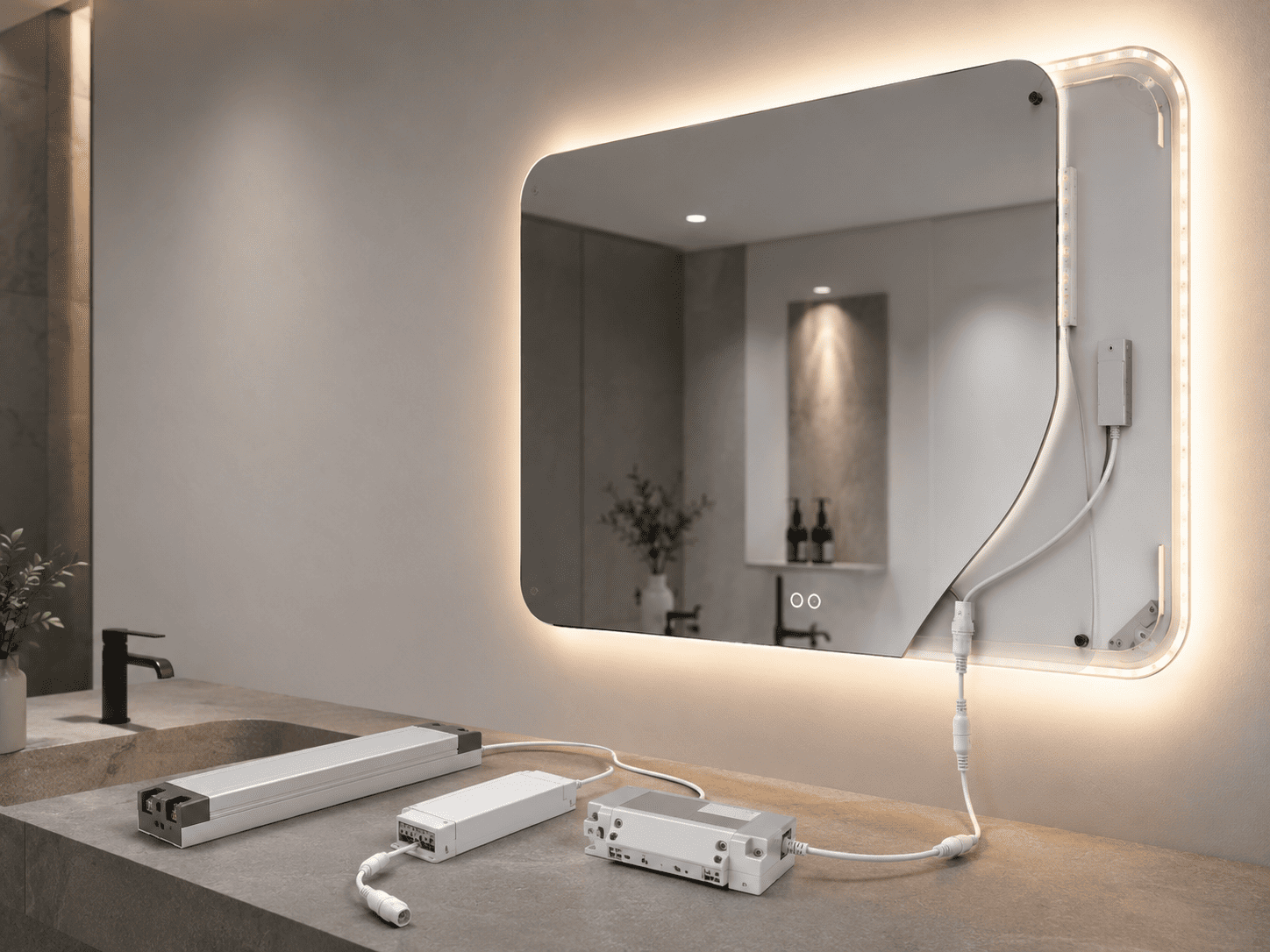
Driver comparison view showing internal strip layout, service access and external power components relevant to specification review.
Engineering Decisions That Impact Total Cost of Ownership
Beyond the unit price of the driver, three engineering decisions substantially affect lifetime cost in hospitality deployments.
Replaceable vs. sealed driver compartments. A mirror with a sealed, non-serviceable driver must be entirely replaced when the driver fails — mirror glass, frame, and all. A mirror with an accessible driver compartment (screw-down cover plate on the rear, plug-in terminal connections) can be repaired on-site in 15 minutes by hotel maintenance staff. For projects with 200 or more mirrors, the difference in 10-year maintenance cost is significant.
Standardized driver models across the property. Specifying one driver model (e.g., a 45W 24VDC CV driver with 0-10V dimming) for all guest bathroom mirrors — regardless of mirror size — lets the hotel keep a single spare part SKU. The 20% loading rule provides headroom so that a 45W driver can safely power mirrors drawing 18-36W. Standardization reduces spare parts inventory cost and eliminates the risk of maintenance staff installing the wrong replacement driver.
Remote driver placement options. For premium properties where absolute silence matters, specify remote driver mounting — place the driver above the ceiling or in an adjacent service closet, running only the SELV 24VDC cable to the mirror. This eliminates any faint driver hum from the bathroom and keeps the driver in a cooler, dryer environment that extends its service life. The trade-off is more complex cabling during rough-in.
These are not theoretical considerations. Hotel groups have specified exactly these provisions after experiencing 15-20% driver failure rates within 3 years on previous properties where the lowest-bid driver was integrated into a sealed mirror housing with no replacement path.
Rear driver compartment detail showing service access, wiring protection and enclosure planning for humid bathroom installations.
Closing Guidance
LED driver selection for bathroom mirrors is an engineering decision, not an afterthought. The driver type (CC vs CV), dimming protocol, IP rating, and physical form factor must be confirmed before sample approval. A spec sheet that says "LED driver included" without detailing these parameters is incomplete for any professional project supply chain.
For project procurement teams working with RATO LED Mirror, we provide driver documentation including:
Full electrical specifications (input voltage range, output voltage/current, power factor, efficiency curve)
Certification documents for target markets (CE, SAA/CCC — confirm specific market requirements when requesting quote)
Contact our engineering team with your project's electrical design parameters, and we'll match the correct driver specification to your mirror order.
B2B Project Inquiry
Talk to our project team about your mirror specification.
Send drawings, BOQ, mirror sizes, target quantity, voltage, lighting preference, packaging needs and destination market. Specifications are confirmed according to the selected model and project requirements.