Kuwait LED Mirror Market Guide: Supply for Hotel & Commercial Projects
Comprehensive B2B guide to sourcing and specifying LED mirrors for Kuwait hotel and commercial projects. Covers MEW electrical compliance, 240V/50Hz configuration, Kuwait Building Code safety glazing requirements, Universal Design Code accessibility standards, and climate-adapted product specifications for the Gulf market.
Kuwait's expanding hospitality sector — with projects in Kuwait City, the Avenues commercial district, and new coastal resort developments — requires hotel bathroom LED mirrors that meet three non-negotiable criteria: MEW-approved 240V/50Hz electrical configuration, IP44 or higher ingress protection, and safety glazing compliance under Kuwait Building Code Section 13. Missing any of these means your shipment doesn't clear inspection, regardless of the mirror's aesthetic quality.
Kuwait Hotel & Commercial Construction Market
Kuwait's hospitality pipeline continues to expand, driven by government-led economic diversification under Vision 2035 and private investment in luxury hotels, serviced apartments, and mixed-use commercial developments. Hotel projects demand bathroom fixtures in bulk — a single 300-room property typically requires 300–350 bathroom LED mirrors across guest rooms, suites, and public washrooms.
Why does the Kuwait hotel market specifically demand backlit LED mirrors rather than standard glass mirrors? Because operator brands — from international chains to local boutique hotels — now spec LED mirrors as a default bathroom fitting. The combination of ambient lighting, anti-fog functionality, and touch-sensor controls aligns with the guest-experience standards that Kuwait's hospitality sector competes on. For contractors and FF&E procurement teams, this means LED mirrors are no longer an optional upgrade item — they're line items in the base specification.
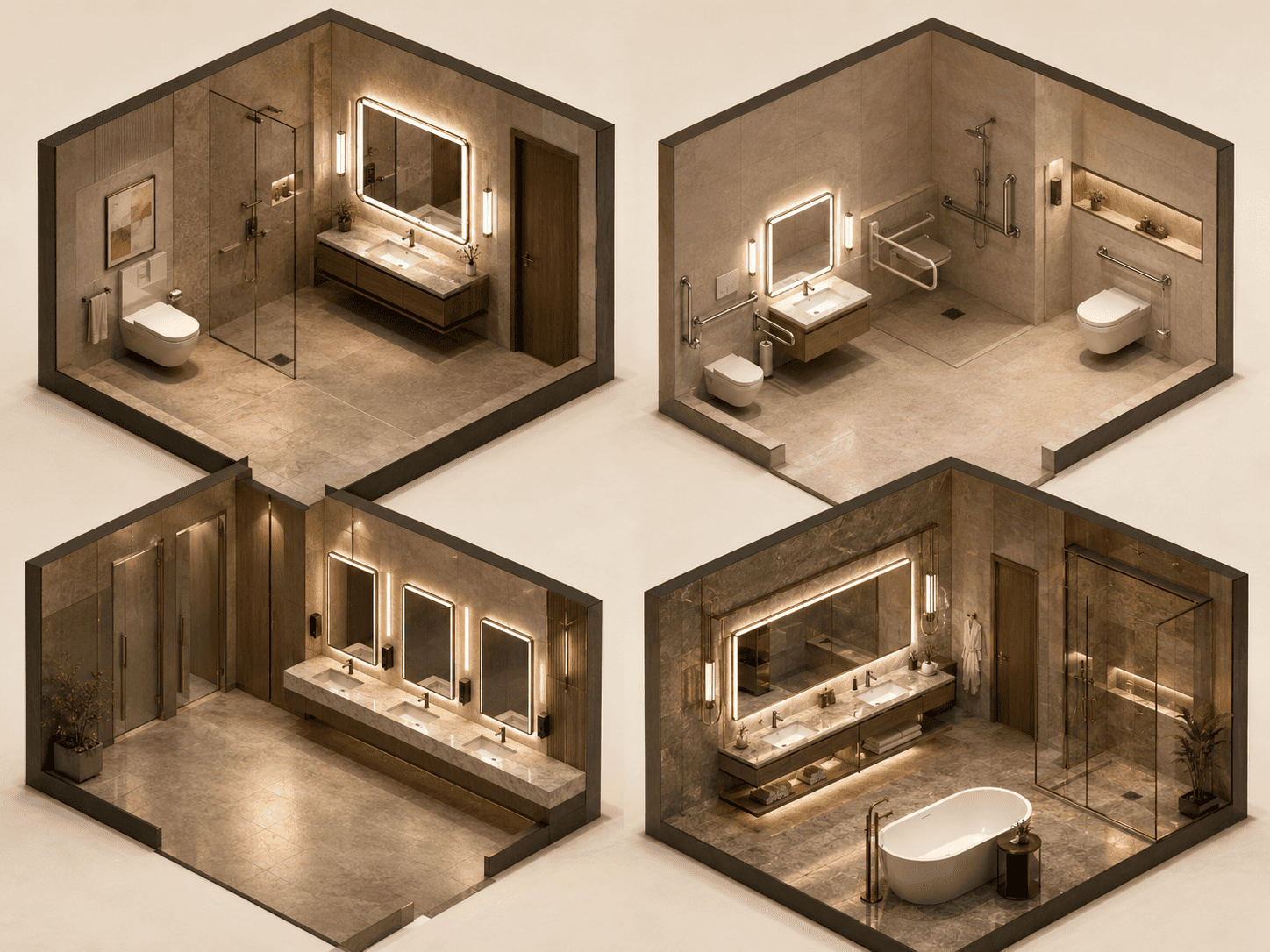
Developers typically source mirrors in the following hotel categories:
5-star city hotels — Kuwait City, Al Asimah district; large-format backlit mirrors, often 80×100cm or custom wall-to-wall dimensions with CCT-adjustable lighting
Airport hotels — near Kuwait International Airport; compact, functional designs with strong anti-fog priority
Coastal resorts — Khiran, Fahaheel area; copper-free mirrors with enhanced corrosion resistance (see climate section below)
Serviced apartments — mid-range LED mirrors with touch dimming, balancing performance and per-unit cost
Contractors should also note: Kuwait's hotel classification standards require at least 10% of guest rooms to be accessible rooms under the Kuwait Universal Design Code. This triggers specific mirror mounting height requirements — we cover this in the safety section below.
Key takeaway: For Kuwait hotel projects, plan LED mirror specifications as part of the FF&E package from schematic design phase. Retrofitting after electrical rough-in is expensive and typically causes inspection delays.
LED mirror applications across Kuwait hotel and commercial project types.
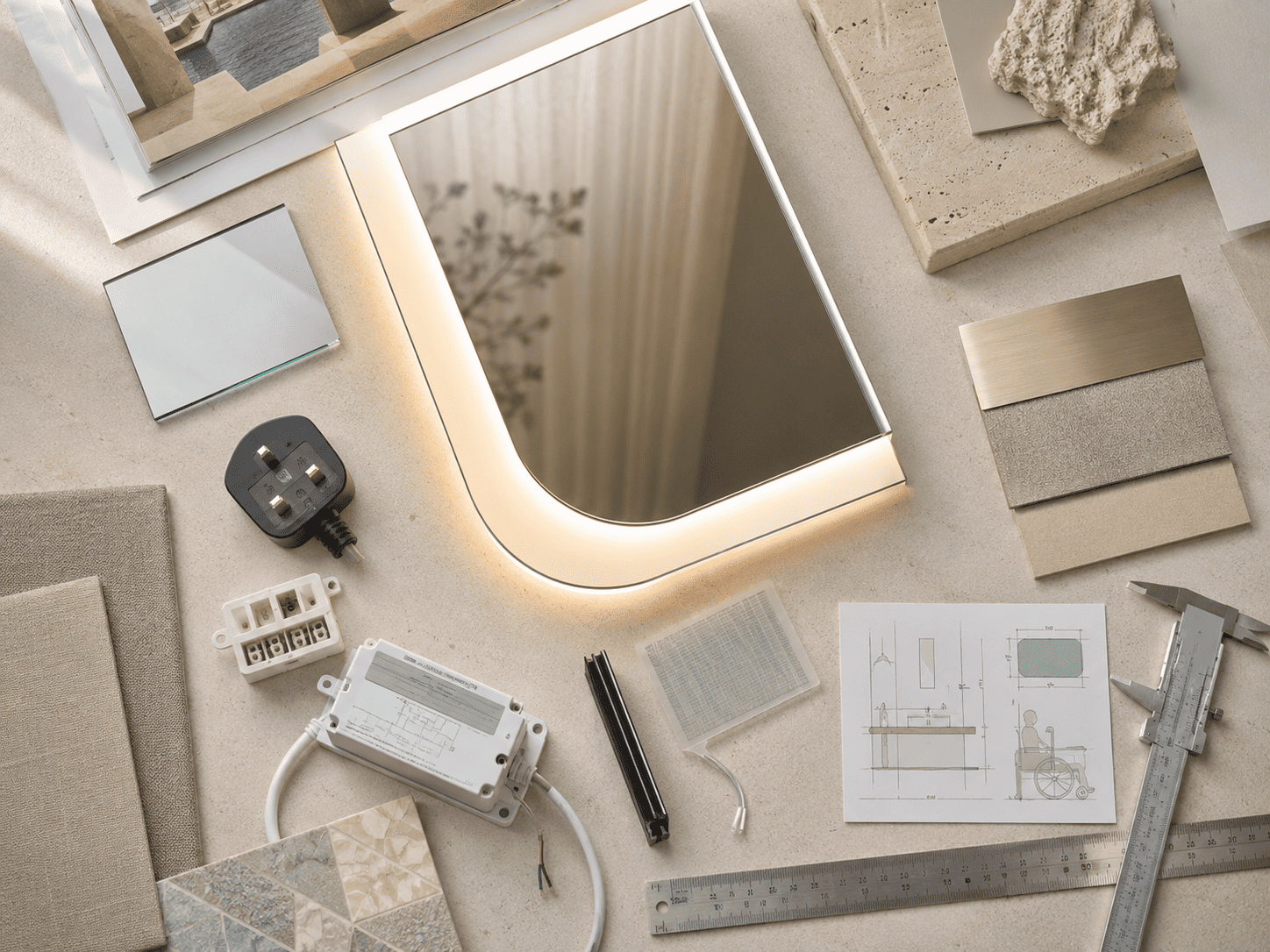
All electrical equipment installed in Kuwait — including LED mirror lighting components — falls under the jurisdiction of the Ministry of Electricity and Water (MEW). This means LED mirrors imported for hotel and commercial projects require MEW-approved LED drivers, and the mirror's internal wiring must be configured for Kuwait's 240V/50Hz single-phase mains supply.
What does "MEW approved" actually mean for an imported LED mirror? It refers primarily to the LED driver — the component that converts mains AC voltage to the low-voltage DC (typically 12V or 24V) used by the mirror's LED strips. The driver must carry MEW recognition, and the complete mirror assembly should be accompanied by a conformity certificate from a recognized testing body. In practice, most Chinese LED mirror manufacturers use globally certified LED drivers (CE, CB Scheme) and work with their driver suppliers to obtain MEW-specific approval documentation.
Here's the technical specification checklist for any LED mirror destined for Kuwait:
Specification
Requirement
Notes
Mains voltage
240V ±10%
Single-phase AC
Frequency
50Hz
Not 60Hz — verify with factory
Plug type
Type G (BS 1363)
3-pin fused plug, or hardwired installation
LED driver input
220-240V AC, 50Hz
MEW-approved driver required
LED driver output
12V or 24V DC
Constant voltage, not constant current
Circuit protection
GFCI / RCD
Residual-current device on branch circuit
Internal wiring
Double-insulated
IEC 60335-2-23 compliant silicone wiring
Fuse rating
3A or 5A
In Type G plug; hardwired units use upstream breaker
Procurement note: When requesting samples from Chinese LED mirror factories, clearly specify "MEW-compatible LED driver, 240V/50Hz input" in the RFQ. Most manufacturers default to 110-240V universal-voltage drivers, but the Type G plug configuration and MEW documentation package is not their standard export kit — it requires a specific line item in the production order.
PAA-style question: What happens if you install a non-MEW-approved LED mirror in a Kuwait hotel project? The mirror itself functions — but it won't pass MEW's electrical inspection, which is a prerequisite for the Certificate of Completion (CoC) required for hotel occupancy permits.
Key takeaway: Ask your LED mirror supplier for: (1) MEW recognition document for the specific LED driver model, (2) 240V/50Hz configuration confirmation in the order invoice, and (3) Type G plug or hardwired terminal block option. These three documents are what your project's MEP consultant will request during submittal review.
Safety & Building Code Requirements for Kuwait Projects
Three regulatory frameworks govern LED mirror installation in Kuwait commercial buildings: the Kuwait Building Code Section 13 (Safety Glazing), the Kuwait Universal Design Code (accessibility), and MEW's electrical installation regulations (ingress protection and circuit safety). Procurement teams who submit mirror specifications without addressing all three risk specification rejection at the contractor submittal stage.
Safety Glazing — Kuwait Building Code Section 13
Kuwait Building Code Section 13 mandates that all glazing in hazardous locations — which includes bathroom mirror installations where the mirror's lower edge is below 1,500mm from the finished floor — must use safety glass. For LED mirrors, this means the mirror glass must be either:
Tempered glass (thermally toughened): 4-5× stronger than annealed glass; fragments into small, blunt-edged granules upon breakage
Laminated glass: Two glass sheets bonded with PVB interlayer; holds fragments in place when broken
In factory reality, most hotel-grade LED mirrors are produced with 5mm tempered float glass with polished edges. Specifying 5mm tempering is the default and avoids the cost premium of lamination while satisfying Section 13 requirements.
Universal Design Code — Mirror Mounting Height
Kuwait Universal Design Code specifies that in accessible bathrooms (minimum 10% of hotel guest rooms), the bottom edge of the mirror must be mounted no higher than 900mm above the finished floor, and the mirror should extend to at least 1,800mm in height to accommodate both standing and seated users. This is a dimensionally specific requirement, not a guideline — MEP drawings must reflect this.
For standard guest rooms, mirror mounting is less constrained, with bottom edges typically set at 1,000-1,100mm above the vanity backsplash.
IP Rating Requirements by Bathroom Zone
Kuwait follows IEC 60529 ingress protection standards, applied by zone within the bathroom:
Zone
Location
Required IP Rating
Example Installation
Zone 0
Inside bathtub/shower tray
Not applicable for mirrors
—
Zone 1
Above bathtub/shower up to 2.25m height
IP65
Mirror adjacent to shower area with direct water exposure
Zone 2
0.6m perimeter around bath/shower
IP44 minimum
Typical vanity mirror near tub but not directly adjacent
Zone 3 (now "outside zones")
Beyond 0.6m from water source
IP44 recommended
Standard vanity mirror in dry area of bathroom
For Kuwait hotel bathrooms, most guest room vanity mirrors fall into Zone 2 or Zone 3 — IP44 is sufficient. IP65 is only necessary when the mirror is integrated into or immediately adjacent to the shower enclosure, which is a premium suite design feature rather than a standard spec.
Important MEW clarification: All bathroom circuits in Kuwait commercial buildings must be protected by RCD (residual current device) with a rated tripping current not exceeding 30mA. This applies regardless of the mirror's IP rating — it's a circuit-level requirement, not a fixture-level requirement. Confirm that your project's electrical design accounts for this, as it affects the total load calculation on RCD-protected circuits.
Key takeaway: Submit your LED mirror specification to the project's MEP consultant with explicit call-outs for: tempered glass compliance with KBC Section 13, mounting height compliance with Universal Design Code (900mm for accessible rooms), and the mirror's tested IP rating documentation. Package these three items as a single compliance submittal batch.
Product Adaptation for Kuwait's Climate
Kuwait's climate — summer ambient temperatures exceeding 50°C, annual average relative humidity of 50-60% with coastal peaks above 90%, and airborne salt content in coastal zones — imposes specific material requirements on bathroom LED mirrors that differ from what you'd spec for a project in, say, Central Europe or inland North America. This isn't about preference; it's about preventing in-situ failure within the warranty period.
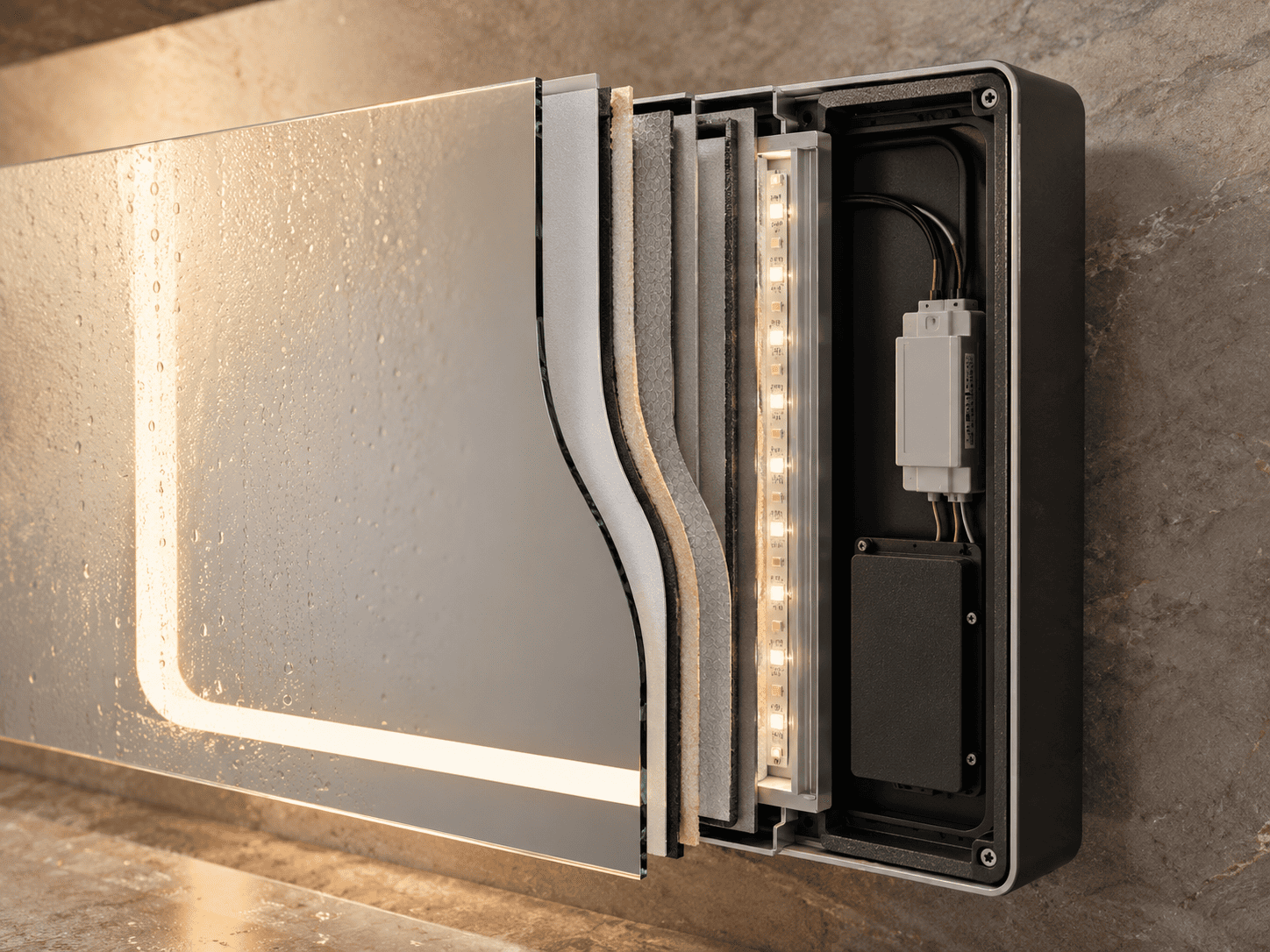
Climate-adapted LED mirror construction for Kuwait's heat, humidity, and coastal conditions.
The Copper-Free Mirror Argument for Gulf Projects
Standard bathroom mirrors use a silver coating deposited on float glass, protected by a copper layer and then a paint backing. In Kuwait's coastal humidity — think Fahaheel, Khiran, or any hotel within 5km of the Gulf — the combination of heat, moisture, and airborne salt accelerates a well-known failure mode: copper oxidation at the mirror edge. This manifests as black edge corrosion that creeps inward, eventually reaching the reflective silver layer and creating permanent dark spots.
Copper-free mirrors eliminate the copper layer entirely and use a passivated silver coating with a specialized paint backing. In factory terms, this typically involves:
Silver coating applied via chemical deposition
Passivation treatment (tin or palladium-based) replacing the copper layer
Double-coat epoxy paint backing with edge sealant
The additional material cost is approximately 8-12% over standard copper-backed mirrors, but for high-humidity Gulf installations, it extends service life from a typical 3-5 years (standard mirror with edge corrosion) to 10-15 years. For hotel FF&E with a 7-10 year renovation cycle, that difference determines whether mirrors survive to the next refurbishment or get replaced mid-cycle at the operator's expense.
Anti-Fog Demister Pad — Not Optional in Kuwait
Demister pads are thin heating elements adhered to the back of the mirror glass, maintaining the glass surface temperature above the dew point so condensation cannot form. In Kuwait bathrooms — where post-shower humidity spikes are intense — demister pad performance directly determines the mirror's usability.
Factory specification points for demister pads in Gulf export products:
Pad coverage area: Minimum 70% of mirror surface for effective anti-fog; some factories default to a smaller centrally placed pad to reduce cost. Verify the pad dimensions, not just the "anti-fog included" checkbox.
Watt density: 2-3W per square foot is the sweet spot — sufficient to prevent fogging without generating detectable heat on the glass surface.
Wiring: The demister pad should operate on the same 12V/24V DC supply as the LED lighting. Separate AC-powered demister pads complicate the MEW approval chain.
Auto shut-off: Most demister circuits are designed to run for 45-60 minutes per activation. Confirm this timer logic with the factory — continuous-operation demister pads waste energy and shorten pad life.
Edge Sealing and Enclosure Design
Beyond the mirror glass itself, the LED mirror's enclosure — typically an aluminum alloy frame or IP-rated rear casing — needs to prevent moisture ingress that can corrode internal LED strips, drivers, and wiring connections:
Silicone gaskets at all enclosure seams
IP-rated cable glands for power entry points
Aluminum frame fabricated from 6063 alloy with anodized or powder-coated finish for corrosion resistance — avoid bare steel or untreated aluminum in coastal-spec products
Internal desiccant packs or vent-and-drain design for backlit panels that cannot be fully sealed
These are production-line details, not afterthoughts. When auditing a factory's Gulf-market product line, check whether these protections are part of the standard bill of materials or treated as customer-specified add-ons. BOM-integrated protections indicate a factory that understands the market; bolt-on modifications signal a factory that's guessing.
Key takeaway: For Kuwait hotel and coastal resort projects, the minimum viable product specification is: copper-free mirror glass, demister pad at ≥70% coverage, anodized aluminum enclosure with silicone-sealed seams, and LED driver rated for ambient operating temperature of 0-55°C. Don't negotiate on any of these four items — each one addresses a documented failure mode in Gulf installations.
Specification Checklist for Kuwait Hotel LED Mirror Procurement
Use this checklist when preparing RFQs or reviewing supplier quotations for Kuwait hotel projects. It consolidates electrical, safety, climate, and installation requirements into a single procurement reference document.
Electrical & Certification
[ ] LED driver: MEW-approved, 240V/50Hz input, 12V or 24V DC output
[ ] Plug configuration: Type G (BS 1363) or hardwired terminal block option
[ ] CE / CB Scheme certification for complete mirror assembly
[ ] Power connection: recessed junction box behind mirror, or surface-mounted trunking with Type G socket
Key takeaway: Circulate this checklist to your factory contact before finalizing the proforma invoice. Items marked as verified should reference specific SKU options or BOM lines, not verbal confirmations. For Kuwait project bids, attach this completed checklist as an annex to your technical submittal.
Procurement Process: Sourcing LED Mirrors from Chinese Factories
For Kuwait-based hotel developers and contractors, sourcing bathroom LED mirrors directly from Chinese manufacturers offers a 40-60% landed cost advantage versus buying through regional distributors. However, the procurement timeline, MOQ structure, and logistics routing require advance planning — particularly for projects where the mirror specification ties directly to MEP milestones.
Factory produces 2-3 spec samples, ships via air courier (DHL/FedEx)
Sample approval & order confirmation
1-2 weeks
Client approves samples, confirms final BOM, signs PI
Mass production
4-6 weeks
Full production run (varies by order volume and complexity)
Quality inspection
3-5 days
Third-party QC or client inspection at factory (Guangdong/Jiangmen)
Sea freight to Kuwait
18-25 days
FCL/LCL via Shuwaikh Port; customs clearance in Kuwait
Total lead time
14-18 weeks
From RFQ to delivery at site
MOQ and Commercial Terms
LED mirror factory MOQs can vary significantly depending on the level of customization involved. Here's a practical breakdown:
Standard catalog products — mirrors from an existing factory range with no customization beyond the standard size/color options. This is the most straightforward procurement path and the quickest to production.
Custom sizes with standard features — mirrors built to project-specific dimensions but using the factory's existing LED strip, demister pad, and touch sensor components. The factory needs to cut glass and fabricate the frame to new dimensions, but the electrical system is proven.
Fully bespoke — new CCT configuration, custom frame finish, proprietary sensor integration, or hotel-brand engraving. These orders require engineering time and a design-for-manufacturing review before the sample phase.
Commercial terms on B2B LED mirror orders typically follow FOB (Shenzhen/Guangzhou) or CIF (Shuwaikh). For first-time Kuwait project buyers, CIF terms reduce logistics risk — the factory handles shipping and insurance through their freight forwarder — but the landed cost is 5-8% higher than FOB with your own forwarder. Once you've established a relationship with a freight forwarder handling the China-Kuwait route, FOB terms offer better cost control.
Logistics: Sea Freight to Shuwaikh Port
Shuwaikh Port is Kuwait's primary commercial seaport and the standard entry point for containerized goods. LED mirrors ship in plywood crates with foam-lined compartments — typically 20-30 units per crate depending on mirror dimensions. An FCL (full container load) 20-foot container accommodates approximately 250-350 standard-sized hotel LED mirrors. LCL (less-than-container load) is viable for smaller orders but adds handling at the Kuwait consolidation warehouse and increases breakage risk.
Customs clearance in Kuwait requires:
Commercial invoice with HS code 7009.92 (framed glass mirrors)
Packing list
Bill of lading
Certificate of origin (Form A for preferential duty under applicable trade agreements)
MEW conformity documentation for electrical components
Work with a Kuwait-based customs broker who has experience clearing building materials and FF&E shipments. The broker will flag any missing documentation before the container arrives — catching a missing MEW approval document at the customs stage adds 1-2 weeks of demurrage.
Factory Selection Criteria for Kuwait Projects
When evaluating Chinese LED mirror factories for Kuwait hotel supply, prioritize these indicators:
Gulf project track record: Ask for photos and spec sheets from completed hotel projects in the GCC — UAE, Saudi Arabia, Qatar, or Kuwait. A factory that has supplied a Dubai or Riyadh hotel understands the regional regulatory context without a learning curve.
In-house glass processing: Factories that temper, silver, and edge their own glass have better quality control on copper-free mirror specs than those sourcing pre-cut mirror panels from third-party glass processors.
LED driver supply chain: Confirm which LED driver brand the factory uses and whether that brand has existing MEW recognition. Factories using Mean Well, Tridonic, or similarly certified driver brands have a smoother MEW compliance path.
QC documentation: Request the factory's outgoing QC checklist — it should include individual light-up test, demister function test, touch sensor calibration, and visual inspection for edge defects. A factory that doesn't have a printed QC checklist isn't a factory ready for hotel-grade supply.
Key takeaway: Start the factory engagement 16-18 weeks before your project's FF&E installation milestone. The single biggest schedule risk on Kuwait LED mirror procurement is not production time — it's the lag between specification confirmation and MEW documentation review. Build that review window into the project schedule.
FAQ
Can I use standard European-spec LED mirrors in Kuwait if they run on 220-240V?
Not automatically. European-spec mirrors (Schuko plug, 230V/50Hz) share the correct voltage and frequency range, but three differences block direct use: (1) the MEW approval chain for the LED driver isn't covered by CE marking alone — MEW-specific recognition is required; (2) European Schuko plugs are not compatible with Kuwait's Type G wall sockets; and (3) European bathroom installation zones (derived from IEC 60364-7-701) have slightly different zone boundaries than Kuwait's adopted IEC 60529 application. A mirror that passes German VDE will likely pass Kuwait inspection — but the documentation package and plug configuration must be explicitly addressed.
What's the price difference between Chinese-factory direct LED mirrors and buying from a Kuwait distributor?
For hotel-grade LED mirrors with custom dimensions, the landed-cost comparison typically shows factory-direct pricing at 55-70% of distributor pricing for equivalent specification. The gap narrows for small orders (below MOQ minimums) and standard-sized catalog products where distributors hold warehouse stock. The real savings on factory-direct procurement materialize at the 50+ unit level — below that, freight and customs broker fees erode the spread. For a 200-room hotel project ordering 220 mirrors, expect total landed cost savings of approximately $15,000-$25,000 versus regional distribution pricing.
For Kuwait hotel and commercial projects, the LED mirror specification isn't a procurement afterthought — it's a technical submittal that intersects electrical compliance, building code, accessibility regulation, and climate-adapted manufacturing. Start the factory conversation early, anchor it to written specifications (not verbal descriptions), and verify MEW documentation before the sample stage. Contact the RATO factory team to discuss your project's Kuwait-specific LED mirror requirements, including MEW-compatible driver options and copper-free mirror configurations for Gulf coastal installations.
FAQs
What electrical specifications are required for LED mirrors in Kuwait?
Kuwait operates on 240V/50Hz with Type G (British standard) plugs. LED mirrors require MEW (Ministry of Electricity and Water) approved LED drivers that convert mains voltage to low-voltage DC (12V or 24V). All electrical components must be rated for continuous operation in Kuwait's ambient temperature range. Confirm MEW approval status directly with your LED mirror supplier before ordering.
What IP rating should hotel bathroom LED mirrors have in Kuwait?
For general hotel bathroom installation above vanities (Zones 2 and 3), a minimum IP44 rating is required for splash resistance. For mirrors installed in or adjacent to shower areas (Zone 1), specify IP65 for protection against direct water jets. All installations should be on GFCI-protected circuit breakers per Kuwait electrical safety codes.
B2B Project Inquiry
Talk to our project team about your mirror specification.
Send drawings, BOQ, mirror sizes, target quantity, voltage, lighting preference, packaging needs and destination market. Specifications are confirmed according to the selected model and project requirements.