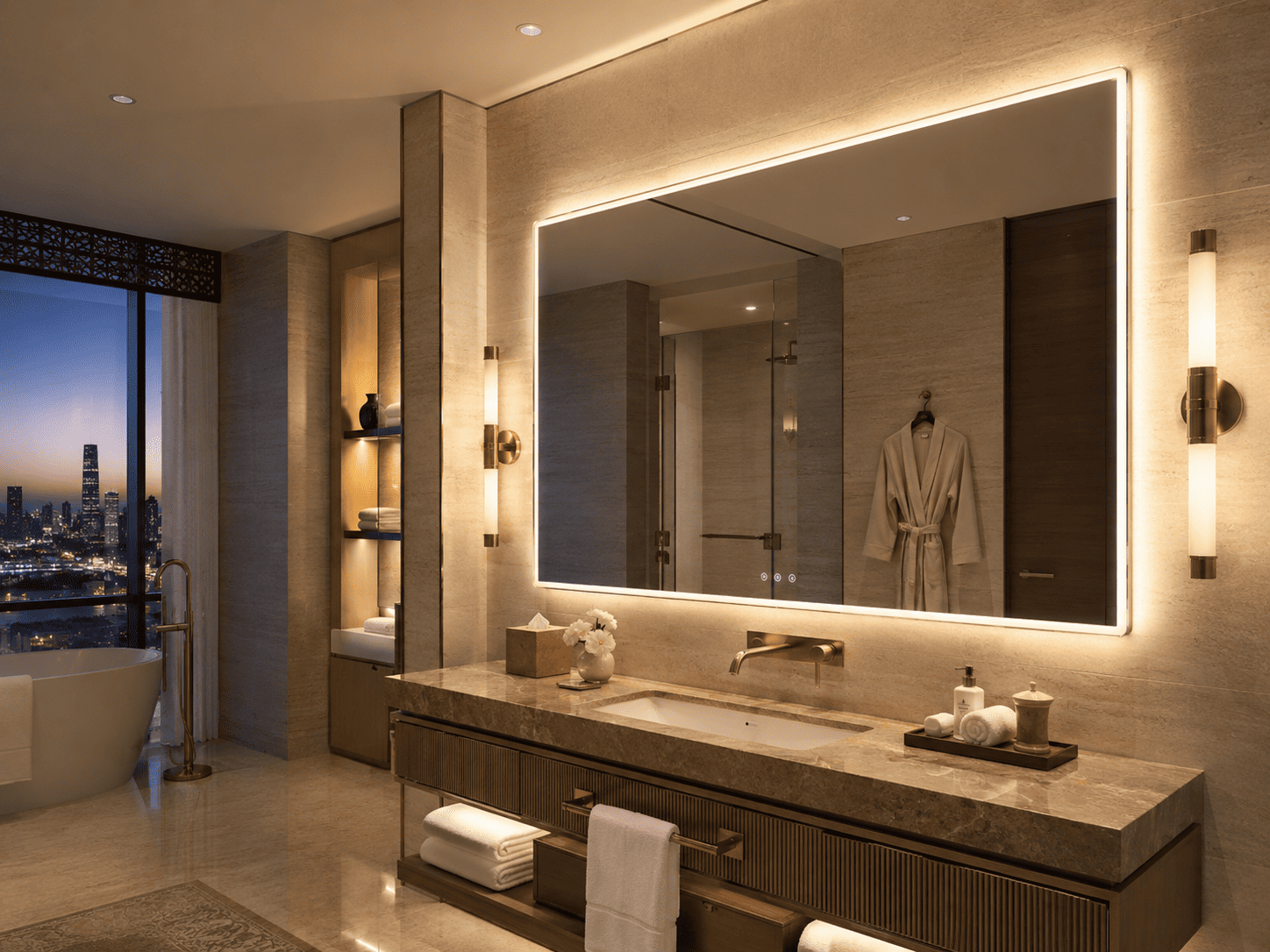
Kuwait LED Mirror Market Guide — Sourcing & Selection for Hotel Projects
A procurement-focused guide to sourcing LED bathroom mirrors for Kuwait hotel projects, covering 240V/50Hz drivers, coastal corrosion resistance, IP ratings, certifications and China-to-Kuwait import planning.
Kuwait Hotel Market & Demand Overview
Kuwait's hotel pipeline through 2028 will add over 2,000 keys — roughly a 10% expansion of current capacity — driven by government-backed tourism initiatives under Kuwait Vision 2035. For procurement teams, this growth means 4,000 to 6,000 additional bathroom LED mirrors entering specification sheets within the next five years, based on standard key-to-mirror ratios for midscale and upscale properties.
Several projects directly shape near-term demand. The InterContinental Kuwait Al Thuraya City opens in late 2025 with 120 rooms. The JW Marriott renovation delivers 195 rooms the same year. The Hilton Kuwait Resort renovation in Mangaf, projected for 2027, will create the country's largest coastal resort with approximately 330 guest rooms, 80 chalets, and 64 villas — a project where bathroom mirror specification must account for direct shoreline exposure. The Mandarin Oriental (200 rooms, 2028) and Mysk Hotel (202 rooms, 2026) add further volume.
What this means for specifiers: the Kuwait hospitality pipeline is not a theoretical long-term trend. It is a defined, addressable procurement window. Projects breaking ground in 2024-2025 will place mirror orders within 12-18 months. If your preferred supplier cannot produce to Kuwait's voltage, corrosion, and certification requirements, that gap needs closing now — not during the tender phase.
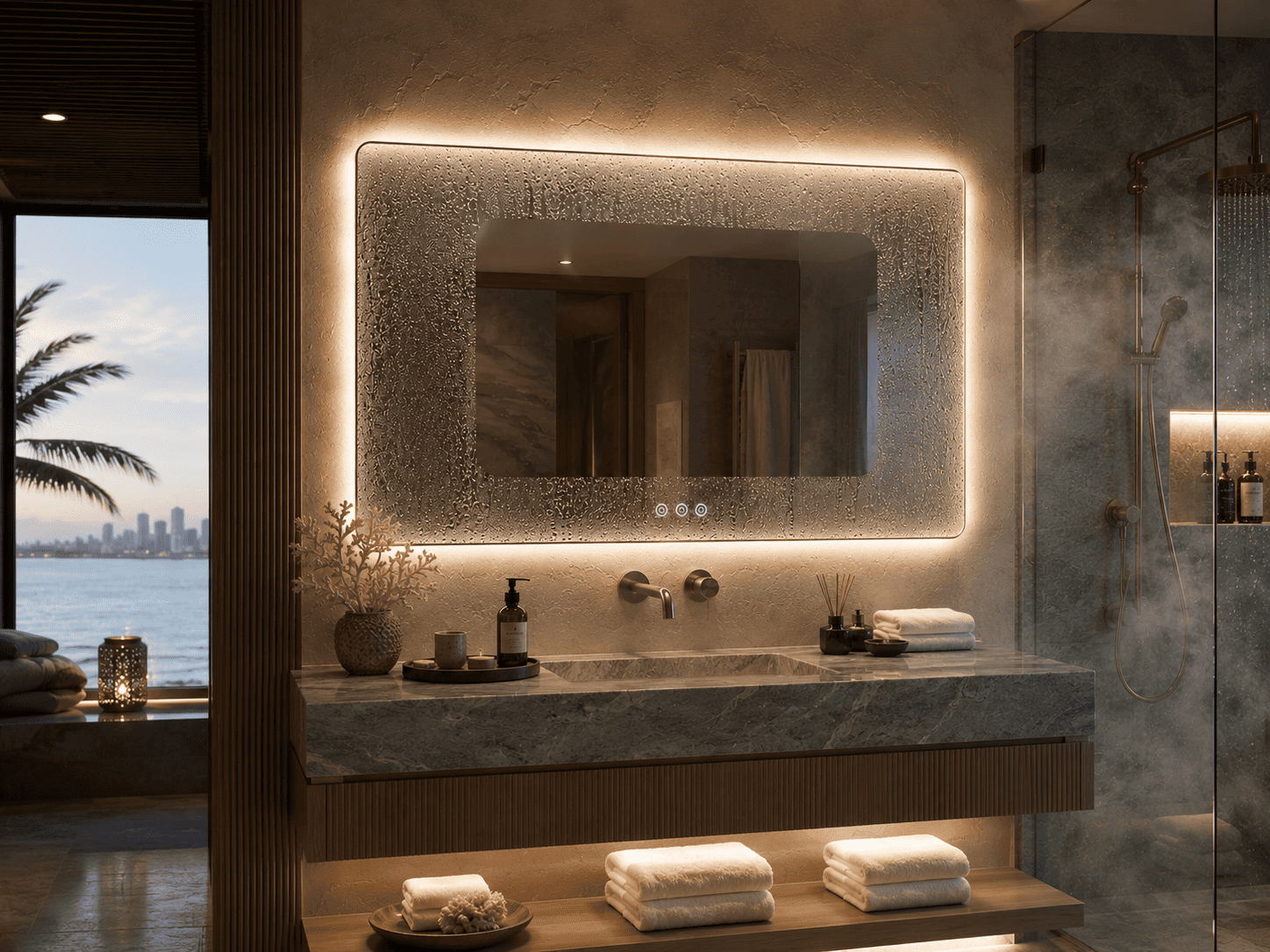
Coastal hotel bathroom LED mirror design should account for humidity, salt exposure and demister performance.
Demand Drivers at a Glance
Kuwait Vision 2035 tourism push — government capital expenditure on hospitality infrastructure continues, with the "Visit Kuwait" e-visa portal launched in 2024 to accelerate inbound visitor volume.
MICE sector recovery — occupancy rates projected to rise from mid-40% to 56-60% by 2026, pulling new hotel inventory into operation.
Coastal resort development — major island projects (Awha Island, Miskan Island, Warba Island) are in long-term planning and will require mirrors engineered for extreme coastal exposure.
Procurement takeaway: Kuwait hotel projects are geographically concentrated along the coast. Every LED mirror specification for these properties must factor in salt-laden air and sustained high humidity. Standard residential-grade mirrors will fail prematurely.
Technical Specifications for Kuwait Hotel Projects
LED mirrors destined for Kuwait hotels require three baseline specifications that differ from standard European or North American hotel specs: 240V/50Hz driver input, minimum IP44 ingress protection, and mirror substrate rated for high-humidity coastal exposure. Getting any one of these wrong at the RFQ stage creates downstream cost — either in retrofit labor or warranty liability.
Voltage, Frequency & Electrical Standards
Kuwait operates on 240V/50Hz, consistent with the UK and GCC standard (BS 1363 / GSO-compliant). This is higher than the 220V/50Hz used in mainland China and several Asian markets — a critical detail when sourcing LED mirror drivers from Chinese manufacturers.
Specification
Kuwait Requirement
Nominal voltage
240V AC
Frequency
50Hz
Driver input range
220-240V AC (nominal 240V)
Plug standard
BS 1363 (UK-type, 3-pin fused)
EMC compliance
GSO CISPR 14 / GSO IEC 61000 series
A driver rated only for 220V nominal may operate outside its design envelope on Kuwait's 240V supply. Over-voltage stress degrades LED driver electrolytic capacitors and shortens mean-time-between-failure (MTBF). Specify 220-240V wide-input drivers and confirm the driver's rated input voltage on the supplier datasheet — not the sales quote.
IP Rating for Bathroom Zones
Hotel bathroom mirror placement falls into IEC bathroom Zone 2 (above and beside the vanity, outside the shower enclosure perimeter). IP44 is the minimum rating for this zone: protection against solid objects >1mm and water splashes from any direction.
For properties within 5 km of the Kuwait coastline — which applies to most of the hotel pipeline — IP65 is the safer specification. IP65 means the enclosure is dust-tight and protected against low-pressure water jets. It adds approximately 5-8% to unit cost but eliminates moisture ingress through the housing, which is the primary failure mode in humid coastal bathrooms where air conditioning cycling creates condensation cycles.
CCT & CRI: Lighting Color for Guest Bathrooms
The hospitality industry has largely converged on 3000K warm white as the standard for guest bathroom mirror lighting. It produces a flattering, residential-quality light that matches the ambient warmth guests expect in a hotel setting. CRI 90+ is the baseline for accurate skin-tone rendering at the mirror — CRI 80 is acceptable in corridors but not at the grooming point.
For properties targeting business travelers who use the bathroom mirror for grooming and makeup, tunable CCT mirrors (2700K–5000K via touch sensor) are gaining specification traction. The cost increment is roughly 15-20% per unit over fixed-CCT equivalents. Budget for this feature in executive floors and suites rather than across all room categories.
Procurement takeaway: the spec sheet for a Kuwait hotel LED mirror should read: 240V driver, IP44 minimum (IP65 for coastal), 3000K CCT, CRI ≥ 90, integrated demister pad. Any supplier quoting below these minimums is offering a residential product, not a hospitality-grade solution.
Climate Adaptation — Why Corrosion Resistance Matters in Kuwait
Kuwait presents a uniquely aggressive corrosion environment for bathroom mirrors. The combination of coastal salt spray, summer ambient temperatures above 50°C, and high year-round humidity creates conditions that accelerate standard mirror edge failure within 12-18 months of installation. This is not a hypothetical risk — it is a predictable outcome driven by the interaction between mirror chemistry and ambient conditions.
The Chemistry of Mirror Corrosion
Standard silver mirrors use a copper layer between the silver reflective coating and the protective backing paint. Copper serves as an adhesion promoter — it helps the silver bond to the glass — but it is electrochemically reactive. When moisture penetrates the protective backing (through micro-cracks at the edge or pinholes in the paint layer), the copper reacts with chloride ions from salt-laden air. This galvanic reaction produces copper chloride, which appears as the characteristic black-edge corrosion that spreads inward from the mirror perimeter.
In a climate-controlled European hotel bathroom, this process may take 3-5 years to become visible. In a Kuwait coastal hotel bathroom — where the mirror cycles daily between air-conditioned dryness and shower-generated humidity in an ambient air column saturated with salt — the timeframe compresses to 12-18 months.
Copper-Free Silver Coating: The Engineering Answer
Copper-free mirrors eliminate the reactive copper layer entirely. Instead, a passivation film is applied directly over the high-purity silver reflective coating, followed by lead-free protective paint layers. This removes the electrochemical pathway for chloride-driven corrosion.
The performance difference is quantified in accelerated corrosion testing:
Corrosion Resistance Metric
Standard Copper-Backed Mirror
Copper-Free Silver Mirror
CASS test endurance
24–48 hours to visible edge failure
120–240+ hours without oxidation
Humidity resistance (60°C / 95% RH)
Edge corrosion within 200–300 hours
No visible degradation at 500+ hours
Estimated Kuwait coastal service life
12–18 months before visible edge blackening
5+ years with edge sealing
Additional Protective Measures
Edge sealing is not optional in Kuwait. Even copper-free mirrors benefit from precision edge grinding followed by epoxy or polymer edge sealant application. The mirror edge is the primary ingress point for moisture and chloride ions. An unsealed edge on a copper-free mirror still exposes the reflective layer interface to the atmosphere.
Demister pads serve a dual purpose in this context. Beyond the guest-comfort benefit of a fog-free mirror surface, the gentle heating cycle (typically 30–40°C at the glass surface) actively drives moisture away from the mirror body, reducing the total time the mirror backing is exposed to condensation.
Multi-layer backing — at minimum, a silver coating passivation layer + corrosion-resistant primer + waterproof topcoat (epoxy or Valspar-grade) — creates a physical barrier system. Single-layer painted backs, common on budget residential mirrors, are inadequate for Kuwait hotel bathrooms.
What this costs: copper-free substrate adds roughly 10-15% to mirror glass cost compared to standard copper-backed mirror. Edge sealing and multi-layer backing add a further 5-8%. The total premium is approximately 15-23% over baseline mirror cost — but avoids the far larger cost of replacing corroded mirrors in an operating hotel, including labor, guest disruption, and brand-reputation damage.
Procurement takeaway: for any Kuwait hotel project within 5 km of the coastline, specify copper-free silver mirror substrate with sealed edges and multi-layer protective backing. It is the single highest-ROI specification choice in the LED mirror procurement process.
Product Types in Demand for Kuwait Hospitality
Kuwait hotel projects follow the broader GCC hospitality specification pattern, with some market-specific variations driven by construction typology and operator brand standards. International chain operators (IHG, Marriott, Hilton, Mandarin Oriental) bring their own FF&E specification books; local developers and independent hotel operators typically specify through procurement consultants, creating an opening for supplier-led value engineering.
High-Volume Categories
Backlit Bathroom LED Mirrors dominate guest-room specifications. The edge-lit or backlit format provides even, shadow-free illumination around the mirror perimeter, which operators and designers prefer for the clean architectural look and the elimination of separate vanity light fixtures. Standard sizes for hotel guest rooms range from 600×800 mm to 800×1200 mm, with a thickness profile of 35–45 mm to accommodate the LED array and driver housing.
Smart LED Mirrors with Touch Control are specified for premium rooms, executive floors, and suites. Features include touch-sensor on/off and dimming, CCT tuning (2700K–5000K), integrated Bluetooth speakers, and digital clock/weather display. Smart mirrors carry a 40-80% cost premium over standard backlit units, so procurement teams typically allocate them selectively rather than across all room categories.
LED Mirror Cabinets — combining a mirrored door front with recessed storage behind — are gaining traction in extended-stay and serviced-apartment hotel segments, where guest storage needs differ from short-stay hotel rooms. These units require the same IP and corrosion specifications as open-faced mirrors but add cabinet-body material selection (aluminum frame + moisture-resistant MDF or ABS construction preferred over standard particleboard, which swells in humidity).
Specialty Categories
Salon & Spa Mirrors appear in hotel fitness centers, spa treatment rooms, and salon facilities within resorts. These demand larger formats (often 1000×1500 mm or custom dimensions), higher lumen output for professional- grade visibility, and CRI 95+ for accurate color rendering. CCT flexibility is particularly valued here — a spa treatment room may call for 2700K warm ambience, while a salon station needs 4000K neutral white for color accuracy.
Commercial-Grade Vanity Mirrors for hotel public-area restrooms require a different specification philosophy from guest-room units. Anti-vandal construction (tamper-resistant mounting, impact-resistant glass thickness of 5–6 mm minimum), higher IP rating (IP65 minimum regardless of coastal proximity, due to higher usage frequency and cleaning chemical exposure), and simplified lighting controls (fixed on/off with motion sensor or permanent-on via central circuit) differentiate this category.
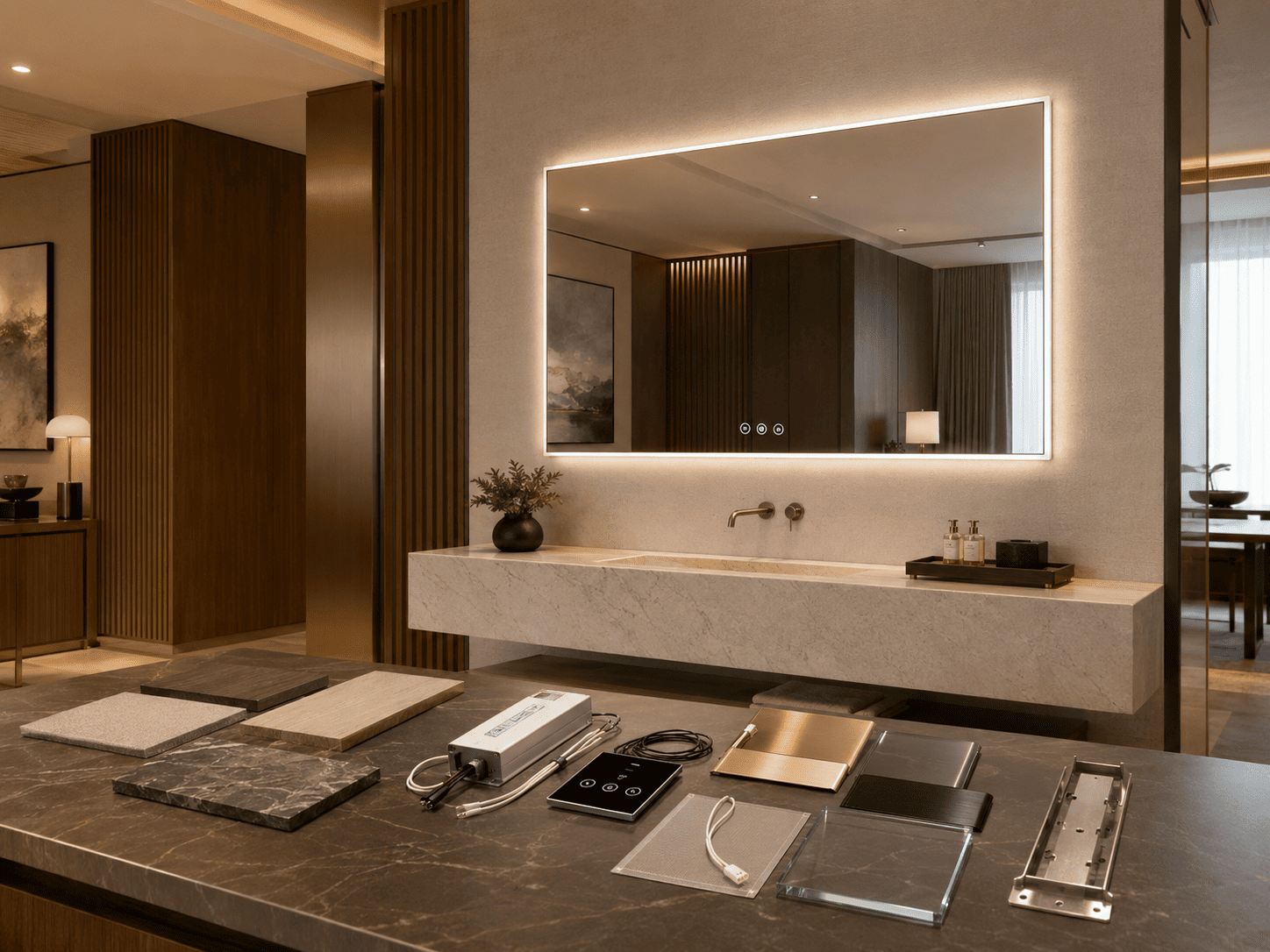
Mirror components, drivers and finish samples should be reviewed before a Kuwait hotel production order.
Construction Typology Notes
Kuwait hotel construction spans mid-rise urban towers (Kuwait City), low-rise coastal resorts (Mangaf, Al Khiran), and island developments. Mirror packing and logistics must account for elevator restrictions in tower projects (palletized loads with height limits) and extended transport chains for island sites (additional moisture barrier wrapping beyond standard export packaging).
Procurement takeaway: map your mirror types to room categories before issuing the RFQ. A 300-room hotel typically requires 3-4 distinct mirror SKUs: standard backlit (guest rooms, ~280 units), smart backlit (suites, ~15 units), public-area commercial mirrors (~5-8 units), and spa/salon mirrors if applicable (~3-5 units). Consolidating all types with a single OEM supplier reduces logistics complexity and freight cost per unit.
Procurement Process — Importing LED Mirrors from China into Kuwait
Importing LED mirrors from Chinese factories into Kuwait follows a structured path. The main friction points are certification documentation, customs valuation, and local representation for clearance. Understanding the sequence before issuing a purchase order avoids shipment delays at Shuwaikh Port.
Step-by-Step Import Flow
1. Supplier Qualification & Sample Verification Request physical samples with full specification sheets. Verify: driver input voltage (must read 220-240V, not 220V only), mirror substrate type (request copper-free certification from glass supplier), IP rating test certificate from an accredited lab, and CE/RoHS documentation. Do not accept "equivalent to" claims — request the actual test report.
2. Certification & Documentation Package The supplier should provide:
CE Declaration of Conformity (EMC + LVD directives)
RoHS compliance certificate
IEC test reports (if available; not mandatory for all shipments but strong project-level requirement)
G-mark / GCTS documentation (if applicable to the specific product classification)
Commercial invoice with HS code (7009.91 for unframed glass mirrors)
Certificate of origin (required for Kuwait customs clearance)
Detailed packing list (per-carton contents, dimensions, gross/net weight)
3. KUCAS Compliance Verification Kuwait's Conformity Assurance Scheme (KUCAS), enforced by the Public Authority for Industry (PAI), covers electronic and electrical products. LED mirrors fall under this scope. For first-time product introduction to the Kuwait market, a Technical Evaluation Report (TER) is required. For each shipment batch, a Technical Inspection Report (TIR) must accompany the goods. Confirm with your supplier whether their existing certifications satisfy KUCAS TER/TIR requirements, or whether additional testing at a GSO-accredited Notified Body is needed.
4. Freight & Customs Most hotel-project LED mirror shipments from China to Kuwait travel by sea freight to Shuwaikh Port. Transit time from major Chinese ports (Shenzhen, Guangzhou, Ningbo) is 20-35 days. Customs duty is 5% of CIF value. No VAT is currently applied in Kuwait. A 20ft container holds approximately 300-400 LED mirrors depending on packaging configuration; a 40ft HC container holds 600-800 units. LCL shipping is viable for smaller orders but adds roughly 15-25% to per-unit freight cost.
5. Local Representation for Clearance Kuwait customs requires the importer of record to be a Kuwaiti citizen or Kuwait-registered entity. Foreign suppliers and buyers without a Kuwait entity must engage a licensed customs broker. The broker's name must appear on the bill of lading. Factor broker fees (typically 1-2% of shipment value) into total landed cost calculations.
Pitfalls to Avoid
220V-only drivers. Confirm driver labeling shows 240V nominal input. A 220V-only driver will fail prematurely on Kuwait's grid.
Missing KUCAS TER for new products. First-time product introductions without a TER can face customs detention. Initiate the TER process 4-6 weeks before shipment.
Insufficient packaging for humidity. Standard export cartons with desiccant packs are inadequate for sea freight to Kuwait during summer months (May-October), when container interior temperatures can exceed 60°C. Request vacuum-sealed individual unit wrapping with industrial desiccant and moisture-indicator cards.
Procurement takeaway: build 8-10 weeks of lead time for first-time Kuwait imports beyond production lead time. This covers TER processing, sample shipment, freight booking, and customs clearance buffer.
Why Source from a Specialized LED Mirror Factory
General lighting manufacturers and building-material trading companies can both supply LED mirrors. Neither is the optimal procurement channel for a Kuwait hotel project. A factory that specializes exclusively in LED mirror manufacturing — with in-house glass processing, LED assembly, and QC testing — delivers three measurable advantages that matter at project scale.
Unit Cost vs. Total Cost
A general lighting factory buys mirror glass from a third-party glass processor. A trading company buys finished mirrors from whichever factory quotes lowest. Each intermediary adds margin without adding value. A specialized factory with in-house glass cutting, silvering, edge sealing, and LED integration eliminates these margin layers. The unit price difference is typically 10-20% — but the larger delta is in quality consistency. When 300 mirrors ship across two production batches from two different glass suppliers through a trading company, the variance in mirror tint, edge quality, and LED color temperature is visible at installation. A single-factory, single-line production run eliminates this variance.
Corrosion Specification Accountability
Copper-free silver coating is a glass-processing decision, not an LED decision. A lighting factory that purchases mirror glass externally cannot guarantee the coating specification — they can only relay their supplier's claim. A factory with in-house silvering line controls the coating chemistry directly and can provide batch-level CASS test certificates for the glass used in your specific production order. For a coastal Kuwait hotel where corrosion resistance is the primary technical risk, this chain-of-custody matters.
OEM Customization Continuity
Hotel projects often require mirror dimensions, frame profiles, light-color temperatures, and control interfaces that do not match standard product catalogs. A specialized factory designs around an LED mirror architecture from the ground up — the aluminum frame extrusion, the LED PCB layout, the touch-control firmware — rather than adapting a generic lighting product into a mirror form factor. When a hotel operator requests a revision (different CCT, modified touch-control logic for accessibility compliance, branded etching on mirror surface), a specialized factory executes the change on existing production tooling, not through a third-party engineering request to a sub-supplier.
What to verify before engaging a factory:
In-house glass cutting and silvering line, or documented long-term exclusive supply agreement with a glass processor that provides batch-level CASS test data
IP rating test certificates from IEC 60529-accredited labs (not self-declared)
Existing export history to GCC markets — specifically, whether the factory has shipped to Kuwait, UAE, Qatar, or Saudi Arabia under KUCAS or equivalent conformity schemes
Production lead time for OEM orders (standard backlit mirrors: 25-35 days; custom smart mirrors: 35-50 days)
Procurement takeaway: request a factory audit report or a live video walkthrough of the silvering line and LED assembly station before committing to a production order. A factory that cannot show its own glass processing is a factory that cannot stand behind its mirror coating specification.
Frequently Asked Questions
What voltage do LED mirrors need for Kuwait hotel installations?
Kuwait operates on 240V/50Hz, matching the UK/GCC standard. LED mirrors should be configured with 220-240V input drivers rated for 240V nominal. Confirm that the LED driver labeling explicitly states 240V input — a 220V-only driver stressed at 240V will experience accelerated electrolytic capacitor degradation and shortened service life. This is the single most common procurement error in LED mirror imports to Kuwait.
What IP rating is required for hotel bathroom LED mirrors in Kuwait?
IP44 is the minimum for bathroom Zone 2 installation (above and beside the vanity). For coastal hotels within 5 km of the shoreline, IP65 is the recommended specification — it provides dust-tight sealing and protection against low-pressure water jets. The cost increment is roughly 5-8% per unit. The cost of replacing moisture-damaged mirrors in an operating hotel, including guest-room downtime and labor, exceeds the IP65 premium by an order of magnitude.
Do LED mirrors need special corrosion protection for Kuwait's climate?
Yes. Kuwait's coastal humidity, ambient salt spray, and summer temperatures exceeding 50°C combine into a corrosion environment that degrades standard copper-backed silver mirrors within 12-18 months. Copper-free mirror substrate eliminates the reactive copper layer that drives black-edge corrosion. Combined with precision edge sealing and multi-layer protective backing, copper-free mirrors deliver 5+ years of service in Kuwait coastal hotels. The specification premium (15-23% over standard mirror cost) is recovered through avoided replacement cycles.
What certifications are required to import LED mirrors into Kuwait?
The baseline documentation package includes CE (EMC + LVD directives) and RoHS certificates. For Kuwait market entry under KUCAS, a Technical Evaluation Report (TER) is required for first-time product introductions, and a Technical Inspection Report (TIR) accompanies each shipment batch. The Gulf Conformity Mark (G-mark) applies to regulated electrical products and may be requested for large-scale hotel projects. IEC compliance documentation strengthens the submission for international chain-operator projects. Confirm the specific certification matrix with the project's local consultant before placing the production order.
How long does it take to import LED mirrors from China to Kuwait?
Sea freight from major Chinese ports (Shenzhen, Guangzhou, Ningbo) to Kuwait's Shuwaikh Port takes 20-35 days transit. Add 25-45 days for OEM production (depending on order complexity and whether tooling exists), 4-6 weeks for first-time KUCAS TER processing, and 1-2 weeks for customs clearance and inland delivery. Total lead time from purchase order to site delivery: 10-14 weeks for a first-time order. Repeat orders with established certification reduce to 6-8 weeks.
Can LED mirror designs be customized for a specific hotel brand standard?
Yes. A specialized LED mirror OEM can customize mirror dimensions (within glass sheet constraints, typically up to 2000×3000 mm), aluminum frame profile and finish (anodized, powder-coated, brushed), LED color temperature and CRI, touch-control interface behavior, demister pad wattage and activation logic, and surface treatments including sandblasted logo etching or decorative patterns. Customization lead time adds 7-15 days to standard production. The minimum order quantity (MOQ) for full-custom designs is typically 50-100 units per SKU, depending on the complexity of tooling changes.
Next Steps for Kuwait Hotel Project Procurement
If you are specifying LED mirrors for a Kuwait hospitality project, the most productive next step is a technical consultation that covers your specific room-count matrix, operator brand standards, and project timeline. A supplier with in-house glass processing and existing GCC export documentation can provide:
Per-SKU unit pricing based on your project's mirror-type breakdown
Lead-time confirmation with production slot reservation
Full certification documentation package for Kuwait customs clearance
Copper-free silver coating batch certification for corrosion warranty
Contact RATO LED Mirror's project supply team at ratoledmirror.com to request a project quotation with Kuwait-specific technical specifications.
B2B Project Inquiry
Talk to our project team about your mirror specification.
Send drawings, BOQ, mirror sizes, target quantity, voltage, lighting preference, packaging needs and destination market. Specifications are confirmed according to the selected model and project requirements.