Edge-lit vs Backlit Mirror Construction — What Procurement Teams Need to Know
A technical comparison of edge-lit and backlit LED mirror construction for B2B buyers, covering LED placement, manufacturing differences, durability, certification and project-level selection criteria.
How Edge-lit Mirror Construction Works
Core takeaway: edge-lit LED mirrors position SMD 2835 or 5050 LED strips along the inner perimeter of an aluminum frame, with light exiting through a precision-sandblasted glass edge. This creates forward-facing illumination directly onto the user's face — ideal for grooming tasks where accurate CRI 90+ color rendering matters.
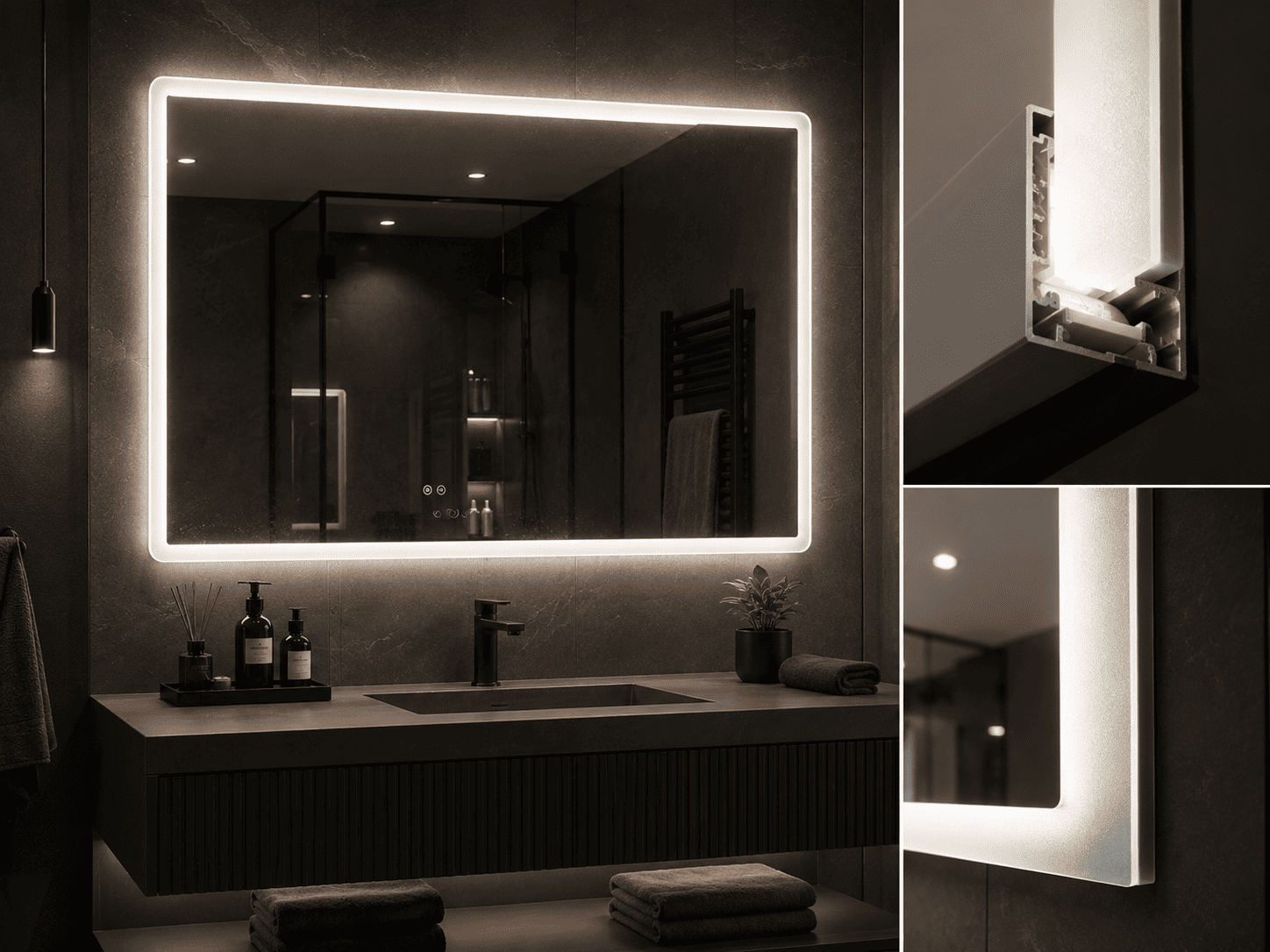
The manufacturing process starts with tempered glass, typically 4mm or 5mm thickness depending on mirror size. The glass edge undergoes sandblasting to create a frosted, translucent channel — this etched zone is where the LED light escapes. LED strips are bonded inside an extruded aluminum frame profile that wraps the glass perimeter. The frame serves three functions: structural housing, heat dissipation path, and light-direction control.
From an optical standpoint, edge-lit construction delivers directional task lighting. Because the LEDs face outward through the sandblasted edge, light travels in a forward cone rather than diffusing across the wall. This makes edge-lit mirrors the preferred spec for vanity areas, salon mirrors, and hotel bathrooms where guests need clear facial illumination for shaving or makeup application.
A practical question procurement teams often raise: What thickness does an edge-lit mirror require? The answer depends on the aluminum frame profile. Standard edge-lit mirrors measure approximately 30mm in total depth — including the glass, LED strip cavity, and back panel. Slim-profile frames can reduce this to 22-25mm, but at the cost of narrower LED strips (fewer lumens per meter). For hotel projects where wall-mounted depth is constrained — behind-hinge door clearances, for instance — edge-lit construction is the safer choice.
In terms of procurement considerations, edge-lit mirrors hold an advantage when the project calls for a flush-mounted appearance with minimal protrusion from the wall. The driver is typically housed in a recessed back-box cut into the mirror's rear panel, keeping the overall profile thin. For OEM buyers, specifying the LED strip density (commonly 60 or 120 LEDs per meter) and CCT range (3000K warm to 6000K cool, or tunable CCT) during the RFQ stage avoids later production mismatches.
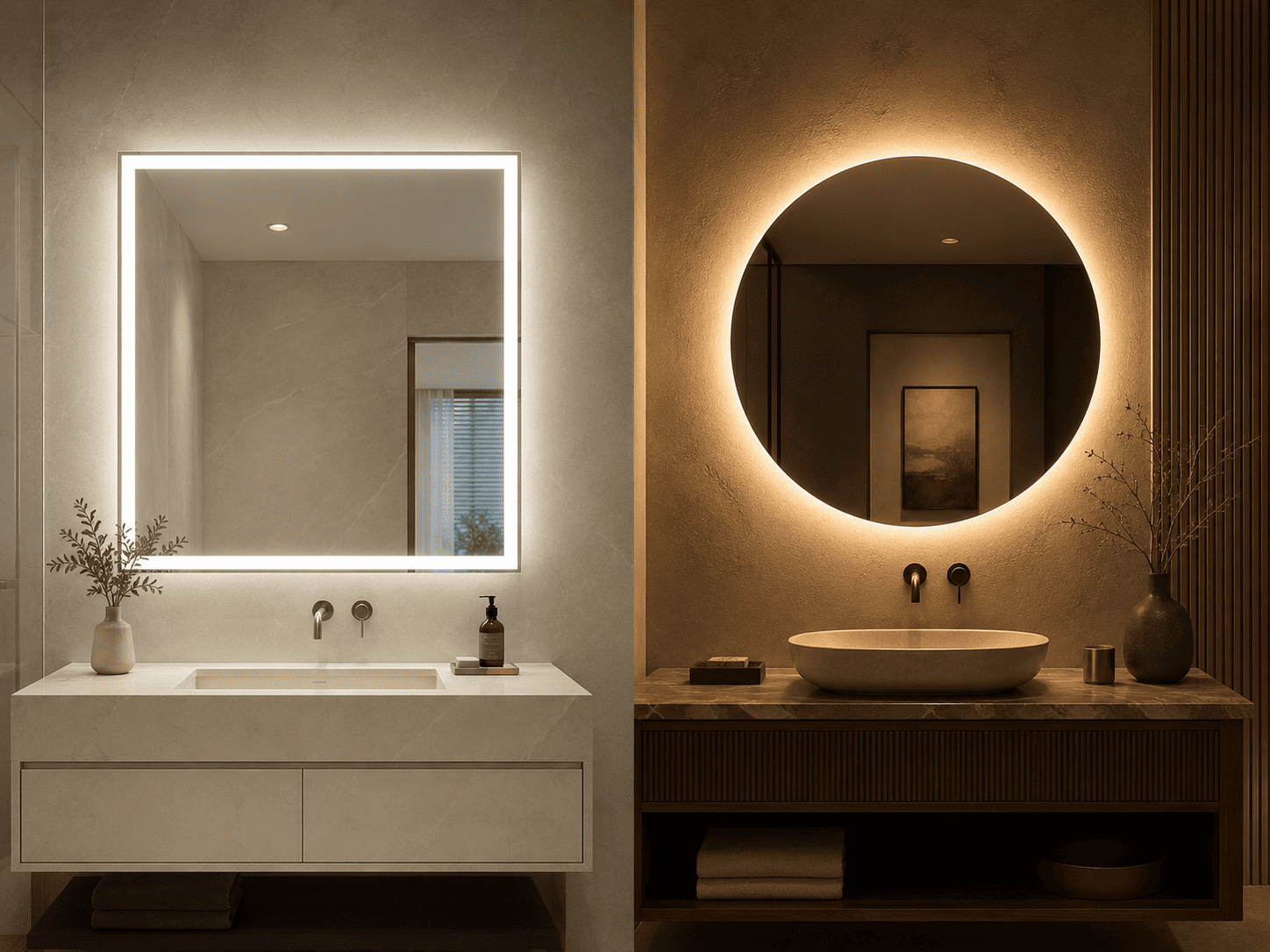
Edge-lit LED mirror construction combines direct task lighting with a slim perimeter frame.
How Backlit Mirror Construction Works
Core takeaway: backlit LED mirrors mount LED strips behind the mirror glass surface, projecting light backward onto the wall. The result is a soft, ambient halo effect around the mirror perimeter — shadow-free and visually comfortable for bathrooms where atmosphere matters as much as function.
Manufacturing a backlit mirror involves mounting LED strips on a backing board — typically aluminum composite panel or PVC — positioned behind the glass substrate. The mirror itself uses a copper-free silver coating with a protective paint layer on the rear surface. A deliberate gap exists between the mirror edge and the wall: this is where the halo escapes. The standard clearance is 15-25mm, determined by the spacer frame depth. The LED strips face the wall, not the user, so all light is indirect.
The optical signature of backlit construction is ambient rather than task-oriented. Light bounces off the wall surface before reaching the room, eliminating harsh shadows and reducing glare. This makes backlit mirrors the default specification for hotel bathroom designs where the mirror doubles as a decorative lighting element — boutique hotels, resort properties, and high-end residential projects all lean toward backlit configurations for the premium visual impression.
A frequently asked question during project specification: Do backlit mirrors need a gap behind them for installation? Yes — and this is a non-negotiable design constraint. The wall clearance (typically 15mm minimum, 25mm for larger panels over 1000mm width) must be accounted for during rough-in. If the bathroom wall is already tiled flush to the planned mirror position, a recessed mounting solution or a surface-mounted spacer frame becomes necessary. Procurement teams should flag this dimension to the installation contractor before finalizing mirror specifications — I've seen hotel fit-outs where 30 backlit mirrors had to be re-ordered because the wall clearance wasn't coordinated in the MEP drawings.
The driver for backlit mirrors is typically surface-mounted on the rear panel, enclosed in a plastic or metal housing rated to the same IP level as the mirror assembly. For hotel projects specifying backlit mirrors above vanity counters, confirming that the driver housing clearance does not interfere with plumbing rough-in positions saves rework during installation.
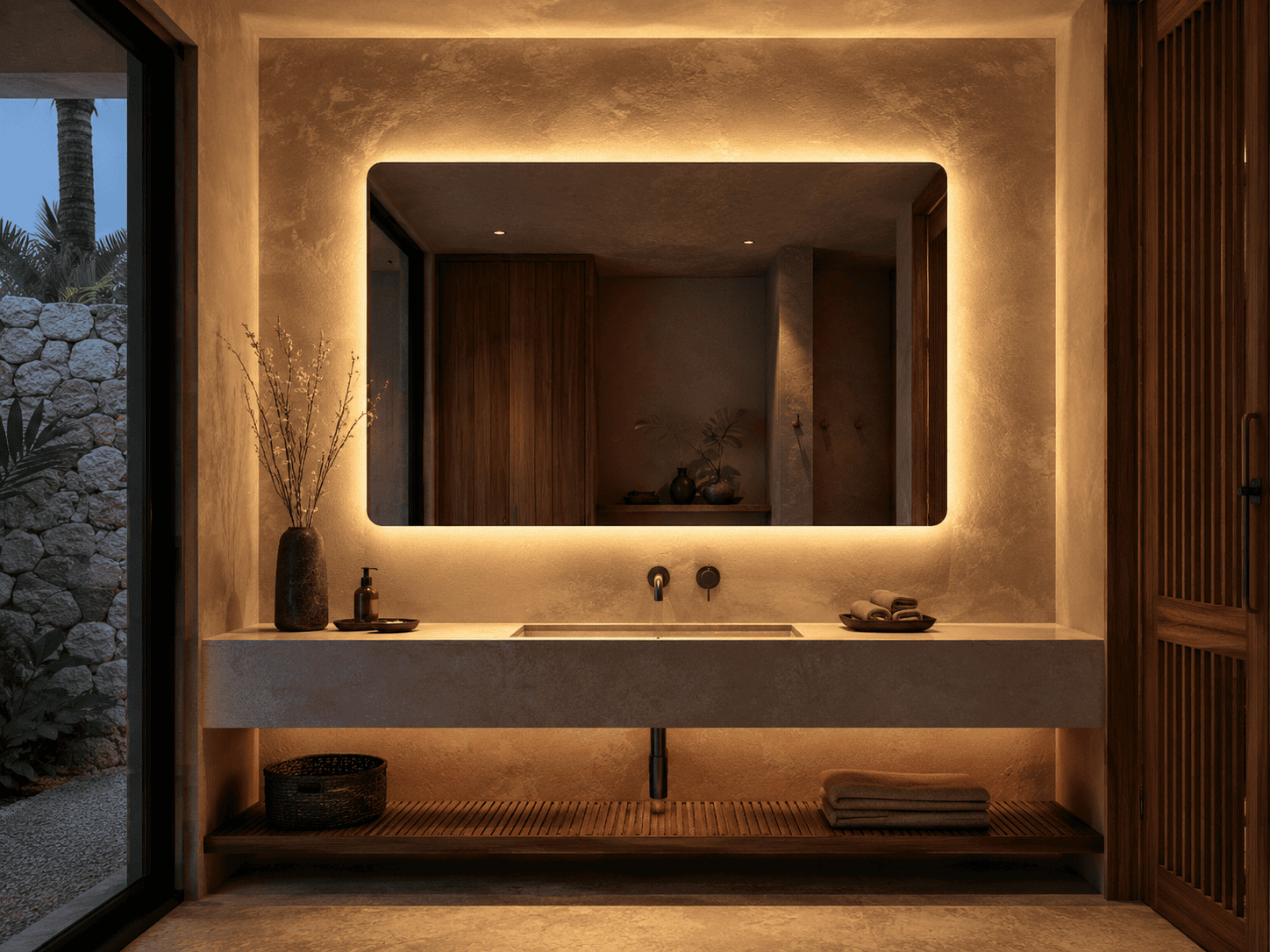
Backlit LED mirror construction creates an indirect halo effect behind the mirror.
Manufacturing Comparison — Materials, Durability, and Certification
Core takeaway: while both edge-lit and backlit mirrors share common materials (tempered glass, copper-free silver coating, aluminum framing), the differences in LED strip exposure, heat management, and IP testing requirements directly affect long-term reliability in high-humidity bathroom environments.
The table below breaks down key construction differences at the component level:
Specification
Edge-lit Mirror
Backlit Mirror
LED strip type
SMD 2835 (narrow, 8mm PCB)
SMD 2835 or 5050 (wider PCB acceptable)
LED strip position
Inside aluminum frame channel
On rear backing panel, facing wall
Glass thickness
4mm standard, 5mm for >1200mm width
4mm standard, 5mm for >1000mm width
Edge processing
Sandblasted etched edge required
Standard polished edge (no etch needed)
Frame profile
Extruded aluminum, acts as heatsink
Slim aluminum or frameless (glass-only)
Total depth
~30mm (slim option 22-25mm)
~35-50mm (includes wall clearance)
Heat dissipation
Via aluminum frame (active cooling path)
Via rear panel air gap (passive)
Driver location
Recessed back-box in rear panel
Surface-mounted on rear panel
IP rating target
IP44 minimum (frame-to-glass seal critical)
IP44 minimum (rear housing seal critical)
Demister pad
Optional, fits behind back panel
Optional, same integration method
Copper-free Silver Coating and Long-term Reliability
A manufacturing detail that directly impacts both edge-lit and backlit mirror durability is the silver coating composition. Standard mirrors use a silver layer with a copper backing for protection — but copper oxidizes over time in humid conditions, creating black edge corrosion. Copper-free silver coating eliminates the copper layer entirely, replacing it with a multi-layer protective paint and passivation treatment.
For edge-lit mirrors, copper-free coating is particularly important because the sandblasted edge exposes more glass surface area to ambient moisture. Without copper-free silver, edge corrosion appears around the sandblasted zone within 18-24 months in bathroom environments — visible as dark spots along the lit perimeter. For backlit mirrors, the corrosion risk concentrates at the rear silver coating interface, where condensation can accumulate between the mirror and the backing panel if the edge seal is inadequate.
When reviewing factory specifications, procurement teams should ask: Which construction type lasts longer in high-humidity bathrooms? The honest answer is that material quality matters more than construction type. A backlit mirror with copper-free silver coating, IP65-rated LED strips, and a fully sealed rear housing will outlast a budget edge-lit mirror with standard silver coating and IP20 strips. That said, edge-lit construction has a slight inherent advantage in moisture protection because the LED strip sits inside a sealed aluminum channel, whereas backlit strip placement behind the mirror creates a potential condensation trap. Specify copper-free silver coating and IP44 minimum for either construction — IP65 if the property is coastal or tropical.
Certification Differences
CE certification applies to both construction types, but the test methodology differs. Edge-lit mirrors undergo ingress protection testing focused on the frame-to-glass seal interface. Backlit mirrors are tested on the rear housing seal integrity. A mirror that passes IP44 in edge-lit configuration does not automatically pass in backlit configuration — they are separate SKUs requiring separate certification.
UL certification for North American projects follows a similar principle. Confirm with the factory that the specific construction type (not just the mirror product line) carries the required certification. For Australian SAA and UKCA markings, the same rule applies.
Choosing the Right Construction for Your Project
Core takeaway: the decision between edge-lit and backlit mirrors should be driven by three factors — the primary lighting function of the space, the available wall mounting depth, and the project's aesthetic positioning. There is no universally superior construction; there is only the right construction for the specific bathroom environment.
Project Type Decision Matrix
Hotel projects (4-star and above, 100+ rooms): Backlit mirrors deliver the ambient, shadow-free lighting that elevates bathroom perception. The halo effect photographs well for marketing, and guests consistently rate backlit bathroom lighting higher in satisfaction surveys. Specify 4000K neutral white as the default CCT with tunable CCT as an upgrade option. Budget for the additional wall clearance in the MEP package.
Serviced apartments and multi-family residential (50-200 units): Edge-lit mirrors are typically more practical. The thinner profile works with standard wall construction, the task-oriented lighting serves daily grooming needs, and the unit cost is lower at scale. If the developer wants to differentiate, specifying edge-lit mirrors with a built-in demister pad and touch-switch dimming adds perceived value without the cost delta of full backlit construction.
Retail, spa, and wellness facilities: Backlit mirrors are the standard choice. The indirect lighting creates a soft, flattering environment that aligns with premium brand positioning. For salon mirrors, however, edge-lit remains the functional requirement — hairstylists and makeup artists need the direct facial illumination that backlit construction cannot provide.
Office and commercial washrooms: Edge-lit, with an emphasis on durability. These environments prioritize maintenance simplicity over ambiance. Specify IP65 ingress protection if the washroom experiences high daily traffic and frequent cleaning with water-based methods.
Procurement Decision Chain
The most efficient path from specification to PO follows a four-step sequence:
1. Confirm wall depth availability. Measure the gap between the finished wall surface and any obstructions (plumbing, electrical boxes, door swing clearance). If the depth is under 40mm, edge-lit is the default. If over 50mm, both options are viable.
2. Select LED placement based on lighting function. Task lighting = edge-lit. Ambient atmosphere = backlit. For mixed-use bathrooms (hotel suites with separate vanity and bathing areas), consider a split specification — edge-lit above the vanity, backlit as a decorative wall feature.
3. Specify IP rating per bathroom zone. Zone 2 (adjacent to bath/shower) requires IP44 minimum. Zone 3 (general bathroom area away from water sources) can use IP20 in some jurisdictions, but IP44 is recommended for any hotel or commercial installation as a conservative standard.
4. Confirm driver installation method. Recessed driver (edge-lit) requires coordination with the wall cavity. Surface-mounted driver (backlit) requires clearance behind the mirror. Either way, confirm access for maintenance — hardwired installations without an accessible junction box create service headaches.
A Note on Factory Capability
One reality procurement teams should account for: not all LED mirror factories offer both edge-lit and backlit constructions at the same quality level. Edge-lit manufacturing requires sandblasting equipment and precision frame extrusion capability. Backlit manufacturing depends on rear housing design and spacer frame engineering. Before sending an RFQ, verify with the production team that they have active production lines for the specific construction type you need. A factory that produces 10,000 backlit mirrors per month may run edge-lit mirrors as a secondary line with less experienced operators — ask about volume mix and request construction-specific reference projects.
Decision-ready takeaway: Before ordering, ask the factory for a CRI test report and an IP test certificate for the specific construction type — not just a generic mirror certification. A CRI 90+ rating means little if the test was performed on an edge-lit configuration but your order is for backlit, because light diffusion characteristics and perceived color accuracy differ between the two constructions. For hotel specifications, also request a lumen maintenance report (L70 rating) to validate the LED strip's rated lifespan under the mirror's actual operating conditions.
*For project-specific technical data sheets, construction drawings, or OEM inquiries covering edge-lit and backlit LED mirror production, contact the RATO engineering team with your mirror dimensions, target CCT range, and required certification standards.*
B2B Project Inquiry
Talk to our project team about your mirror specification.
Send drawings, BOQ, mirror sizes, target quantity, voltage, lighting preference, packaging needs and destination market. Specifications are confirmed according to the selected model and project requirements.