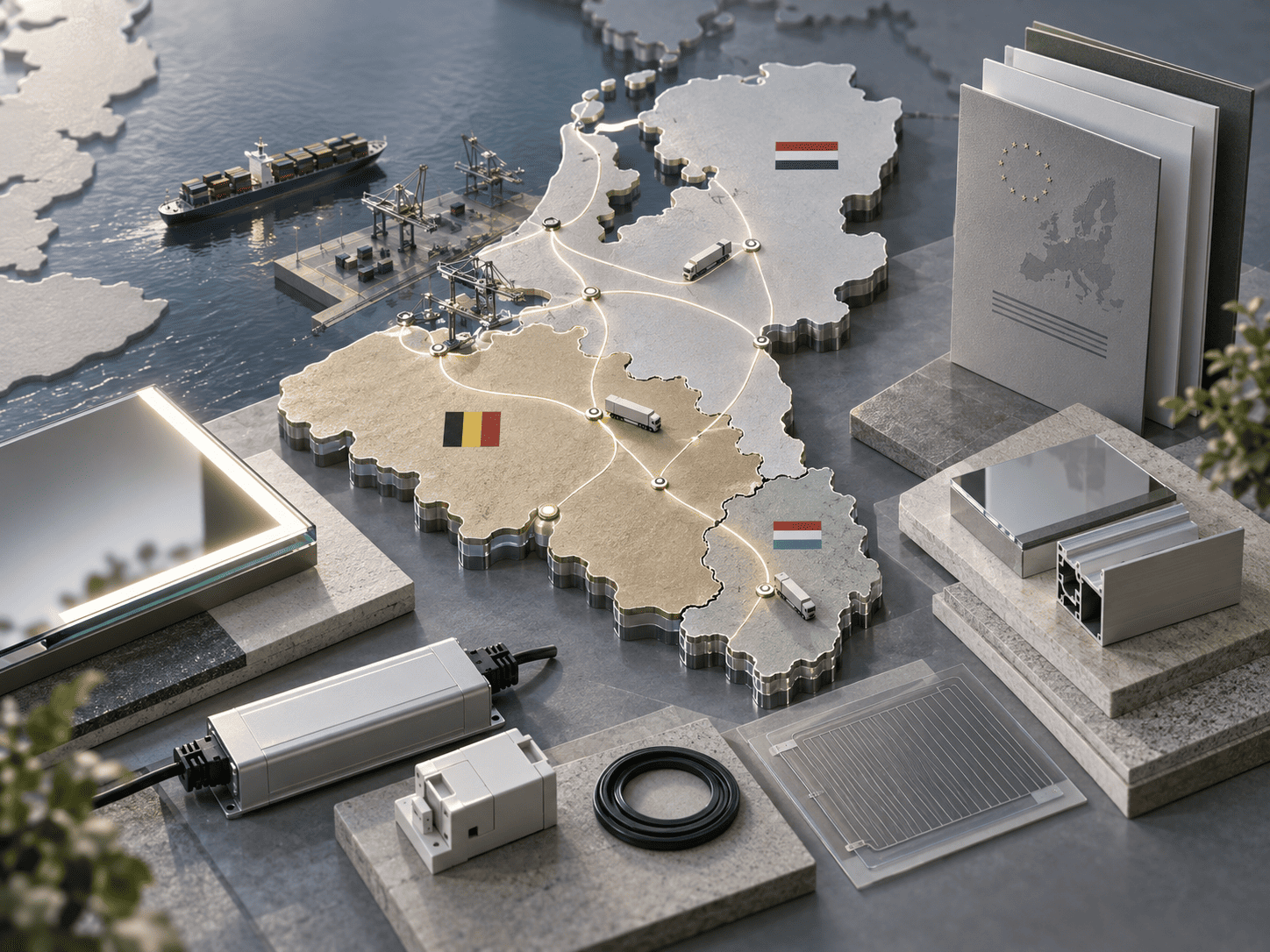
If you are importing LED mirrors for hotel or contract projects in the Benelux — Belgium, the Netherlands and Luxembourg — the legal baseline is CE marking under the Low Voltage Directive (LVD 2014/35/EU) and the EMC Directive (2014/30/EU), with RoHS, REACH and, for heated or demister models, ErP ecodesign and WEEE obligations. What makes the Benelux distinctive is not a separate contract-law mark but a trilingual specification layer (Dutch, French and German), two national installation codes that sit on the same IEC root (NEN 1010 and AREI-RGIE), and a regional preference for voluntary advisory marks such as the CVRA scheme and antenna-N alongside third-party certification from bodies like KEMA. Treating the Benelux as "just Germany or France" misses exactly the wording and mark distinctions that separate an accepted tender from a returned one. This guide separates the legal must-haves from the localisation should-haves, with the electrical and language specifications a 230V/50Hz three-country corridor actually demands.
Benelux Hotel & Contract Project Supply Overview
The Benelux is a compact but dense Hospitality and commercial office market — Belgium with roughly 2,000 hotels and a deep city-hotel stock in Brussels, Antwerp and Bruges, the Netherlands with a large branded and boutique pipeline centred on Amsterdam, Rotterdam and Utrecht, and Luxembourg's smaller but well-funded business-hotel sector driven by the financial district. Because the three counties share a single 230V/50Hz grid, open EU borders and one logistics backbone, project buyers order LED mirrors and Custom Mirror configurations in the same way an OEM buyer handles a pan-European volume, but the tender language and the mark expectation change at each border.
From a project supply standpoint, the Benelux demand splits into three visible tiers. Renovation-driven residential and apartment bathrooms buy mid-spec vanity LED mirrors with touch control and a demister pad. Hotel and commercial projects buy in volume with IP44 or IP65, Class II insulation, a dimmable or CCT-switchable source, and technical-file evidence that maps against the customer's own Dutch or French spec sheet. OEM and private-label buyers add a third layer: their Belgian distribution arm routinely asks for antenna-N, while a Dutch hotel procurement team may reference the CVRA scheme and expect the installation to follow NEN 1010. Luxembourg, being trilingual in practice if officially tri-lingual on paper, writes specifications that mix Dutch-style engineering notes with French terminology.
The practical lesson for a B2B buyer is that winning in the Benelux is a documentation and translation exercise as much as a manufacturing one. In factory reality I have watched otherwise sound orders stall because the Declaration of Conformity was issued in Chinese and unattested English, the driver was rated 220V-only against the 253V upper tolerance, or the RFQ asked for an "antenna-N" model and the supplier had no idea that Belgian buyers use the mark trade name of Antenne-N for their certification. Every one of those errors is avoidable when the localisation layer is understood from day one.
Compliance Requirements for Belgium, Netherlands & Luxembourg
The Benelux countries apply the same six EU obligations as the rest of the single market, and the correct starting point is LVD 2014/35/EU for electrical safety, followed by the two national installation codes and the voluntary advisory marks that local specifiers actually reference. The shared CE baseline for a bathroom LED mirror covers:
- LVD 2014/35/EU — the core electrical safety requirement, meaning protection against electric shock (Class II double insulation for most hardwired fixtures), thermal safety and correct creepage and clearance. This is the directive the Declaration of Conformity must cite.
- EMC Directive 2014/30/EU — the LED driver is a switch-mode power supply whose conducted and radiated emissions must stay in limits. This is the document most often missing from Chinese factory files.
- RoHS 2011/65/EU — restricts lead, mercury, cadmium, hexavalent chromium, PBB, PBDE and four phthalates across the LED strip, driver PCB, solder, cables and housing.
- REACH (EC 1907/2006) — obliges EU importers to declare substances of very high concern above 0.1% by weight.
- WEEE 2012/19/EU — producer take-back and recycling registration, which in the Netherlands and Belgium connects to the national producer-registration schemes before equipment is legally placed on the market.
- ErP / ecodesign — (EU) 2019/2020 — energy-efficiency and standby-power limits relevant to a mirror with a permanently lit driver or a demister/heater.
Where the Benelux diverges from its neighbours is the national layer. The Netherlands installs to NEN 1010 (the national adoption of IEC 60364), and its electrical advisory scheme — the CVRA scheme operated with bodies such as KEMA — provides a recognised route for third-party review of non-standard or decorative low-voltage equipment. Belgium installs to the AREI-RGIE general electrical regulations, and the Belgian market commonly references the antenna-N mark, a national safety and quality certification issued by the Belgian certifier, which project buyers and distributors treat as an additional signal beyond the bare CE mark. Neither NEN-CVRA review nor antenna-N is a legal precondition for sale — CE is the law — but an RFQ that writes "KEMA-gecertificeerd" or "marquage antenne-N" is telling you what the technical file must show.
Product Adaptation for the Benelux & the Lowlands Climate
A hotel bathroom LED mirror for the Benelux has to survive chronic coastal humidity, heavy condensation cycling from hot showers in cool rooms, and repeated window-open winter ventilation — which is why we treat a sealed demister pad, IP44-or-higher enclosure and a copper-free mirror backing as baseline features rather than upgrades. The lowlands climate is wetter and milder than inland Germany or southern France, and the wear pattern in a canal-side Amsterdam hotel or a Brussels business hotel is the same: repeated hot/cold cycles that drive moisture behind the glass and corrode an unprotected silver backing from the edge.
The engineering response is a set of factory choices locked in before the deposition, not an afterthought:
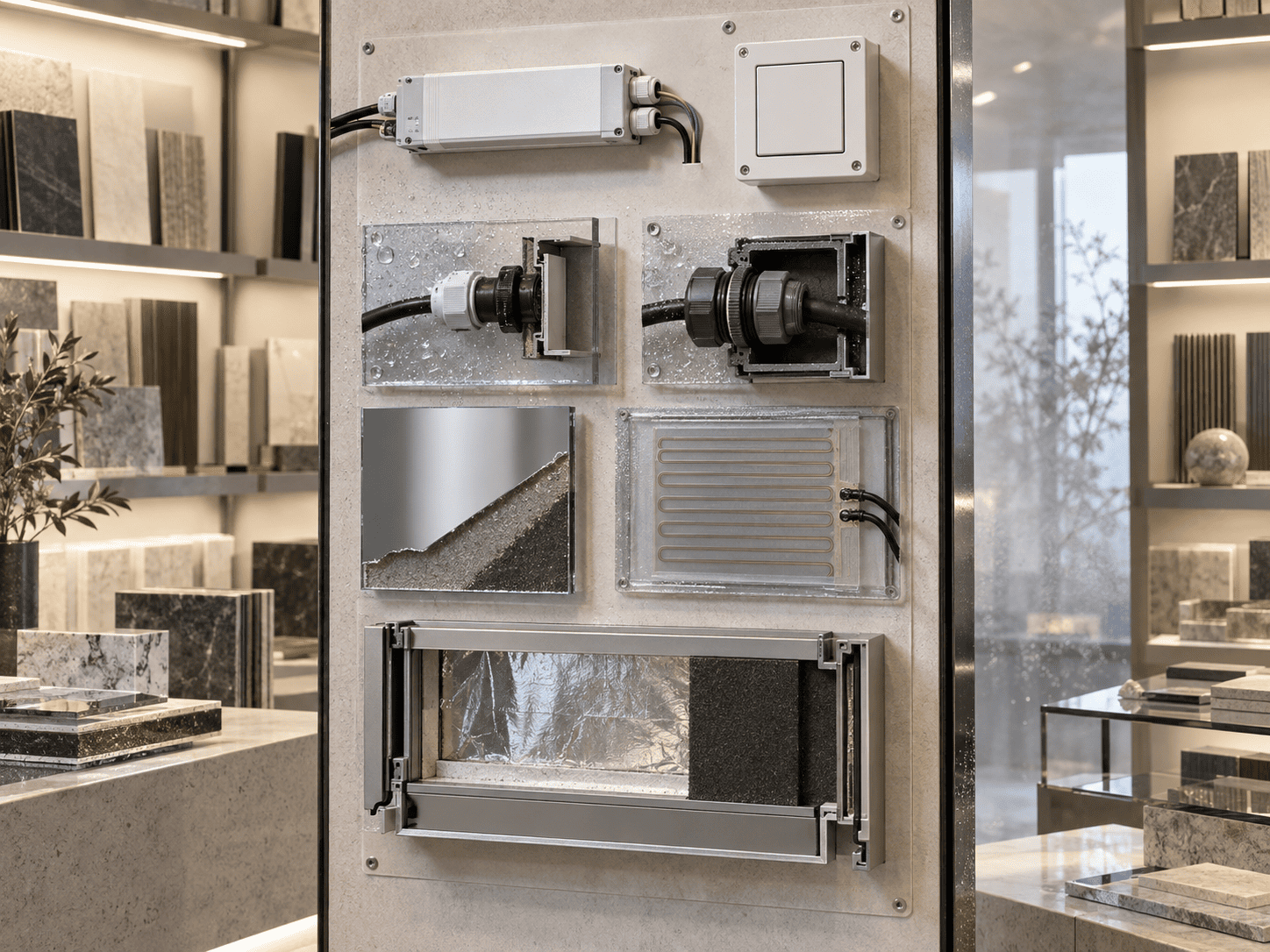
- Demister pad: a 12V SELV low-voltage heating film (typically 20–30 W depending on glass area) mounted behind the reflective surface, wired through a SELV circuit so the heater stays isolated from mains. It clears a steamed vanity mirror in two to four minutes and is the single most-requested hospitality feature across Benelux RFQs.
- Copper-free backing: the reflective silver layer is sealed with a passivation coat and protective paint so edge corrosion from bathroom humidity cannot creep in. This is where durability is won or lost in a humid hotel bathroom, and it is the difference between a mirror that survives a five-year refurb cycle and one that shows black edge speckling within eighteen months.
- Sealed enclosure: backlit and edge-lit LED modules are vapour-sealed ahead of the IP rating, because a cosmetic mirror can carry an IP44 label and still condense internally in a zone 1 or zone 2 bathroom if it is not internally vapour-sealed.
- CCT selection for northern European light: 3000K warm-white dominates hospitality and residential ambience in the Benelux, 4000K reads neutral in commercial and office project spaces, and 6000K is rarely specified outside clinical or back-of-house settings. CRI ≥ 90 is now the hospitality baseline for accurate skin-tone rendering.
Why does a sealed demister and copper-free backing matter more than a raw IP number in the Benelux? Because in a lowlands bathroom the failure mode is not a splash — it is weeks of fog, winter ventilation and shower steam migrating behind the glass and attacking the silver layer from inside. A vapour-sealed, copper-free mirror will reliably outlast a higher-rated but internally unsealed unit in exactly the conditions Belgian, Dutch and Luxembourgish projects create.
Voltage, Electrical & Trilingual Specification Configurations (230V / 50Hz)
All three Benelux countries run the continental 230V / 50Hz grid, and a correctly specified LED mirror should be rated 220–240V / 50Hz with a Class II double-insulated design so it tolerates the realistic ±10% band European supply delivers — from about 207V at the low end to 253V at the peak. Because the market is trilingual, the electrical RFQ is where the localisation layer bites hardest in practice.
- Input voltage: 220–240V AC, 50Hz, never a fixed 220V-only driver which is pushed out of range at the 253V upper tolerance.
- Insulation class: Class II (double-insulated, no earth required) is the standard for hardwired bathroom luminaires in the Netherlands and Belgium, simplifying connection in an existing bathroom without a dedicated earth spur.
- Protection: IP44 minimum above the basin (zone 2) and IP65 for shower-adjacent, zone-1 or steam-room placements under NEN 1010 and AREI-RGIE zoning.
- Light output: CCT switchable 3000K / 4000K / 6000K, typically 500–900 lm per metre from an efficient strip, CRI ≥ 90 for hospitality.
- Driver: a dimmable constant-current LED driver certified to EN 61347-1/-2-13 with a full EMC report and power factor ≥ 0.9 at nominal load.
- Demister pad: 12V SELV low-voltage heating film, 20–30 W depending on glass area.
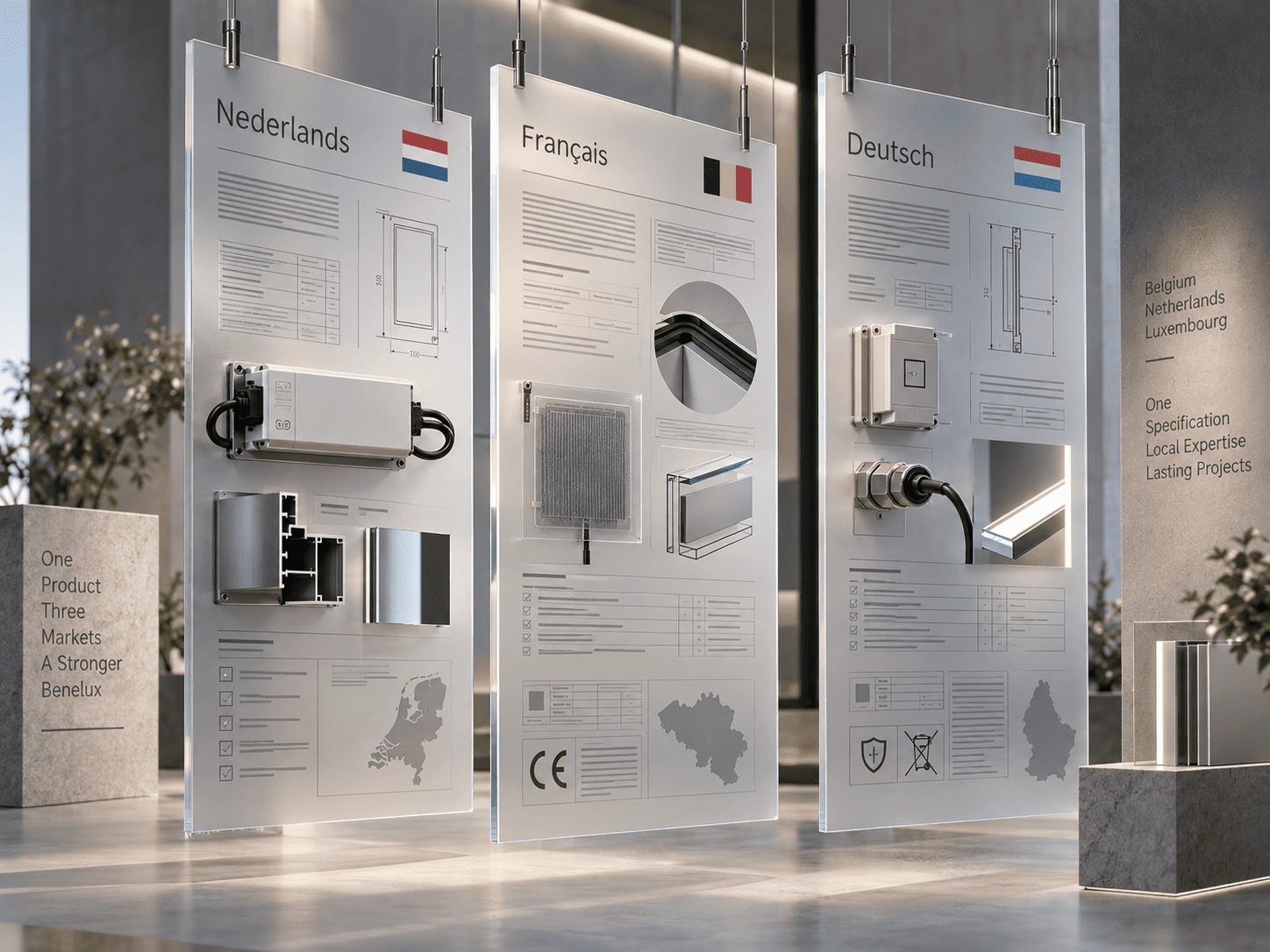
What does the trilingual spec sheet change for a factory? In the Netherlands the ordering documentation and the technical annexes are written in Dutch ("spiegel", "verwarmingsmat", "LED-verlichting", "IP-waarde"); in Belgium much of the commercial and technical review follows French ("miroir", "plaque chauffante", "éclairage LED", "marquage antenna-N"); and Luxembourg, where a German-speaking workforce overlaps both, may add German terms ("Spiegel", "Heizfolie", "LED-Beleuchtung"). This is not cosmetic — a technical file that carries an English-only Declaration of Conformity and untranslated hand-over notes will pass customs but stall the electrical review and the reception sign-off. For OEM and Custom Mirror supply we provide the model-specific documentation so the EU importer can attach translated annexes and references before submission.
Procurement Process with a Chinese Factory (OEM / Project Supply)
Sourcing a compliant Benelux LED mirror from a Chinese factory is a documentation exercise as much as a manufacturing one, and the sequence that works is: lock the electrical and language spec, then require the EU Declaration of Conformity, the EMC/LVD test reports and any KEMA or antenna-N evidence before the production deposit clears. A supplier that cannot produce the file before payment is unlikely to produce it after.
For OEM and project supply buyers in the Benelux, structure the engagement in four stages:
1. Specification and language lock. Fix input voltage (220–240V/50Hz), insulation class (Class II), IP rating (IP44/IP65), CCT options, driver brand and wattage, demister function, and the documentation language of the market you are supplying. Reference EN 60598-1, EN 61347 and EN 62471 where relevant. 2. Documentation gate. Require the EU Declaration of Conformity for the exact model, the EMC and LVD test reports (ideally from an accredited lab such as TÜV, SGS, Intertek or a recognised KEMA-affiliated body), RoHS test data, and the Dutch or Belgian WEEE producer-registration reference of the EU importer. Ask whether the model carries antenna-N certification and confirm the certificate ID against the issuing body before quoting it. 3. Sample and pre-shipment QC. Pull an approved sample, then run a pre-shipment inspection covering voltage rating, insulation class, IP test records, CCT consistency and finish. In the EU the importer — not the Chinese factory — bears the legal compliance obligations unless the factory is the named EU operator. 4. EU authorised representative. If you are a non-EU buyer with no EU entity, appoint an EU authorised representative to hold the Declaration of Conformity and technical file, since the directives require the documentation to be available inside the Union.
The model of the Benelux market is the same as the rest of the EU: the importer is the legal "manufacturer" for compliance purposes, and CVRA-scheme review, antenna-N and WEEE registration all sit with the EU side. Every supplier claim on a certificate should therefore be independently verified, not taken at face value.
The Logistics Advantage: Supplying the Lowlands Through the Benelux Corridor
For a project supply buyer sourcing from China, the Benelux is less a final destination than a gateway — the region's port and inland-network density means a container of LED mirrors can land at Rotterdam or Antwerp and reach warehousing or an installation site across the Netherlands, Belgium and Luxembourg within a day by truck. The practical consequence is that a Benelux distribution hub supports onward re-supply into the German Ruhr, northern France and the wider EU single market without a second import clearance once the goods are in free circulation.
This matters for the procurement decision in three ways. First, it lets an OEM buyer stage lead time against fixed hotel refurb windows while keeping stock close to the installation sites. Second, because the Benelux shares one internal market with Germany and France, a single CE file and one EU authorised representative can serve multi-country hotel programmes as long as the model-level documentation and local mark expectations (antenna-N in Belgium, VDE-adjacent evidence in Germany, the trilingual annexes) are assembled once and reused across the corridor. Third, it means the lowlands is a practical place to run consolidated pre-shipment and reception checks before mirrors fan out to individual sites.
LED Mirror Compliance Baseline for the Benelux Market
The table below summarises the compliance baseline across common Benelux configurations, so a buyer can see at a glance what each product tier should carry.
| Product Tier | EU Directives | Local-Market Marks | Typical Voltage / IP |
|---|
| Standard vanity mirror (no heater) | LVD, EMC, RoHS, REACH | CE (antenna-N optional) | 220–240V / IP44 |
| Heated / demister mirror | + ErP, WEEE | CE + optional KEMA/CVRA route | 220–240V / IP44–IP65 |
| Hotel project mirror (shower-adjacent) | LVD, EMC, RoHS, REACH, ErP, WEEE | antenna-N commonly requested (BE) | 220–240V / IP65 |
| OEM / private-label mirror | Full set above | Per buyer's brand spec | Per buyer's spec |
Frequently Asked Questions: Benelux LED Mirror Project Supply
Is CE marking enough for LED mirrors sold into the Netherlands and Belgium?
Yes — CE marking is the mandatory legal requirement to place an LED mirror on the EU single market, and it applies equally in the Netherlands, Belgium and Luxembourg. On top of CE, Dutch buyers follow the CVRA advisory scheme and Belgian distribution commonly references the antenna-N mark, but neither is a legal precondition for sale. Confirm the exact model's certificate scope with the supplier before quoting against a KEMA or antenna-N requirement.
Which electricity grid does a hotel in Belgium really run on?
Belgium runs the shared continental grid at 230V / 50Hz with realistic tolerance around 207V to 253V, exactly like the Netherlands and Luxembourg. A mirror destined for the Benelux should be rated 220–240V / 50Hz with a Class II double-insulated driver so it holds that ±10% band, not a narrow 220V-only specification.
Who is legally responsible for CE compliance when importing from China into the Benelux?
The EU importer — or the EU authorised representative for a non-EU supplier with no EU entity — is the legal "manufacturer" for compliance purposes. That party holds the Declaration of Conformity and technical file, affixes the CE mark, and carries the RoHS, REACH and WEEE obligations. The Chinese factory's test reports support the file, but the legal responsibility stays inside the EU.
Confirm Certification with Your Supplier Before You Commit
The compliance path for a Benelux LED mirror is a bundle of evidence, not a single certificate: a valid Declaration of Conformity citing LVD, EMC, RoHS and REACH (plus ErP and WEEE where a heater or demister is present), the underlying test reports from an accredited laboratory, national WEEE producer registration, the Dutch or French language annexes the local electrical review expects, and — where the tender demands it — a verifiable antenna-N mark verified against the issuing body. Before you place a volume order for hotel project supply or submit a tender, ask the factory to produce that evidence for the exact model you are buying, and verify the certificate IDs independently. For OEM and Custom Mirror volume into Belgium, the Netherlands and Luxembourg, work with the supplier before the deposition so the trilingual file, the mark requirements and the 230V/50Hz Class II spec are confirmed at specification lock — not defended after reception.