LED Mirror Supply for Australia Hotel Projects: Compliance, Climate & Procurement Guide
A B2B procurement guide to LED mirror supply for Australian and New Zealand hotel projects, covering RCM and EESS compliance, IP44 and IP65 bathroom performance, 230V and 50Hz hardwired installation, and factory-direct sourcing from China.
Australia & New Zealand Hotel Construction: The Supply Opportunity
Australia's hotel construction pipeline is delivering approximately 7,270 new rooms currently under construction, with 2026 representing the peak delivery year. Key openings in 2026 include the 121-room HYDE Perth (March 2026), the 202-room Andaz Gold Coast (Q2 2026), the 196-room Crystalbrook Sam in Adelaide (late 2026), the 180-room Avani Mooloolaba Beach on the Sunshine Coast, and the 140-room Hilton Palm Cove Cairns Resort (Q4 2026). New Zealand's pipeline is smaller in volume — primarily boutique and resort projects — but follows the same AS/NZS regulatory framework with minor local variations (SDOC requirements).
For LED mirror suppliers targeting this region, the opportunity spans both new-build specifications and the ongoing refurbishment cycle. Australia's established hotel stock — an estimated 6,500+ properties nationwide — undergoes bathroom renovation on 7- to 12-year cycles, creating a consistent replacement demand independent of new construction.
Procurement teams on these projects face a consistent challenge: balancing Australian compliance requirements with competitive factory-direct pricing from Chinese manufacturers. The key is understanding which compliance elements the factory can handle and which the importer must manage locally.
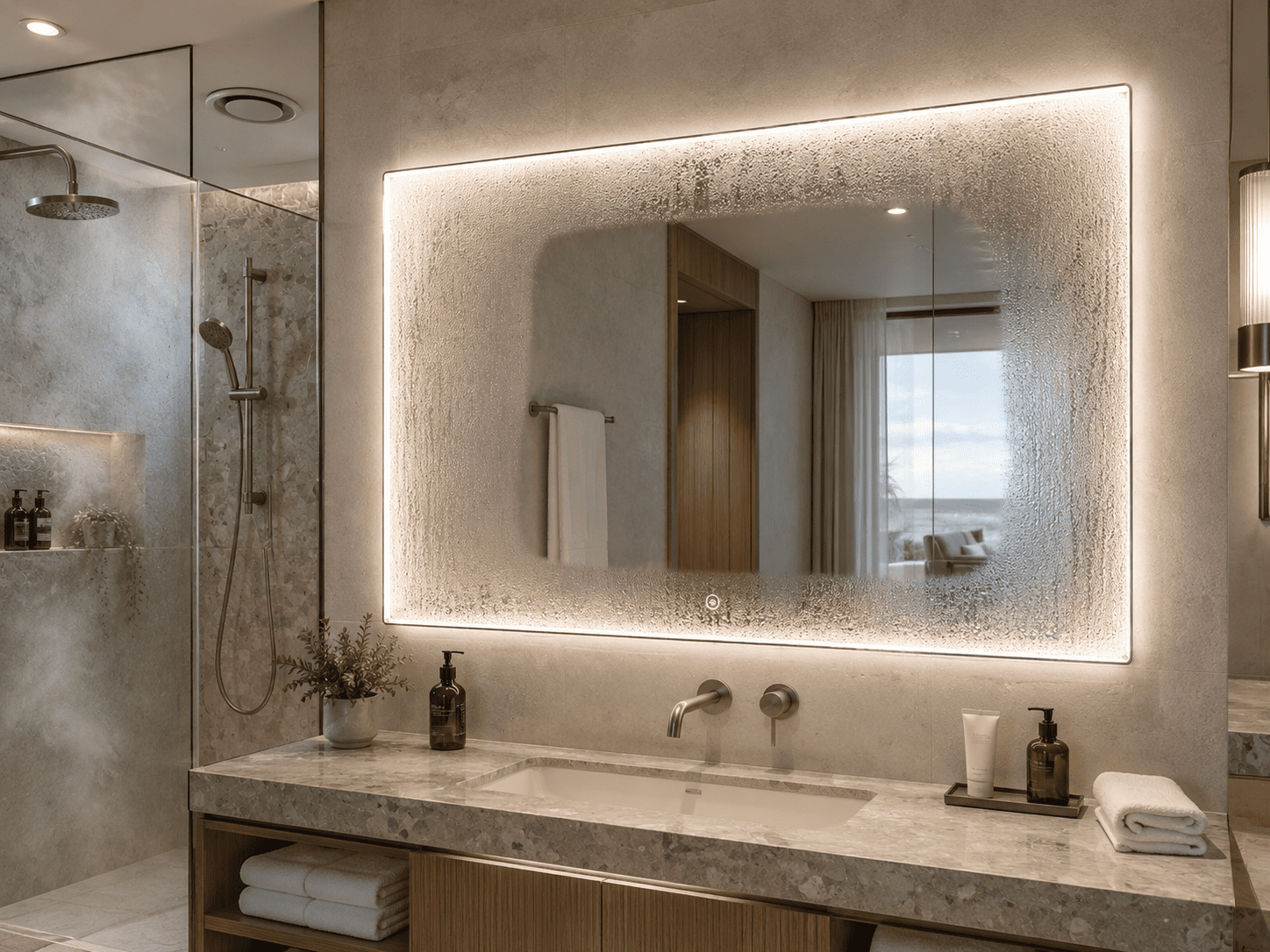
Backlit LED bathroom mirror with anti-fog clearing performance relevant to coastal and high-humidity hotel bathroom specifications.
Every LED mirror entering the Australian market must carry the RCM (Regulatory Compliance Mark), managed under the Electrical Equipment Safety System (EESS). This is the single mark that covers both electrical safety and electromagnetic compatibility (EMC) — there is no separate "SAA mark" required on the product itself. SAA refers to the certification process, not the label.
Conducted and radiated emissions from LED lighting
Installation environment
AS/NZS 3000:2018
Bathroom zone IP ratings, RCD protection, wiring methods
The practical path for importers — The LED driver is typically the bottleneck for Australian compliance. The mirror body, glass, and aluminium frame do not require separate electrical certification. The driver, however, must hold a valid Certificate of Conformity from an accredited body (e.g., TÜV Rheinland Australia, SAA Approvals, Global-Mark, or EMC Technologies).
In factory reality, most Chinese LED mirror manufacturers use third-party LED drivers from Shenzhen/Guangdong power supply specialists. The smartest procurement move: ask your mirror factory which driver brands they stock that already carry Australian certification. Mean Well, for instance, has a range of SELV LED drivers with existing Australian approvals. Using a pre-certified driver cuts compliance lead time from 12 weeks to essentially zero — the importer registers the product on the EESS database with a Declaration of Conformity referencing the driver's existing certificate.
PAA: What's the difference between Level 1, Level 2, and Level 3 equipment under EESS? LED mirrors typically fall under Level 2 (medium risk) or Level 3 (high risk), depending on the driver classification and whether the mirror is hardwired or plug-in. Level 3 requires a full Certificate of Conformity; Level 2 requires a Declaration of Conformity supported by test reports. Confirm the classification with your certification body during the quoting phase — don't assume.
Climate-Driven Product Adaptations for Australian Bathrooms
Australia's geography creates distinct environmental challenges for bathroom LED mirrors that don't apply in European or North American markets. Coastal humidity, salt-air corrosion, and significant temperature variation between air-conditioned hotel interiors and unconditioned wall cavities all affect long-term mirror performance.
Demister pads are non-negotiable. In Australian coastal hotels — Gold Coast, Sydney, Cairns, Perth — the combination of hot showers and high ambient humidity means mirror fogging is a daily operational issue, not an occasional nuisance. Standard demister pad coverage on a 600×800mm hotel mirror should be at minimum 300×400mm. Confirm with the factory whether the pad covers the full mirror surface area or only a defined zone — many budget-spec mirrors clear only the centre 40–50%.
Corrosion resistance on frames. Aluminium frames with anodised or powder-coated finishes perform adequately in most Australian locations. However, for properties within 500 metres of breaking surf — common for Gold Coast and beachfront properties — specify 304-grade stainless steel hardware and marine-grade coated aluminium frames. Salt spray testing per AS 2331.3.1 provides a quantifiable benchmark: ask the factory for salt spray test reports showing ≥200 hours without red rust on ferrous components.
IP rating: IP44 minimum, IP65 for coastal. AS/NZS 3000 requires IPX4 for bathroom Zone 2 (where mirrors above basins are installed). For hotel projects, IP44 provides adequate protection for standard installations. Upgrade to IP65 when the mirror is positioned where cleaning staff use water jets or where monsoon-season humidity is persistent (northern Queensland, Northern Territory, and Pacific Island projects). The cost difference at factory level between IP44 and IP65 sealing on a standard hotel mirror is typically USD $8–15 per unit.
PAA: Can LED mirrors handle the temperature difference between an air-conditioned hotel room and the wall cavity? Most quality LED mirrors operate reliably from 0°C to 40°C ambient. The concern in Australian hotels is condensation forming inside the mirror housing when cold air-conditioned room air meets the warmer, more humid wall cavity. Specify sealed LED strip housings with silicone gaskets at the wiring entry points — this prevents internal condensation from shorting the LED circuit. The factory should provide thermal cycling test data showing performance across at least two complete hot/cold cycles.
Voltage, Wiring & Installation Configurations
Australia operates on 230V/50Hz (nominal 240V), with the AS/NZS 3112 three-pin flat-blade plug standard. For hotel LED mirror installations, hardwired connection is the dominant specification — it eliminates visible cables, meets the aesthetic requirements of 4- and 5-star properties, and complies with Australian wiring regulations when installed by a licensed electrician.
Key electrical specifications for Australian hotel mirrors:
Input voltage: 220–240V AC, 50Hz (ensure the driver accepts 230V nominal with ±10% tolerance)
Output voltage: 12V DC or 24V DC constant voltage (SELV — separated extra-low voltage)
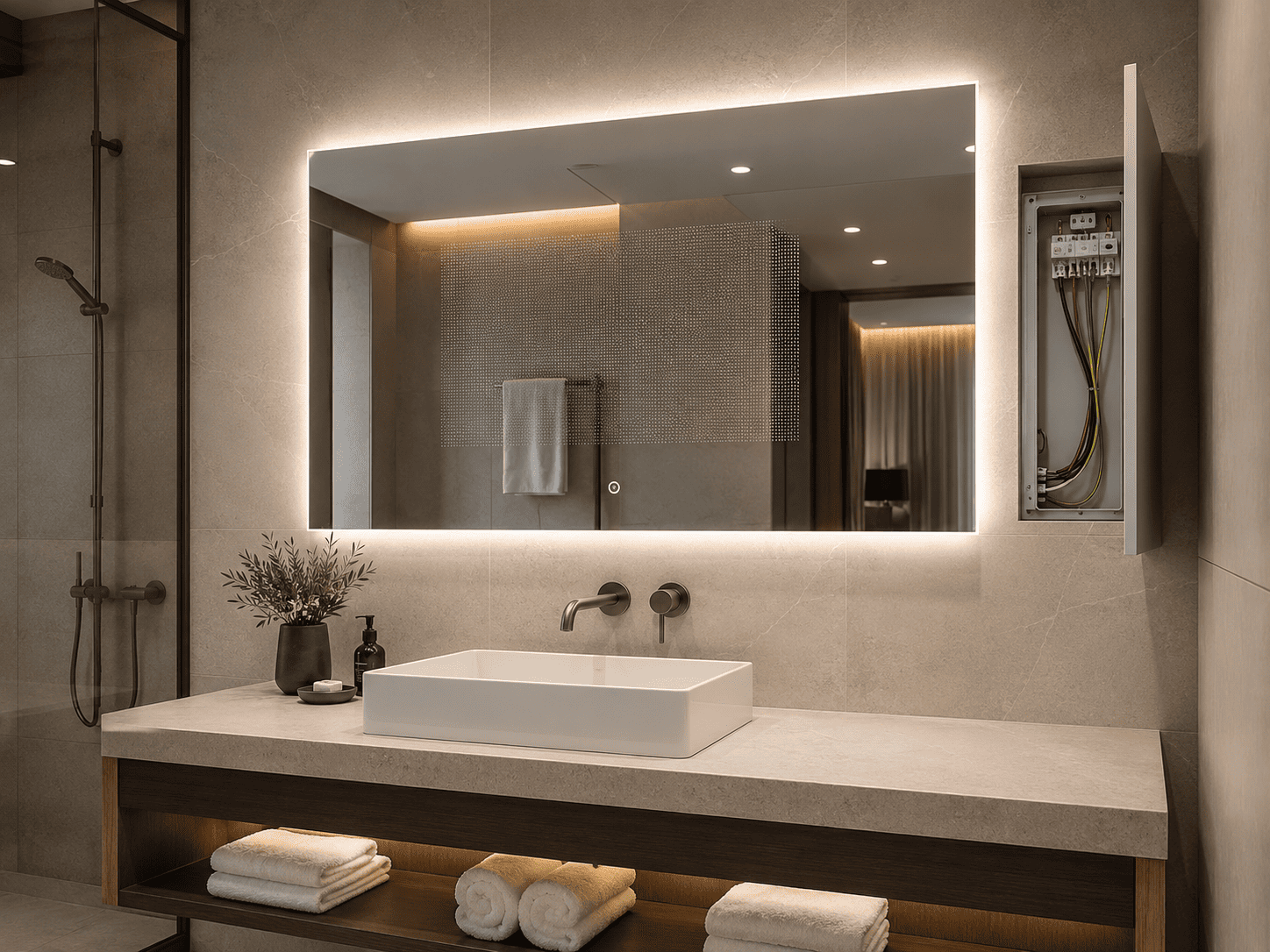
Wiring method: Hardwired via junction box behind the mirror, with isolation switch accessible per AS/NZS 3000
RCD protection: Mandatory on all lighting circuits in residential and hotel bathroom installations
CCT options: 3000K (warm, suited to luxury hotels), 4000K (neutral, the most common hotel specification), 6000K (cool, occasionally specified for commercial bathrooms)
CRI: ≥90 Ra for 4-star and above properties; ≥80 Ra acceptable for 3-star and serviced apartments
For New Zealand projects, the same 230V/50Hz standard applies. The key difference is the compliance pathway: New Zealand accepts Australian RCM certification plus a Supplier Declaration of Conformity (SDOC) under New Zealand's own Electrical Safety Regulations. No separate certification body approval is required if the product already holds Australian RCM.
PAA: Should hotel LED mirrors be hardwired or plug-in for Australian projects? Hardwired is standard for Australian hotel bathrooms above 3-star rating. It provides a clean, professional installation without visible cables and satisfies the expectation of hotel operators and electrical inspectors. Plug-in mirrors (with an Australian 3-pin plug and a nearby GPO in a concealed cabinet) are an option for serviced apartments and budget properties where the mirror may need to be replaced without an electrician. However, GPOs in bathrooms are restricted to specific zones under AS/NZS 3000 — the installation electrician must confirm compliance.
Technical Specification Checklist for Australian Hotel LED Mirrors
Use this checklist when preparing RFQs for Chinese LED mirror manufacturers. Each parameter should be explicitly confirmed in the proforma invoice or technical datasheet before sample production begins.
Specification
Recommendation
Notes
Mirror glass
5mm copper-free silver mirror
Copper-free prevents edge corrosion in humid environments; 5mm is standard hotel grade
LED type
SMD2835 or SMD5050, ≥130 lm/W
Confirm binning consistency across the production batch
CCT
4000K (hotel default)
Offer 3000K as alternative for luxury properties
CRI
≥90 Ra
Below 90 visible in hotel bathroom lighting where makeup application occurs
IP rating
IP44 minimum; IP65 coastal
Confirm test certificate covers the complete assembly, not just the LED strip
Demister pad
≥300×400mm coverage, ≤45°C surface temp
Request thermal image from factory for even heat distribution
Frame material
Powder-coated aluminium, ≥1.2mm thickness
Marine-grade coating for properties within 500m of coast
Driver
SELV, 12V or 24V DC, Australian RCM certified
Mean Well APV/ELG series or equivalent with existing AU certificate
Touch switch
Capacitive touch, IP44-rated membrane
Confirm switch cycles tested to ≥50,000 actuations
Certification docs
RCM DoC, driver CoC, AS/NZS 60598.1 test report
Importer registers product on EESS database referencing these docs
Standard B2B warranty terms for hotel project supply
Procurement Process: Sourcing from a Chinese LED Mirror Factory
Procurement teams sourcing LED mirrors from Chinese factories for Australian hotel projects should follow a structured qualification process. The compliance pathway is front-loaded — most of the work happens before the purchase order is issued.
Phase 1 — Factory Qualification (2–3 weeks)
Request the factory's existing Australian certification portfolio. Specifically ask for: (a) a current RCM Declaration of Conformity for a similar LED mirror model, (b) the Certificate of Conformity for the LED driver they propose to use, and (c) AS/NZS 60598.1 test reports from an accredited lab. If the factory has never supplied the Australian market, factor in 8–12 weeks for first-time certification.
Also request evidence of hotel project experience: reference photos from completed hotel installations, minimum order quantity (MOQ) confirmation, and lead time commitment in writing.
Phase 2 — Sample Approval (4–6 weeks)
Order 2–3 production-grade samples with the exact specification intended for the project. Do not accept "similar to" samples — the sample must match the production BOM. Have the samples inspected by a licensed Australian electrician for installation compatibility (junction box position, wiring terminal access, mounting bracket spacing against Australian stud centres at 450mm or 600mm).
Phase 3 — Certification Finalisation (Concurrent with Phase 2 or 4–8 weeks standalone)
If using a pre-certified driver, the importer registers the product on the EESS database as a Level 2 or Level 3 responsible supplier. This is typically a 1–2 week administrative process. If a new driver needs certification, engage an accredited Australian test lab and allow 8–12 weeks for testing and certificate issuance before EESS registration can proceed.
Phase 4 — Production & Logistics (12–16 weeks)
Production: 30–45 days. Ocean freight Guangdong ports to Sydney/Melbourne/Brisbane: 18–25 days. Customs clearance and quarantine inspection: 5–7 working days. Final-mile delivery to project site: 3–5 working days. Total door-to-door from PO: approximately 14–18 weeks.
For time-sensitive hotel openings, consider air freight for the first 20–30% of the order as an advance installation batch, with the balance arriving via sea freight. The premium is significant — roughly 3–4× sea freight unit cost — but keeps the construction schedule on track.
Phase 5 — Installation & Handover
The licensed Australian electrician installs the mirrors per AS/NZS 3000, issues a Certificate of Compliance for the electrical work, and confirms RCD protection on the lighting circuit. The mirror supplier should provide an installation manual specific to Australian mounting requirements (wall anchor types for plasterboard over timber stud, minimum clearance from water outlets, junction box position).
Service-access detail showing internal wiring layout and component access points relevant to compliance review and maintenance planning.
What Australian Importers Often Miss
EMC compliance is not optional. Some importers focus entirely on electrical safety (AS/NZS 60598) and overlook the EMC requirements under ACMA's Radiocommunications Labelling Notice. The LED driver's switching power supply generates conducted and radiated emissions that must fall within AS/NZS CISPR 15 limits. If the driver supplier cannot provide a CISPR 15 test report, budget AUD $1,500–$2,500 for EMC testing at an Australian NATA-accredited lab.
The RCM is a declaration, not a rubber stamp. Registering a product on the EESS database and applying the RCM means the importer (responsible supplier) legally declares the product compliant. If a non-compliant product is discovered in the market — through random audit or an incident report — the importer bears the liability, not the Chinese factory. This is why verifying the factory's documentation chain (test reports → driver CoC → factory DoC) before registration matters. The paperwork trail is your insurance.
Bathroom lighting circuits must be RCD-protected. Under the current AS/NZS 3000:2018, all final sub-circuits in residential and hotel bathrooms require 30mA RCD protection. The LED mirror's driver must be compatible with RCD-protected circuits — meaning low earth leakage current (typically ≤0.5mA per driver). If multiple mirrors share a single RCD circuit, the cumulative leakage must remain below the RCD's 30mA threshold. Ask the driver supplier for the earth leakage specification.
Lead time on replacement drivers. Hotel operators care about maintenance turnaround. If a driver fails 18 months into operation, can they get a replacement quickly? Stock 5–10% spare drivers with the initial order and establish a restocking arrangement — either the importer holds local inventory or the factory commits to air-freight dispatch of spares within 48 hours of notification. This is a contractual point, not a technical one, but it directly affects the hotel's long-term satisfaction with the mirror supplier.
FAQ
Do LED mirrors need separate certification for New Zealand if they already have Australian RCM?
New Zealand accepts Australian RCM certification under the Trans-Tasman Mutual Recognition Arrangement (TTMRA). The importer must submit a Supplier Declaration of Conformity (SDOC) to Energy Safety (Worksafe NZ) and register on the New Zealand national database. No retesting is required. The same driver CoC and AS/NZS 60598.1 test report package covers both markets.
How are LED mirrors classified for Australian customs duty and GST?
LED mirrors fall under HS code 7009.92.00 (framed glass mirrors). Customs duty is generally 5% on FOB value, though this may reduce to 0% under the China-Australia Free Trade Agreement (ChAFTA) with a valid Certificate of Origin. GST of 10% applies on the landed cost (CIF value + duty). Use a licensed customs broker for first-time imports to ensure correct classification.
What are the most common compliance failures for imported LED mirrors in Australia?
The three most frequent issues: (1) LED driver lacks an Australian Certificate of Conformity — importer assumed CE marking was sufficient (it is not); (2) mirror IP rating is claimed by the factory but no test certificate covers the complete assembled unit — the LED strip may be IP65 rated but the wiring entry and driver enclosure are unsealed; (3) EMC compliance is entirely undocumented — the driver emits above CISPR 15 limits and causes interference with hotel WiFi or guest electronics.
Next Steps: Engaging a Chinese Factory for Australian-Spec LED Mirrors
Australian hotel projects demand LED mirrors that comply with a specific and enforced regulatory framework — but the compliance pathway is well-defined and repeatable. The critical decision point is driver selection: using a pre-certified LED driver from an established brand with existing Australian approval removes the largest single source of delay and cost from the procurement process.
When engaging a Chinese LED mirror factory for Australian projects, provide the specification checklist above as part of the RFQ package. Request the certification document package before placing a deposit — not after. And budget 14–18 weeks from purchase order to delivery for a standard hotel project order of 100–500 units.
For technical enquiries, certification document review, or to request a quotation for your Australian hotel project, contact the factory's export team with your project specifications and target delivery date.
B2B Project Inquiry
Talk to our project team about your mirror specification.
Send drawings, BOQ, mirror sizes, target quantity, voltage, lighting preference, packaging needs and destination market. Specifications are confirmed according to the selected model and project requirements.