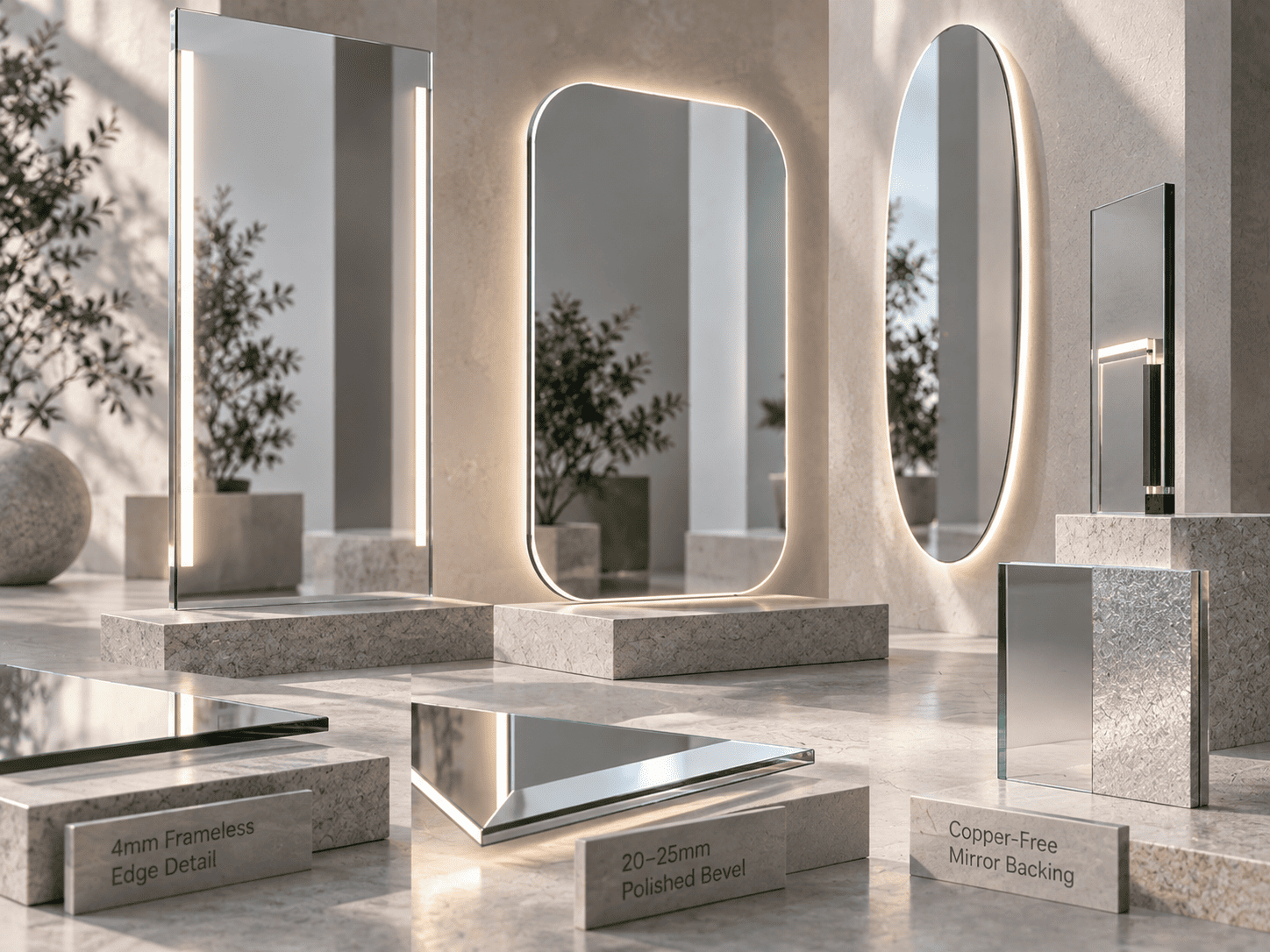
4mm Frameless LED Mirror: How It's Made, and What Makes It Hard
A 4mm frameless LED mirror starts with 4mm float glass, receives a copper-free silver coating, and gets every exposed edge flat-polished or ground into a 20–25mm polished bevel — the LED, driver, and diffuser are then concealed in a thin rear profile suspended on a hidden French cleat. The manufacturing difficulty is that there is no frame to hide tolerances: deflection, edge chipping, optical distortion, and backlight falloff all sit in direct view.
In factory reality, a framed mirror forgives a lot. An aluminium profile covers edge grind marks, masks 1–2mm of panel bow, and carries the wiring and driver inside the extrusion. Strip the frame off, and the same mirror has nowhere to hide. That single difference drives nearly every process decision in this article.
For OEM buyers and hotel developers, the practical question is not whether a factory can *say* it builds frameless mirrors — nearly everyone lists one in the catalogue. The question is whether the edge polish, backing board, and mounting rating hold up across a 500-room order. I've seen factory specs where the frameless sample looked perfect and the container-load units creaked against the wall because the cleat was rated for a 3kg decorative mirror, not a 9kg backlit panel.
Why Specify 4mm Thin Mirror Substrate
4mm is chosen to cut panel weight, freight cost, and installed wall load, and it works within a defined large-sheet size boundary — past a roughly 600mm unsupported span, deflection grows faster than the glass thickness buys back, which is where 5mm or 6mm becomes the correct call. The trade-off is stiffness: 4mm deflects noticeably more than 5mm or 6mm at equal span and load, so optical flatness has to come from the backing board, not the glass alone.
A 4mm mirror weighs roughly 10 kg/m² for the glass alone, against about 12.5 kg/m² at 5mm and 15 kg/m² at 6mm. On a single vanity unit that difference is trivial; across a hotel tower with 400–800 mirrors, it is a measurable reduction in container payload, handling effort, and — critically — the load the wall anchors must carry.
When should you specify 4mm instead of 5mm mirror glass? Specify 4mm when freight and wall-load reduction are the priority and each panel is backed by a rigid substrate or is small enough to stay within its deflection budget. Specify 5–6mm for large floor-to-ceiling panels, unsupported spans, or anywhere optical flatness across a big reflective face is the spec that matters most.
The stiffness gap is the point to internalize, because it drives the rest of the process. Under a 600mm unsupported span, 4mm exhibits visibly more waviness and optical distortion than 6mm at the same load — reflection on a 4mm sheet follows the backing it is bonded to. This is why thin-mirror production moves the flatness problem off the glass and onto the rear construction.
Coating and Warpage Control for 4mm Mirror Glass
The 4mm substrate gets a silver coating, and copper-free grades should be requested where the mirror will sit in humid or bathroom environments, with a moisture-resistant backing paint applied to the rear to stop oxidation from creeping in at the edges. Warpage is controlled not by the glass but by the backing board, rear sealing, and edge support — a rigid backing board is what keeps a large 4mm sheet optically flat.
Two coating decisions matter more than buyers generally realize:
- Copper-free silver coating. Standard mirrors use a copper layer under the protective paint; copper oxidizes visibly as a dark ring at the edge over years of bathroom humidity. Copper-free grades are compatible with the same silver-coating line but remove that failure mode. Confirm "copper-free" in writing — it is a real process distinction, not a marketing adjective.
- Backing paint / anti-moisture back coat. The rear of a frameless mirror is exposed to wall humidity, unlike a framed mirror where the extrusion seals the perimeter. A moisture-resistant back coat plus an edge seal is what prevents edge corrosion from walking inward.
Because 4mm flexes more than 5–6mm, warpage control is structural, not chemical. The mirror is bonded to a rigid backing board — typically MDF, plywood, or an aluminium composite panel — that provides the flatness the glass cannot supply on its own. Edge support matters too: an unsupported corner on a large thin mirror is where waviness and reflection distortion show first.
Procurement teams should confirm three things on any 4mm quote: copper-free coating availability, the backing-board material and thickness, and whether the rear is sealed against moisture at the exposed edges.
Frameless Edges: Flat Polish and Polished Bevel
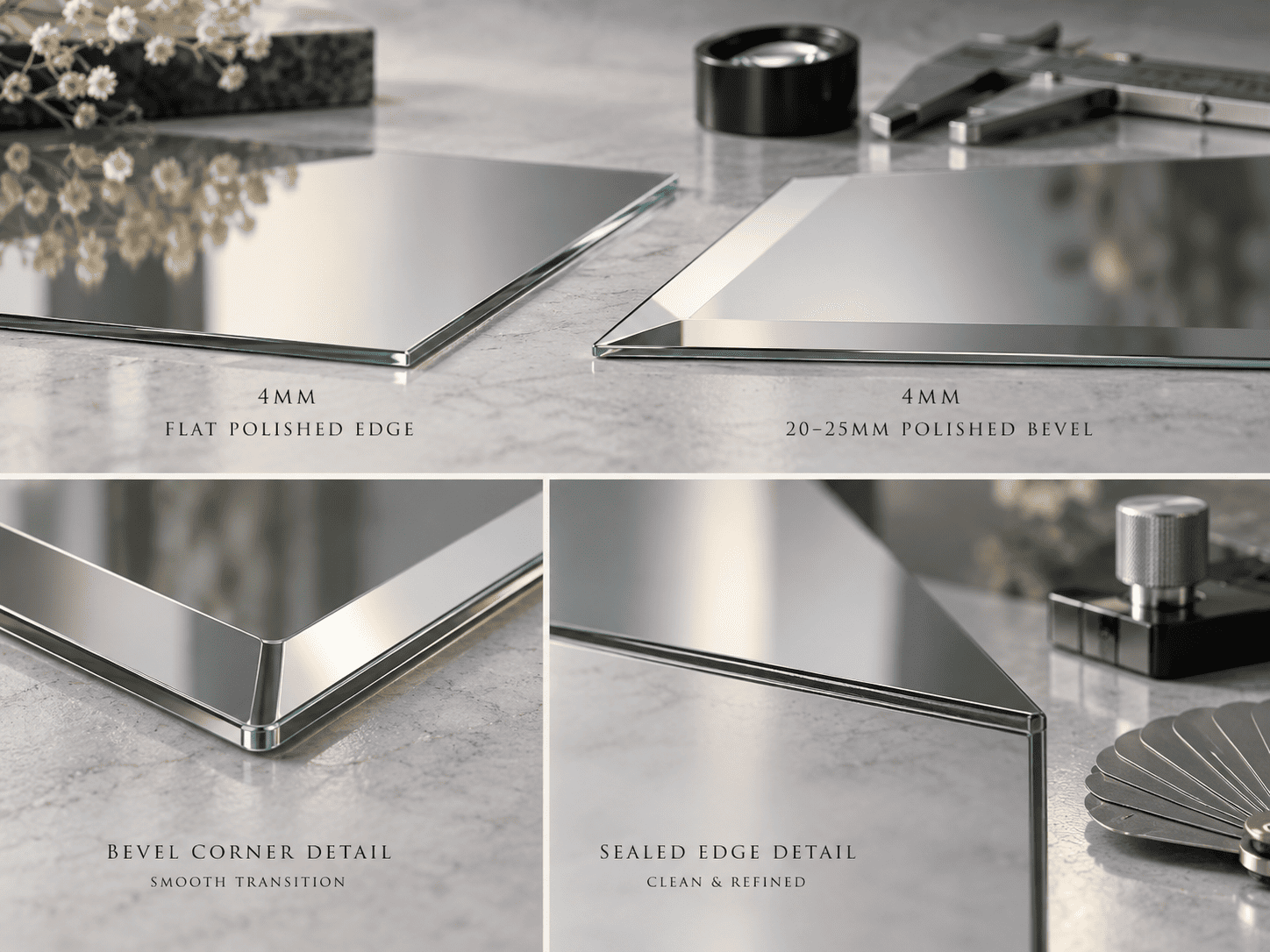
A frameless mirror exposes every edge, so the edge must be flat-polished or ground into a polished bevel, commonly 20–25mm wide, using a CNC rough-grind → fine-grind → polish sequence that removes chipping and micro-cracks and leaves a sealed, moisture-resistant perimeter. A frame would hide minor edge defects; the polished bevel is what makes the frameless mirror safe to touch, safe to install, and safe in humidity.
This is where frameless production separates from commodity mirror work. The edge process runs in stages:
1. CNC rough grind — sets the bevel angle and removes the raw cut edge. 2. Fine grind — takes out the coarser tool marks and tightens the bevel width. 3. Polish — produces the optically clear, light-catching bevel edge.
The difference between flat polish and polished bevel is a design and cost decision. Flat polish keeps the panel visually flush and is the thinner option; a 20–25mm polished bevel adds a reflective rim that reads as a more premium, light-framing detail. For hospitality mirrors, the polished bevel is the more common specification because it gives the panel a defined edge without adding any physical frame.
Edge chipping and micro-crack control is the QC gate here. A micro-crack at a bevel corner is invisible at sample inspection and becomes a stress riser during transport and wall mounting — a 9kg backlit panel dropped a few millimetres onto a hard bracket can propagate exactly that crack. This is why edge inspection under magnification, and a sealed perimeter, belong on every frameless inspection checklist.
Hiding the LED, Driver, and Diffuser in a Frameless Profile
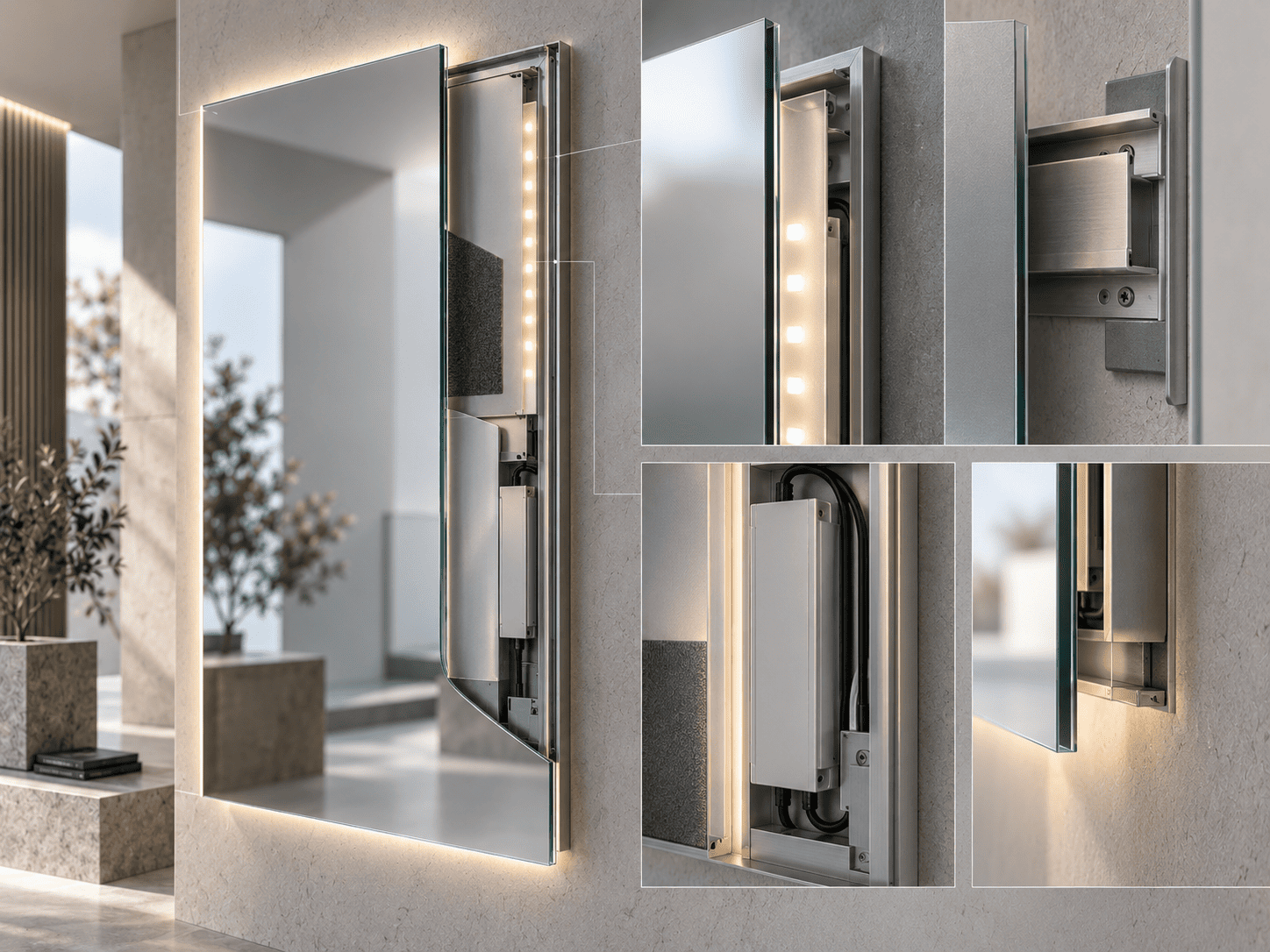
A frameless mirror conceals the LED, driver, and diffuser inside a thin rear profile bonded behind the mirror, doing away with the external frame that a framed mirror would normally use to carry the same parts; the design opens a choice between edge-lit and backlit, and suspends the whole panel on hidden mounting hardware so nothing shows. The total built depth — glass plus backing plus LED cavity plus driver — typically lands in a 28–35mm profile.
The key engineering trade-off is edge-lit versus backlit:
- Edge-lit keeps the profile thin — LEDs sit along the mirror rim and the light pipes through the edge. It suits a sleek, minimal look but gives less uniform light across a large face, with visible falloff at the centre.
- Backlit places an array of LEDs behind the mirror with a diffuser, giving an even glow over the whole face at the cost of a slightly thicker rear profile.
In a frameless structure, the builder has no extrusion to hide the driver, so everything must fit in the rear cavity. The typical section stacks up as 4mm mirror + backing board + LED cavity + diffuser + driver, for a total installed depth around 28–35mm depending on the driver and whether a demister pad is bonded in.
Mounting is the other half of "hidden." The panel is float-mounted on a hidden French cleat or concealed bracket rated for the full panel weight, with the AC outlet and any driver wiring run into a recessed junction box or a wall gap behind the profile. The wall gap itself is part of the design — it must be wide enough for the driver and connectors, and deep enough to keep the panel off the wall so heat from the demister pad and LEDs can dissipate.
I've seen frameless hospitality installs where the spec sheet listed a clean 30mm profile but nobody confirmed the wall-gap depth for the driver, and the install team ended up shimming panels off the wall. Confirm the total profile depth *and* the required wall cavity before sample approval.
Frameless vs Framed LED Mirror: Where the Tolerance Goes
A framed LED mirror uses the aluminium or timber frame to cover edge defects, carry wiring and the driver, and absorb structural tolerance; a frameless mirror has no such cover, so assembly accuracy, edge quality, and backlight uniformity all have to be much tighter. The table below sums up where each design spends its tolerance budget.
| Criterion | Framed LED Mirror | Frameless LED Mirror |
|---|
| Edge defects (chips, grind marks) | Covered by frame | Exposed; must be polished / bevel sealed |
| Wiring, driver, power | Carried inside extrusion | Hidden in rear profile + wall cavity |
| Assembly / panel tolerance | Absorbed by frame | Fully visible; tight dimensional control needed |
| Backlight uniformity | Frame masks edge falloff | Uniformity across whole face is exposed |
| Mounting hardware | Can be semi-concealed in frame | Must be fully hidden (cleat / bracket) |
The through-line: the frame is a tolerance absorber, and removing it pushes every tolerance upstream into glass cutting, edge finishing, and driver placement. That is why frameless prices carry a real premium over framed — the premium is spent on edge polish, backing-board flatness, and hidden mounting, not on a cosmetic name.
Frameless Thin-Mirror Procurement and Sample Checklist
Use this checklist before you approve a sample or sign a PO. Each item ends in a decision you can take today.
- Confirm copper-free coating — ask for it in writing if the mirror is for bathrooms or humid hospitality zones; this removes the edge-oxidation failure mode.
- Confirm backing board material and thickness — a rigid board (MDF, plywood, or aluminium composite) is what keeps a large 4mm panel optically flat; ask which one is quoted.
- Confirm minimum 20mm polished bevel or flat polish — specify the bevel width rather than accepting "polished edge" generically.
- Confirm hidden cleat / bracket weight rating — the rating must exceed the full shipped panel weight (glass + backing + LED + driver), not just the glass.
- Confirm edge-lit vs backlit and diffuser — state the target uniformity and ask which construction achieves it in the quoted profile depth.
- Confirm total profile depth and wall-gap requirement — lock down the 28–35mm profile and the driver cavity depth before install planning.
- Confirm demister pad coverage area — some models only clear a defined zone; get the coverage drawing, not the marketing claim.
- Confirm IP rating and certifications for the market — IP44 is a common bathroom target, but confirm the exact IP grade and CE/SAA compliance with the supplier for your region.
FAQ
When should you specify 4mm instead of 5mm mirror glass? Specify 4mm when freight cost, handling, and installed wall load are the priorities and the panel sits within its deflection budget (a roughly 600mm unsupported span with a rigid backing board). Move up to 5mm or 6mm for large unsupported spans, floor-to-ceiling panels, or wherever optical flatness across a big reflective face is the controlling spec.
Can a 4mm frameless mirror hold a demister pad and LED without an external frame? Yes — the demister pad and LED strip are bonded behind the glass or to the backing board inside the thin rear profile. Confirm the demister pad coverage area with the factory, because some units only clear a defined zone rather than the full face.
How is a frameless LED mirror mounted so hardware stays invisible? It float-mounts on a hidden French cleat or concealed bracket rated for the full panel weight, with the driver and AC wiring run into a recessed junction box or a wall gap behind the 28–35mm rear profile.
Confirm Your 4mm Frameless Specification with RATO LED Mirror
If you are specifying 4mm frameless LED mirrors for a hotel tower, a bathroom range, or an OEM programme, the numbers worth locking down before sampling are: copper-free coating, bevel width (20–25mm or flat polish), backing-board material, hidden cleat rating, backlit versus edge-lit, total profile depth, and the demister pad coverage zone.
Heshan Rato Special Glass and Building Materials Co., Ltd. builds LED mirrors across Bathroom, Hotel, Commercial, Smart, and Salon product lines, with OEM and project supply for hospitality and contractor channels. Send your target panel size, mounting style, and IP/CE/SAA requirements to RATO LED Mirror to confirm the exact 4mm frameless specification and packaging for your market.